

Choosing between PROFIBUS and PROFINET cabling is not just about connector style; it affects network speed, topology, diagnostics, installation cost, and long-term scalability. A PROFIBUS cable, also called a PROFIBUS DP cable, is built for RS-485 fieldbus communication, while a PROFINET cable supports Industrial Ethernet. Understanding the physical cable differences helps engineers avoid signal issues, downtime, and unnecessary replacement costs.
Video Guide: This overview helps frame the practical differences between PROFIBUS and PROFINET before comparing cable construction and application choices.
What is profibus cable,Profibus dp cable?
A PROFIBUS cable, or PROFIBUS DP cable, is a shielded industrial communication cable designed for PROFIBUS DP networks, typically using RS-485 transmission. It connects PLCs, remote I/O, drives, sensors, and actuators in factory automation systems where deterministic fieldbus communication, noise resistance, and reliable device-level connectivity are required.
Video Guide: This video provides a useful background on PROFIBUS DP and how it differs from newer Ethernet-based automation networks.
PROFIBUS DP Cable Construction and Purpose
A PROFIBUS DP cable is usually recognized by its purple jacket and is engineered for stable data transmission in electrically noisy industrial environments. Unlike general-purpose signal wire, it must meet specific impedance, shielding, capacitance, and conductor requirements to maintain communication quality over long bus segments.
Based on our internal data and market analysis, here is the breakdown:
| Item | Typical PROFIBUS DP Cable Requirement |
|---|---|
| Communication standard | PROFIBUS DP over RS-485 |
| Common jacket color | Purple |
| Characteristic impedance | Around 150 Ω |
| Core structure | 1 pair, shielded |
| Typical conductor | Solid or stranded copper |
| Shielding | Foil + braid or high-coverage screen |
| Connector type | DB9, M12, or terminal connection |
| Main application | PLC, drives, I/O, field devices |
| Network style | Bus topology with termination |
The key role of a PROFIBUS cable is to preserve signal integrity across a daisy-chained industrial network. Cable quality is especially important because PROFIBUS DP depends on correct termination, consistent impedance, and reliable shielding. Poor cable selection can cause intermittent communication faults that are difficult to diagnose.
cwcables Pro Tip: We always recommend checking the PROFIBUS cable specification before installation, especially impedance and shielding. A cable that looks similar may still fail if it is not designed for PROFIBUS DP communication.
How Does profibus cable,Profibus dp cable Work?
A PROFIBUS cable, or PROFIBUS DP cable, works by carrying differential RS-485 signals between automation devices on a shared bus. Devices communicate in a controlled sequence, with the PLC or master exchanging data with slaves such as I/O modules, drives, and instruments through correctly terminated shielded cable segments.
Video Guide: This comparison explains how PROFIBUS communication behavior differs from PROFINET, giving useful context for cable selection.
Signal Transmission and Network Behavior
PROFIBUS DP uses a serial fieldbus method. The cable carries balanced differential signals, which improves immunity against electromagnetic interference. Because many PROFIBUS networks operate near motors, variable frequency drives, welding machines, and power cables, shielding and grounding are critical.
A typical PROFIBUS DP communication path works as follows:
- The PLC or master sends a request over the PROFIBUS DP cable.
- Each slave device receives the signal through the shared bus.
- The addressed device responds within a defined communication cycle.
- The shielded cable protects the differential signal from external noise.
- Termination resistors at both ends of the segment prevent signal reflections.
- Repeaters may be used when distance or device count exceeds network limits.
The bus design means installation quality directly affects performance. Incorrect termination, poor connector assembly, long spur lines, or damaged shielding can create reflections and noise. For this reason, PROFIBUS DP cable should be installed according to the network layout and electrical requirements rather than treated as ordinary control cable.
cwcables Pro Tip: When troubleshooting PROFIBUS faults, I check termination first, then shielding continuity, then connector wiring. Many “device failures” are actually caused by cable or termination problems.
What are the key differences between PROFIBUS cables and PROFINET cables?
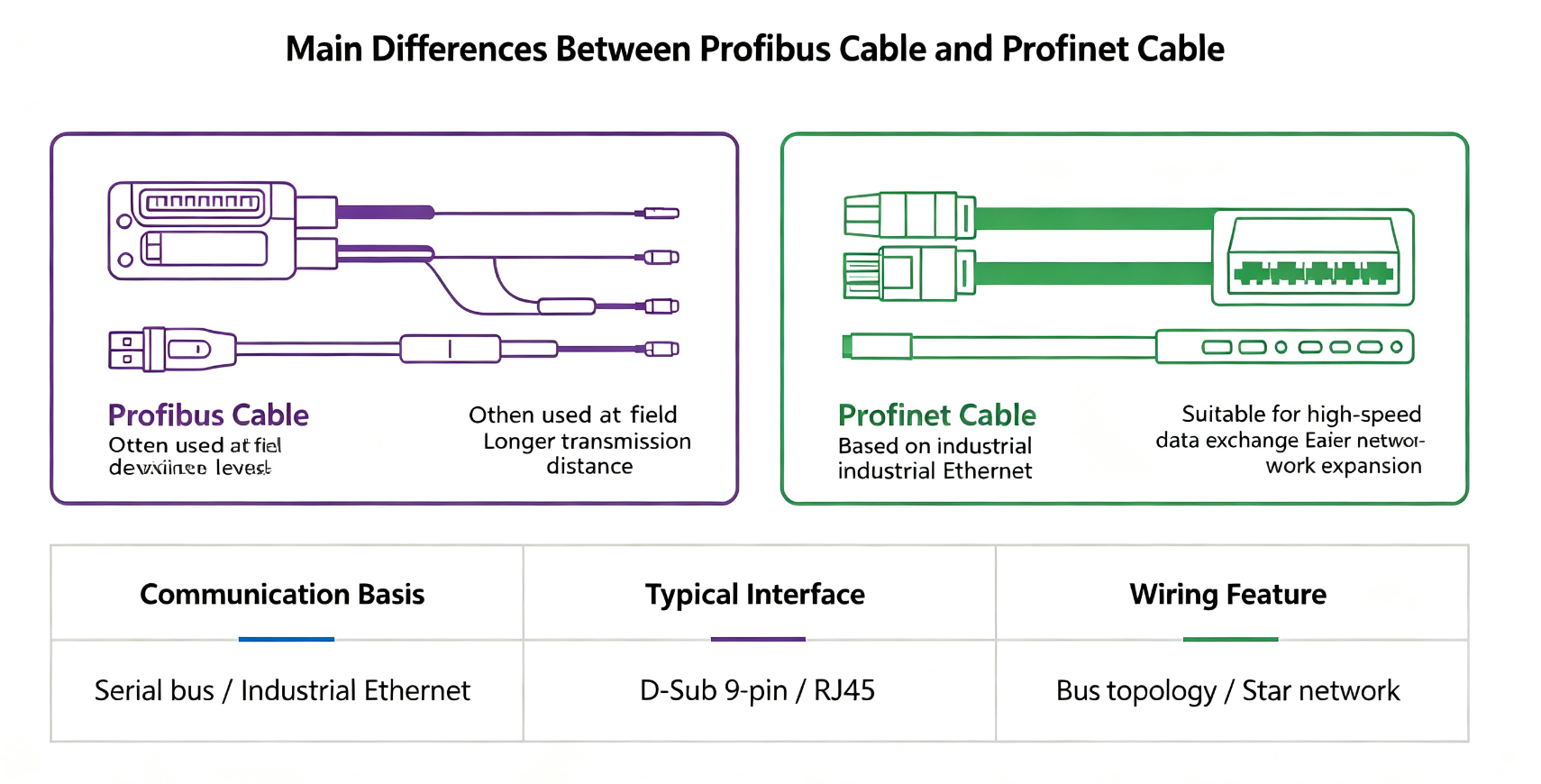
PROFIBUS cables are fieldbus cables designed for RS-485 serial communication, while PROFINET cables are Industrial Ethernet cables designed for high-speed Ethernet-based automation. The biggest differences are cable impedance, conductor pairing, connector types, topology flexibility, bandwidth, and suitability for modern IIoT and data-heavy applications.
Video Guide: This comparison is useful for understanding how PROFIBUS and PROFINET differ at both the network and cable level.
Cable-Level Comparison for Industrial Automation
PROFIBUS and PROFINET are both industrial communication technologies, but their cabling requirements are not interchangeable. PROFIBUS DP is a mature fieldbus system with a shared bus structure. PROFINET is based on Industrial Ethernet and supports faster communication, flexible topologies, and integration with IT networks.
Based on our internal data and market analysis, here is the breakdown:
| Factor | PROFIBUS Cable | PROFINET Cable |
|---|---|---|
| Communication type | Serial fieldbus | Industrial Ethernet |
| Common cable color | Purple | Green |
| Typical impedance | Around 150 Ω | Around 100 Ω |
| Pair structure | 1 shielded pair | 2-pair or 4-pair twisted cable |
| Common connectors | DB9, M12, terminals | RJ45, M12 D-coded, M12 X-coded |
| Typical topology | Linear bus | Star, line, ring, tree |
| Speed range | Up to 12 Mbps for PROFIBUS DP | 100 Mbps commonly; higher for advanced Ethernet |
| Termination required | Yes, at bus ends | Not in the same RS-485 bus sense |
| Diagnostics | More limited | More advanced Ethernet diagnostics |
| Best suited for | Legacy PLC, I/O, drives | Modern automation, robotics, IIoT |
The biggest practical difference is that PROFIBUS relies heavily on bus termination and cable continuity, while PROFINET behaves like an Ethernet network with switches, ports, and device-level network diagnostics. PROFINET cable is also better suited for high data volumes, motion control, vision systems, and modern plant digitalization.
cwcables Pro Tip: I do not recommend replacing a PROFIBUS cable with a PROFINET cable or vice versa unless the entire communication system is designed for that protocol. The jacket color may be visible, but the electrical design is what matters.
Can an ethernet cable be used for PROFINET?
A standard Ethernet cable may work in limited non-critical conditions, but it is not always suitable for PROFINET. PROFINET cable is Industrial Ethernet cable built for factory environments, with stronger shielding, oil resistance, flex life, EMC protection, and connector reliability compared with ordinary office-grade Ethernet cable.
Video Guide: This video helps distinguish standard Ethernet, PROFIBUS, and PROFINET in practical industrial network terms.
When Standard Ethernet Is Not Enough
PROFINET uses Ethernet technology, but that does not mean every Ethernet cable is appropriate for industrial automation. Office Ethernet cables are often designed for stable building environments, while PROFINET cables are built for vibration, electrical noise, movement, chemical exposure, and cabinet-to-machine installation.
Use PROFINET-grade cable when the application includes:
- High electromagnetic interference from motors or drives
- Continuous or repeated cable movement
- Oil, coolant, or chemical exposure
- Outdoor or harsh industrial environments
- Long production uptime requirements
- M12 industrial connectors or rugged RJ45 connectors
- Safety, motion, or real-time communication requirements
In a clean control cabinet, a high-quality shielded Ethernet cable may sometimes be acceptable for short runs. However, for machine wiring, robot cells, conveyors, and field-mounted devices, PROFINET cable is the safer choice because it is designed to maintain stable communication under industrial stress.
cwcables Pro Tip: If the cable leaves the cabinet, I usually specify a true PROFINET cable. The cost difference is small compared with the downtime caused by intermittent Ethernet communication faults.
What are the key differences between PROFIBUS, Modbus, and PROFINET?
PROFIBUS, Modbus, and PROFINET are all industrial communication protocols, but they differ in speed, architecture, cabling, diagnostics, and integration capability. PROFIBUS is a deterministic fieldbus, Modbus is simple and widely compatible, and PROFINET is Ethernet-based for modern high-speed automation networks.
Video Guide: This resource gives additional context by comparing fieldbus-style communication with Ethernet-based industrial networking.
Protocol and Cable Differences in Real Applications
PROFIBUS, Modbus, and PROFINET often appear in the same plant, especially in facilities with both legacy and modern equipment. Their cable choices depend on the physical layer being used. Modbus, for example, may run over RS-485 or Ethernet depending on whether it is Modbus RTU or Modbus TCP.
Based on our internal data and market analysis, here is the breakdown:
| Category | PROFIBUS DP | Modbus RTU / TCP | PROFINET |
|---|---|---|---|
| Main communication style | Fieldbus | Serial or Ethernet | Industrial Ethernet |
| Typical cable | PROFIBUS DP cable | RS-485 cable or Ethernet cable | PROFINET cable |
| Speed | Medium | Low to medium, depending on version | High |
| Complexity | Moderate | Simple | Moderate to advanced |
| Diagnostics | Good for fieldbus | Basic to moderate | Advanced |
| Topology | Bus | Bus or Ethernet topology | Star, line, ring, tree |
| Common use | PLC, drives, I/O | Meters, instruments, controllers | Modern PLC, robotics, motion, IIoT |
| Best advantage | Deterministic fieldbus performance | Simplicity and compatibility | Speed, scalability, diagnostics |
Modbus is popular because it is simple, open, and widely supported. PROFIBUS is common in established automation systems where deterministic control is important. PROFINET is preferred for new systems requiring high-speed communication, larger data exchange, diagnostics, and integration with digital manufacturing systems.
cwcables Pro Tip: When selecting cable, I first identify the protocol version and physical layer. “Modbus” alone is not enough information because Modbus RTU and Modbus TCP require very different cabling.
Key Features & Comparison
The main cable selection factors are protocol compatibility, impedance, shielding, conductor design, connector type, flexibility, and environmental resistance. A correct PROFIBUS cable specification or PROFINET cable specification ensures stable communication, while the wrong cable can cause retries, signal reflections, device dropouts, or production stoppages.
Video Guide: This video provides another general comparison of PROFIBUS and PROFINET, useful for reinforcing key selection criteria.
Feature Checklist for PROFIBUS and PROFINET Cable Selection
Based on our internal data and market analysis, here is the breakdown:
| Feature | PROFIBUS Cable | PROFINET Cable | Buying Recommendation |
|---|---|---|---|
| Protocol match | PROFIBUS DP | PROFINET / Industrial Ethernet | Never substitute without engineering approval |
| Impedance | Typically 150 Ω | Typically 100 Ω | Match the protocol specification |
| Shielding | Essential for RS-485 stability | Essential for EMC protection | Use high-coverage shielding in noisy plants |
| Jacket material | PVC, PUR, LSZH options | PVC, PUR, LSZH options | Choose based on oil, abrasion, and fire requirements |
| Flexibility | Fixed or flexible versions | Fixed, flexible, drag chain versions | Use flex-rated cable for moving machinery |
| Connector support | DB9, M12, terminal | RJ45, M12 D-coded, M12 X-coded | Match cabinet and field connector standards |
| Distance considerations | Depends on baud rate and segment design | Depends on Ethernet limits and switches | Plan segment length before installation |
| Diagnostics impact | Cable faults can be harder to isolate | Ethernet tools provide stronger diagnostics | Label and test every cable run |
| Typical color | Purple | Green | Helpful for identification, not a substitute for specs |
The best cable is not simply the most expensive option; it is the one that matches the electrical specification, mechanical environment, and network design. For example, a fixed cabinet cable may not survive on a moving gantry, while a drag-chain PROFINET cable may be unnecessary for a short static cabinet patch.
cwcables Pro Tip: We advise customers to standardize cable colors and labeling across the plant. Purple for PROFIBUS and green for PROFINET makes maintenance faster and reduces accidental cross-connection.
Cost & Buying Factors
PROFIBUS and PROFINET cable costs depend on conductor quality, shielding, jacket material, flexibility rating, certification, connector assembly, and order quantity. The lowest-priced cable is not always the lowest-cost choice because communication failures, downtime, and replacement labor often exceed the initial cable savings.
Pricing and Procurement Considerations
When evaluating cost, consider both the cable purchase price and the total installation risk. Industrial communication cables are part of the control system infrastructure, so reliability should be weighed alongside unit price.
Key buying factors include:
- Protocol compliance: Confirm the cable meets PROFIBUS DP or PROFINET requirements.
- Application type: Fixed installation, flexible use, torsion, or drag-chain movement.
- Shielding performance: Higher shielding coverage improves EMC resistance.
- Jacket material: PUR is often preferred for oil, abrasion, and mechanical stress; PVC may suit general cabinet use.
- Connector choice: Pre-assembled connectors reduce wiring errors but may increase upfront cost.
- Certification and testing: Verified cable performance reduces commissioning risk.
- Supplier capability: Choose a cable manufacturer that can support specification review and custom lengths.
- Lifecycle cost: Downtime, troubleshooting, and replacement labor should be considered.
For many projects, the best value comes from selecting the correct grade rather than simply choosing premium cable everywhere. A control cabinet may need one type, while a moving machine section may need a much more rugged cable.
cwcables Pro Tip: I recommend sharing the installation environment before buying: fixed or moving, indoor or outdoor, oil exposure, bending radius, and connector type. With that information, cwcables can help select the right cable grade instead of over-specifying or under-specifying.
Conclusion
PROFIBUS cables and PROFINET cables serve different industrial communication needs. PROFIBUS DP cable is ideal for established RS-485 fieldbus systems, while PROFINET cable supports faster Ethernet-based automation. The right choice depends on protocol, topology, speed, environment, and long-term plant modernization goals, including IIoT integration.
Final Selection Guidance
The safest approach is to select cable according to the network protocol and installation environment. PROFIBUS DP systems require cable that meets the correct PROFIBUS cable specification, including impedance, shielding, and termination requirements. PROFINET systems require Industrial Ethernet cable built for factory conditions, especially where vibration, EMC noise, oil, or motion is present.
A practical selection process is:
- Identify the communication protocol: PROFIBUS DP, PROFINET, Modbus RTU, or Modbus TCP.
- Confirm the required physical layer and connector type.
- Check environmental conditions such as oil, temperature, abrasion, and movement.
- Match the cable impedance and shielding to the specification.
- Choose fixed, flexible, torsion, or drag-chain construction as needed.
- Test and label cable runs during installation.
For industrial buyers, the main takeaway is simple: PROFIBUS cable and PROFINET cable are not interchangeable, even though both support automation communication. Selecting the correct cable from the beginning improves uptime, simplifies maintenance, and protects network performance.
cwcables Pro Tip: If you are unsure whether your project needs PROFIBUS cable, PROFIBUS DP cable, or PROFINET cable, send the device list, network layout, and operating environment to cwcables. We can help match the cable specification to the actual application.