

Choosing the right Ethernet cable depends on where it will be installed, how much moisture, sunlight, temperature change, and physical stress it will face, and how long the network must remain reliable. Indoor cables are designed for protected spaces, while outdoor cables use tougher jackets and moisture-resistant construction. Understanding these differences helps prevent signal loss, cable failure, and unnecessary replacement costs.
What is outdoor vs indoor ethernet cable?
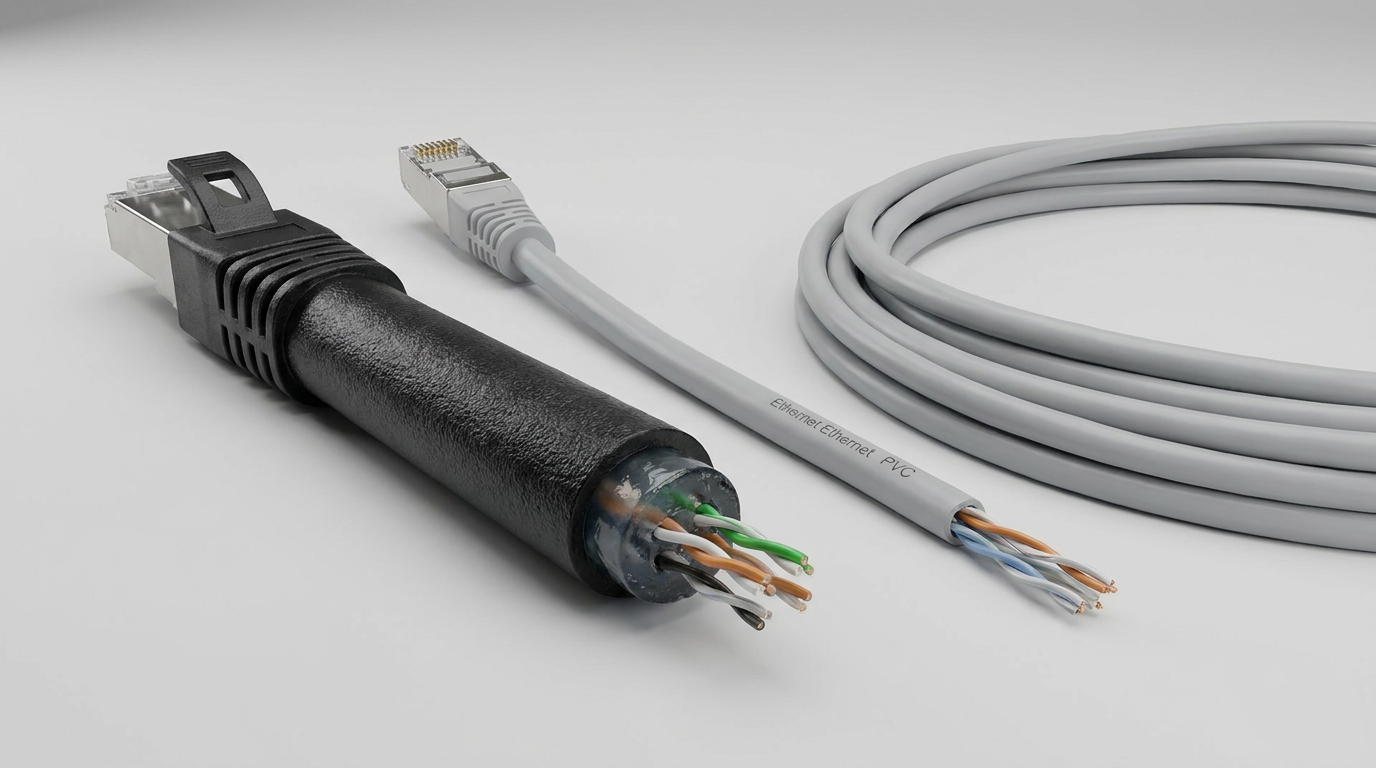
Outdoor vs indoor Ethernet cable refers to the difference between network cables built for exposed environments and cables built for protected interior spaces. Outdoor Ethernet cable has weather-resistant materials, UV protection, and often water-blocking features, while indoor cable prioritizes flexibility, fire ratings, and easy installation inside walls, ceilings, offices, and homes.
Core Definition and Use Cases
Outdoor Ethernet cable is engineered to survive harsh environmental conditions, including rain, sunlight, temperature swings, soil exposure, and abrasion. Indoor Ethernet cable is made for dry, stable environments where building-code compliance, bendability, and flame resistance are more important than weatherproofing.
Based on our internal data and market analysis, here is the breakdown:
| Cable Type | Best Environment | Main Protection | Common Jacket Material | Typical Use |
|---|---|---|---|---|
| Indoor Ethernet cable | Homes, offices, server rooms | Flame resistance, flexibility | PVC, CMP, CMR | Wall plates, patch panels, routers, switches |
| Outdoor Ethernet cable | Exterior walls, rooftops, conduits, direct burial | UV, moisture, abrasion resistance | PE, LLDPE, gel-filled or water-blocked designs | Cameras, access points, building-to-building links |
| Direct burial Ethernet cable | Underground installations | Soil, moisture, compression resistance | Heavy-duty PE, gel-filled | Trenched network runs |
| Shielded outdoor cable | High-interference outdoor areas | EMI/RFI protection plus weather resistance | PE with foil/braid shielding | Industrial sites, long outdoor runs |
Indoor cable should not be treated as a waterproof vs indoor cable alternative. Even if it works temporarily outdoors, sunlight and moisture can crack the jacket, corrode conductors, and degrade performance over time.
cwcables Pro Tip: I always recommend matching the cable jacket to the environment first, then choosing the category rating. A high-speed indoor cable installed outdoors can fail faster than a lower-category cable built with the correct outdoor jacket.
How Does outdoor vs indoor ethernet cable Work?
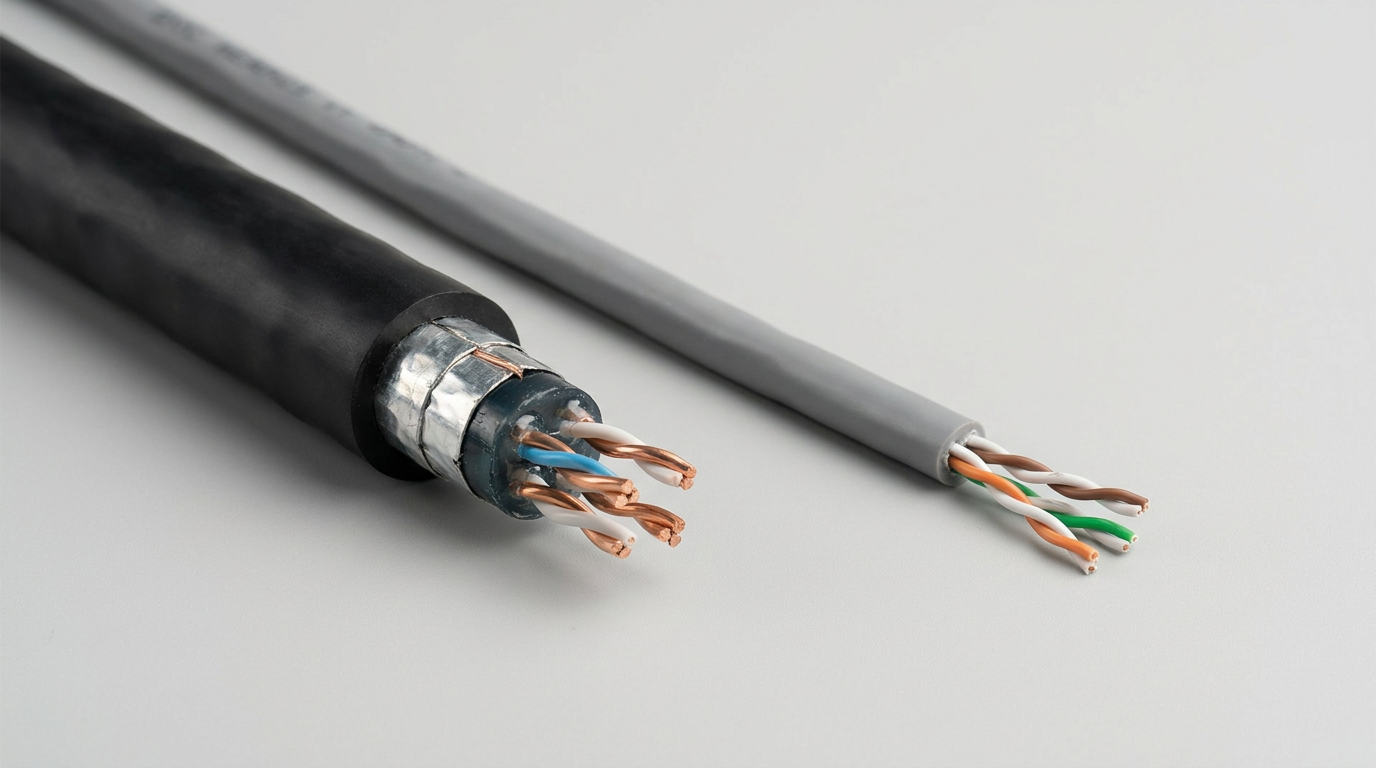
Both outdoor and indoor Ethernet cables transmit data through twisted copper pairs that reduce signal interference. The key difference is not how the signal travels, but how the cable protects that signal. Outdoor cable adds environmental protection, while indoor cable focuses on safe, efficient performance inside controlled building spaces.
Signal Transmission and Environmental Protection
Ethernet cables work by sending electrical signals through twisted copper conductors. The twists help cancel electromagnetic interference and maintain signal quality across the cable run. Cable category, such as Cat5e, Cat6, Cat6A, or Cat7, affects bandwidth, frequency, and performance distance.
The outdoor vs indoor ethernet cable difference appears in the construction around those conductors.
- Conductors: Usually solid copper or copper-clad aluminum, though solid bare copper is preferred for stable performance.
- Twisted pairs: Reduce crosstalk and help maintain clean data transmission.
- Insulation: Separates conductors and supports signal integrity.
- Shielding: Optional foil or braid protects against electromagnetic interference.
- Outer jacket: The main difference between outdoor and indoor cable; outdoor jackets resist UV, water, and abrasion, while indoor jackets are rated for fire safety and flexibility.
- Water blocking: Outdoor cables may use gel filling, dry water-blocking tape, or tight jacket construction to reduce moisture migration.
When comparing outdoor ethernet cable vs indoor, the data transmission principle is similar, but the durability system is very different.
cwcables Pro Tip: I avoid choosing cable by category alone. A Cat6 indoor cable and a Cat6 outdoor cable may support similar speeds, but only the outdoor-rated version is built to protect that performance in rain, sunlight, or conduit condensation.
What are the benefits of outdoor vs indoor ethernet cable?
The main benefit of choosing the correct Ethernet cable is long-term network reliability. Outdoor cable protects against weather, UV exposure, and moisture, while indoor cable offers easier routing, fire-rated options, and cost efficiency. Using each cable in the right environment improves safety, performance, and installation lifespan.
Practical Advantages by Installation Type
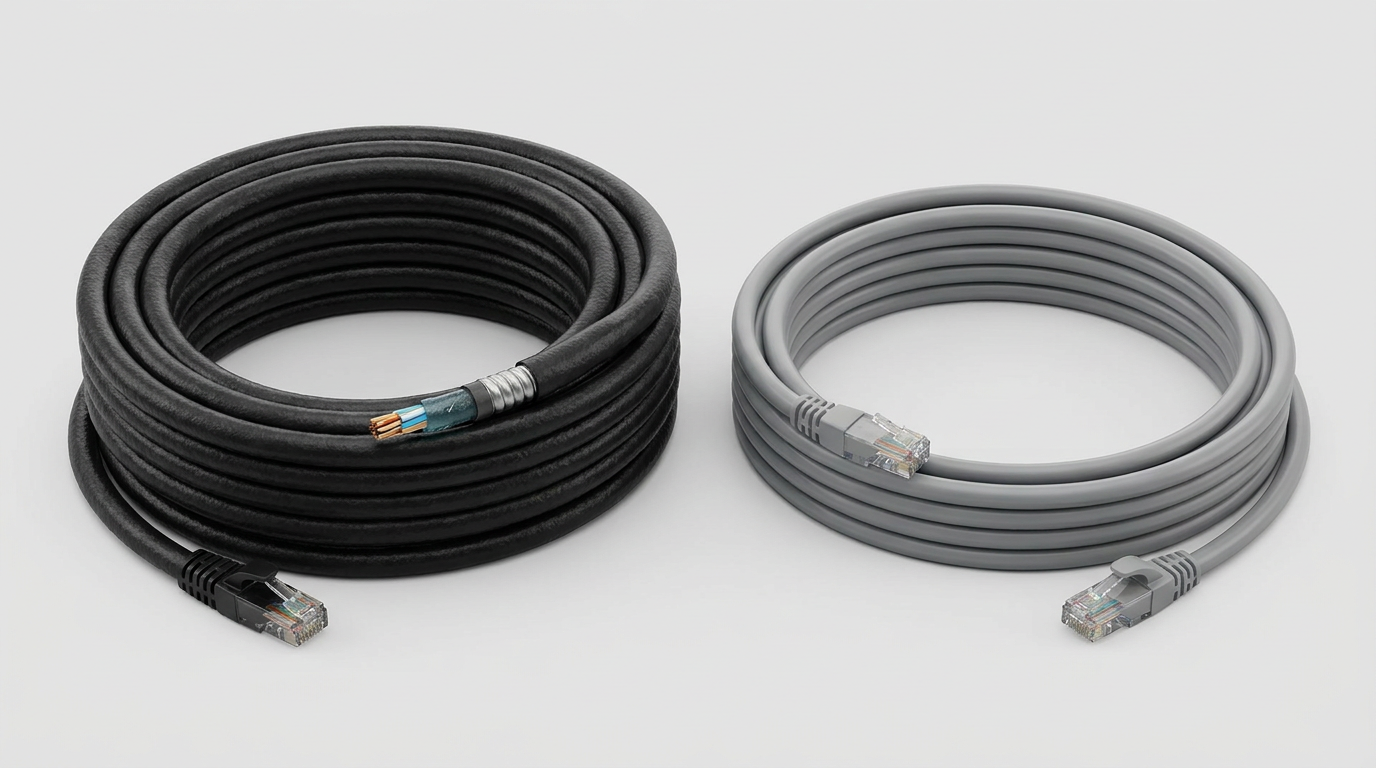
Outdoor and indoor Ethernet cables both provide stable wired connectivity, but their benefits depend on placement. Outdoor cable is best when the run is exposed or semi-exposed. Indoor cable is better when the installation is inside walls, ceilings, racks, or rooms.
Based on our internal data and market analysis, here is the breakdown:
| Benefit | Outdoor Ethernet Cable | Indoor Ethernet Cable |
|---|---|---|
| Weather resistance | Excellent protection from rain, sunlight, and temperature changes | Not designed for weather exposure |
| Fire-code suitability | Usually not ideal for long indoor runs unless properly rated | Available in riser and plenum ratings |
| Installation flexibility | More rigid due to thicker jacket | Easier to bend, route, and terminate |
| Long-term durability | Strong in exposed environments | Strong in protected environments |
| Cost efficiency | Higher upfront cost, lower replacement risk outdoors | Lower cost for indoor use |
| Best applications | Cameras, outdoor Wi-Fi, gates, exterior walls | Offices, homes, patch panels, network closets |
The biggest advantage is avoiding premature failure. A waterproof vs indoor cable decision should be based on exposure level, not convenience. If the cable will touch moisture, sunlight, soil, or outdoor conduit, outdoor-rated cable is the safer choice.
cwcables Pro Tip: I treat “covered outdoor areas” as outdoor environments. Patios, soffits, garages, and exterior conduits still experience humidity, heat, and condensation, so I usually specify outdoor-rated cable for those runs.
How to maintain an outdoor vs indoor ethernet cable?
Maintaining Ethernet cable means protecting it from physical damage, moisture, sharp bends, poor terminations, and environmental stress. Outdoor cables require regular inspection for jacket damage, UV wear, and water entry, while indoor cables need clean routing, proper bend radius, secure labeling, and protection from crushing or heat.
Inspection and Care Checklist
Good maintenance starts with proper installation. Ethernet cable problems often come from crushed jackets, exposed copper, loose connectors, water intrusion, or poor routing near power lines. Outdoor cable needs more frequent inspection because the environment changes constantly.
Use this maintenance checklist:
- Inspect the jacket regularly. Look for cracking, cuts, swelling, discoloration, or abrasion, especially on outdoor runs.
- Check cable entry points. Seal wall penetrations with outdoor-rated grommets, drip loops, and weatherproof boxes.
- Avoid sharp bends. Maintain proper bend radius to prevent conductor damage and signal loss.
- Keep cables away from power lines. Separate Ethernet from electrical wiring to reduce interference and safety risks.
- Test the cable periodically. Use a cable tester to check continuity, pair mapping, and performance.
- Protect outdoor terminations. Use weatherproof couplers, outdoor-rated keystone jacks, and sealed enclosures.
- Replace damaged sections quickly. Moisture and corrosion can spread through a cable once the jacket is compromised.
- Label both ends. Clear labels simplify troubleshooting and reduce accidental disconnection.
Indoor cable maintenance is simpler, but it still matters. Cables in racks and ceilings should not be kinked, overloaded in bundles, or pinched behind furniture.
cwcables Pro Tip: I always add a drip loop before an outdoor cable enters a building or enclosure. It is a simple installation habit that helps keep water from following the cable directly into the connection point.
What is the price of outdoor vs indoor ethernet cable?
Outdoor Ethernet cable usually costs more than indoor Ethernet cable because it uses tougher jacket materials, UV resistance, moisture protection, and sometimes shielding or gel filling. Indoor cable is generally more affordable, especially for patch cords and standard bulk runs, but the cheapest option is not always the lowest-cost long-term choice.
Typical Price Ranges and Cost Drivers
Ethernet cable pricing varies by category, conductor material, shielding, jacket rating, length, and whether it is sold as bulk cable or pre-terminated patch cable. Outdoor cable often carries a higher price because it requires more durable materials and specialized construction.
Based on our internal data and market analysis, here is the breakdown:
| Cable Option | Relative Cost | Common Reason for Price Difference | Best Value Scenario |
|---|---|---|---|
| Indoor Cat5e | Low | Basic performance, common availability | Budget home or office connections |
| Indoor Cat6 | Low to medium | Better bandwidth and crosstalk control | Most modern indoor networks |
| Indoor Cat6A | Medium | Higher frequency and 10Gb support | High-performance office or server runs |
| Outdoor Cat6 | Medium to high | UV and moisture-resistant jacket | Cameras, exterior access points |
| Outdoor shielded Cat6A | High | Weather resistance plus EMI protection | Industrial or long exposed runs |
| Direct burial cable | High | Heavy-duty jacket and water-blocking design | Underground installations |
Outdoor ethernet cable vs indoor pricing should be evaluated against replacement risk. If an indoor cable fails outdoors, labor and downtime can cost far more than the initial cable savings.
cwcables Pro Tip: I recommend budgeting for the correct jacket rating before upgrading to a higher category. For example, outdoor-rated Cat6 is often a better investment for an exterior camera than indoor Cat6A exposed to weather.
Key Features & Comparison
The key differences between outdoor and indoor Ethernet cable are jacket material, moisture resistance, UV protection, flame rating, flexibility, and installation location. Indoor cable is optimized for safe use inside buildings, while outdoor cable is optimized for environmental durability in exposed, wet, hot, cold, or underground conditions.
Feature-by-Feature Comparison
Based on our internal data and market analysis, here is the breakdown:
| Feature | Outdoor Ethernet Cable | Indoor Ethernet Cable | Why It Matters |
|---|---|---|---|
| Outer jacket | PE, LLDPE, or outdoor-rated material | PVC, CMR, CMP, LSZH options | Determines durability and code suitability |
| UV resistance | Yes, typically built in | Usually no | Prevents cracking from sunlight |
| Moisture resistance | High; may include gel or water-blocking tape | Low to moderate | Protects conductors from corrosion |
| Flame rating | Often limited unless specifically rated | Available as riser or plenum | Important for building-code compliance |
| Flexibility | Usually stiffer | Usually more flexible | Affects routing and termination |
| Direct burial option | Available | Not recommended | Required for underground runs |
| Shielding | Optional and common for outdoor/industrial use | Optional | Reduces EMI and crosstalk |
| Best installation area | Exterior walls, conduit, underground, rooftops | Interior walls, ceilings, racks, offices | Prevents premature cable failure |
| Typical lifespan in correct environment | Long | Long | Proper placement extends service life |
| Risk if used incorrectly | Lower when used outdoors properly | High if used outdoors | Wrong cable can fail quickly |
A waterproof vs indoor cable decision should consider whether the cable will face water, condensation, sunlight, or soil. “Waterproof” can mean water-resistant, gel-filled, direct burial, or outdoor-rated, so the exact product specification matters.
cwcables Pro Tip: I never assume all outdoor cables are direct burial cables. If the cable is going underground, I check specifically for direct burial rating, not just “outdoor-rated” wording.
Cost & Buying Factors
The best cable choice depends on installation location, required speed, cable length, exposure level, fire-code requirements, and total project cost. Indoor cable is economical for protected spaces, while outdoor cable is worth the added cost when the run is exposed to UV light, water, conduit condensation, or physical wear.
Buying Criteria Before You Order
Choosing between outdoor vs indoor ethernet cable is easier when you evaluate the installation environment first, then match speed and construction requirements. Brand, testing certification, conductor quality, and compliance ratings also matter.
Consider these buying factors:
- Installation location: Use indoor cable inside protected spaces and outdoor cable for exterior, wet, or exposed runs.
- Cable category: Cat6 is suitable for many modern networks; Cat6A is better for higher bandwidth or 10Gb applications.
- Conductor type: Solid copper is preferred for permanent links and PoE reliability.
- Shielding: Choose shielded cable when running near motors, power equipment, or high-interference areas.
- Jacket rating: Select CMR, CMP, outdoor-rated PE, or direct burial based on code and environment.
- PoE requirements: Cameras, access points, and VoIP devices may require cable that handles power delivery reliably.
- Termination method: Outdoor cable may need compatible shielded connectors, weatherproof boxes, or field plugs.
- Total cost: Include cable, connectors, conduit, labor, testing, and future maintenance.
For cwcables customers, the best choice is usually the one that matches the environment first and performance category second.
cwcables Pro Tip: I always ask where the cable will physically travel from end to end. A run that starts indoors but passes through an exterior wall, attic vent area, outdoor conduit, or underground section may need outdoor-rated cable for that portion.
Conclusion
Outdoor and indoor Ethernet cables may look similar, but they are built for different conditions. Indoor cable is best for protected, code-sensitive spaces, while outdoor cable is designed for weather, moisture, sunlight, and rugged installations. Choosing correctly improves reliability, safety, and long-term network performance.
Final Recommendation
The safest approach is to match the cable to the environment before focusing on speed rating or price. Indoor cable should stay indoors unless it is installed inside a properly protected pathway and allowed by code. Outdoor cable should be used anywhere the run may encounter moisture, UV exposure, temperature swings, or physical stress.
Use this quick decision guide:
- Choose indoor Ethernet cable for offices, homes, patch panels, server rooms, wall plates, and protected ceiling spaces.
- Choose outdoor Ethernet cable for exterior cameras, outdoor access points, gates, exterior walls, rooftops, and exposed conduit.
- Choose direct burial Ethernet cable for underground runs.
- Choose shielded outdoor cable for long outdoor runs near electrical equipment or interference sources.
- Choose plenum or riser-rated indoor cable when required by building codes.
For reliable installations, cwcables recommends selecting the correct jacket rating, verifying conductor quality, and testing every finished run.
cwcables Pro Tip: I consider cable replacement labor when making the final decision. Spending slightly more on the correct outdoor or indoor-rated cable upfront is usually far cheaper than troubleshooting failures after the network is already in service.