

Moving Ethernet is different from static Ethernet: the cable must preserve 10 Gigabit performance while surviving repeated bending, torsion, abrasion, oil, and drag-chain motion. For machine builders, robot integrators, and automation teams, the key is choosing a Cat6A cable rated not only for bandwidth, but also for flex life, bend radius, shielding stability, jacket durability, and installation environment.
What is Cat6A cable for moving machines,high flex Cat6A, drag chain Cat6A cable?
A Cat6A cable for moving machines is an industrial Ethernet cable designed for continuous motion while supporting Cat6A performance, typically up to 10GBASE-T. High flex Cat6A and drag chain Cat6A cable versions use specialized conductors, shielding, and jackets to resist bending fatigue, signal loss, and mechanical wear in automation systems.
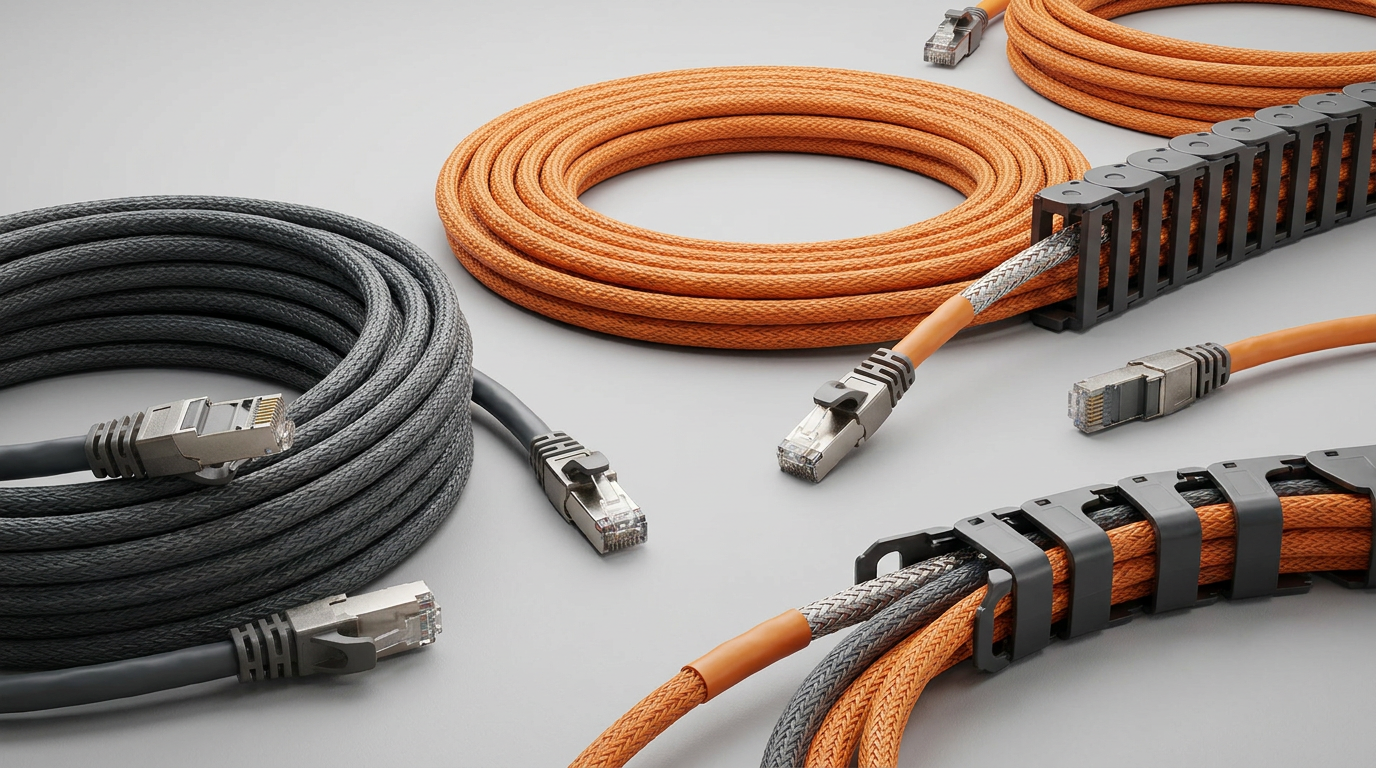
Industrial Ethernet Cable Built for Motion
A standard Cat6A cable is usually designed for fixed building infrastructure. In contrast, a high flex Cat6A cable is engineered for dynamic applications where the cable repeatedly bends, travels, or moves inside a cable carrier.
For moving machines, the cable must maintain electrical geometry while under mechanical stress. That means the conductor stranding, insulation, pair lay length, separator design, shielding, and jacket all matter.
Based on our internal data and market analysis, here is the breakdown:
| Cable Type | Typical Use | Motion Capability | Cat6A Performance | Best Fit |
|---|---|---|---|---|
| Standard Cat6A | Office/building cabling | Low | Yes | Fixed installations |
| Industrial Cat6A | Factory networks | Moderate | Yes | Harsh but mostly static areas |
| High flex Cat6A | Repeated motion | High | Yes, if properly designed | Moving machine axes |
| Drag chain Cat6A cable | Continuous carrier travel | Very high | Yes, with correct shielding | Cable tracks, gantries, robots |
The main difference is durability under motion. A drag chain Cat6A cable is not just a “tougher jacket”; it is a complete cable system designed to protect impedance, pair balance, and shielding coverage over millions of flex cycles.
cwcables Pro Tip: I always check flex-cycle rating, bend radius, and shielding construction before looking at color or jacket marking. If the cable cannot survive the motion profile, Cat6A speed on the datasheet will not matter in the field.
How Does Cat6A cable for moving machines,high flex Cat6A, drag chain Cat6A cable Work?
High flex Cat6A works by preserving pair geometry and shielding integrity during continuous movement. Flexible stranded conductors, optimized insulation, stable pair twisting, motion-rated shielding, and abrasion-resistant jackets work together to maintain impedance control, reduce crosstalk, and protect 10 Gigabit Ethernet signals inside dynamic machine environments.
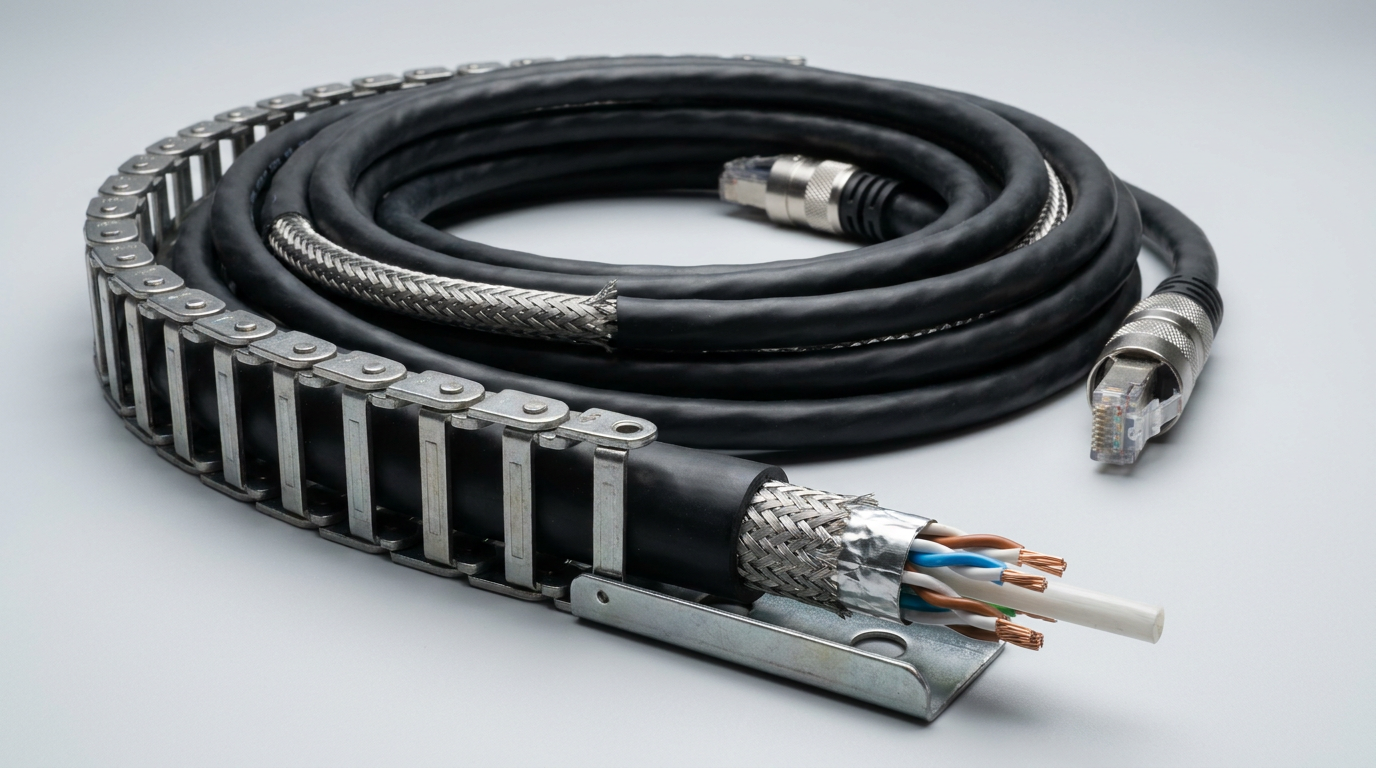
Signal Integrity Under Repeated Flexing
Cat6A performance depends on controlled impedance, low insertion loss, low return loss, and strong crosstalk performance. In a moving machine, bending can deform cable geometry, which may create reflections, packet errors, or intermittent communication failures.
A properly designed drag chain Cat6A cable reduces this risk through layered construction:
- Fine-stranded conductors improve flexibility and reduce conductor fatigue.
- Stable insulation materials help maintain conductor spacing during motion.
- Precision pair twisting supports Cat6A crosstalk performance.
- Internal separators or fillers help keep the cable round and balanced.
- Motion-rated shielding protects against EMI from motors, drives, and servo systems.
- Flexible industrial jacket resists abrasion, oil, coolant, and drag-chain wear.
- Controlled bend radius design prevents over-stressing the cable during operation.
The cable works best when installed correctly. Even a premium high flex Cat6A cable can fail early if it is twisted during installation, forced below its minimum bend radius, or tied too tightly inside a cable carrier.
cwcables Pro Tip: I recommend testing the cable path before final installation. Cycle the machine slowly, watch the cable movement, and confirm it rolls smoothly in the drag chain without corkscrewing, rubbing, or crossing over adjacent cables.
What are the benefits of Cat6A cable for moving machines,high flex Cat6A, drag chain Cat6A cable?
The main benefits are reliable high-speed communication, longer service life, reduced downtime, and better resistance to industrial stress. A high flex Cat6A cable supports demanding Ethernet applications while tolerating continuous bending, vibration, EMI, oil exposure, and mechanical wear common in automated machinery and drag-chain systems.
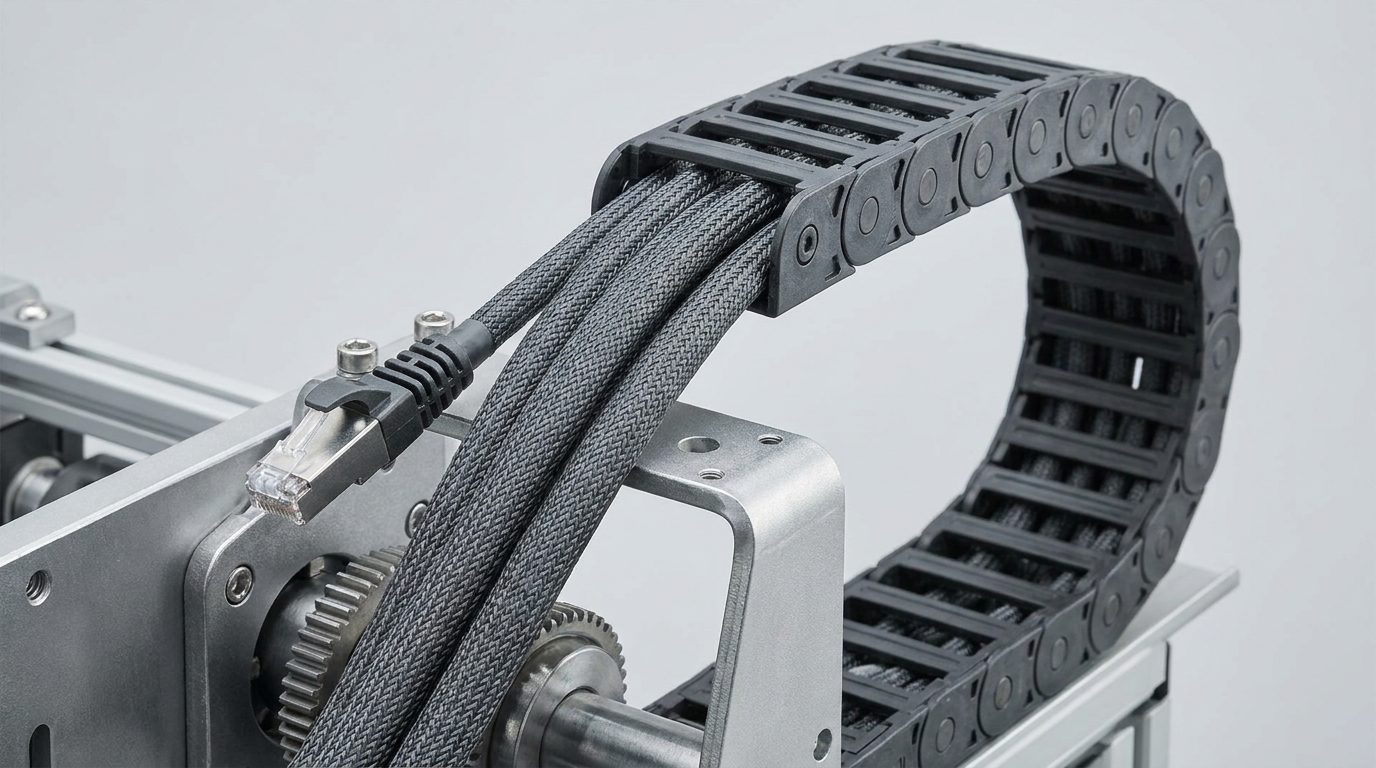
Why Machine Builders Choose Motion-Rated Cat6A
Moving machines often depend on real-time data from cameras, controllers, sensors, drives, and industrial PCs. A communication fault can stop production, create scrap, or trigger difficult troubleshooting. Motion-rated Cat6A helps reduce these risks.
Key benefits include:
- 10 Gigabit-ready bandwidth for vision systems, high-speed inspection, and data-heavy automation.
- Improved uptime by reducing conductor breakage and intermittent signal faults.
- Better EMI protection near servo drives, VFDs, motors, and welding equipment.
- Longer flex life compared with standard Ethernet cables.
- Cleaner drag-chain routing because the cable is designed for repeated travel.
- Lower maintenance cost when replacement intervals are reduced.
- Industrial jacket options for oil, coolant, abrasion, flame, and chemical resistance.
Based on our internal data and market analysis, here is the breakdown:
| Benefit | Why It Matters | Typical Impact |
|---|---|---|
| High bandwidth | Supports modern machine data loads | Faster communication |
| Flex durability | Survives repeated bending | Less downtime |
| EMI shielding | Protects signal quality | Fewer network errors |
| Industrial jacket | Resists harsh environments | Longer cable life |
| Drag-chain compatibility | Moves predictably in carriers | Safer installation |
For automation systems, the value is not only faster Ethernet. The real benefit is stable communication over time, especially where the cable moves every production cycle.
cwcables Pro Tip: I usually ask customers what will cost more: a better cable now or one unexpected line stop later. In moving equipment, cable failure is rarely cheap once production is running.
How to maintain a Cat6A cable for moving machines,high flex Cat6A, drag chain Cat6A cable?
Maintain a drag chain Cat6A cable by inspecting bend radius, jacket wear, connector strain relief, shielding continuity, and cable carrier movement. Prevent twisting, crushing, overfilling, and tight tie-downs. Regular visual checks and network testing help identify early damage before it becomes machine downtime.
Practical Maintenance Checklist for Dynamic Ethernet
Maintenance should focus on both mechanical condition and electrical performance. A cable may look acceptable but still have internal shield fatigue, conductor damage, or impedance changes after long service.
Use the following checklist during planned maintenance:
- Inspect the jacket for cuts, flattening, swelling, abrasion, or cracking.
- Check the bend radius at every moving and fixed transition point.
- Verify drag-chain fill level and make sure cables have room to move.
- Look for twisting or corkscrewing during slow machine cycling.
- Confirm strain relief at connectors, junction boxes, and moving axes.
- Separate power and data cables where possible to reduce EMI risk.
- Test network performance for packet loss, link speed, and intermittent disconnects.
- Check shielding and grounding according to the machine’s electrical design.
- Replace damaged connectors instead of reusing stressed terminations.
- Document flex-cycle history for critical applications.
Based on our internal data and market analysis, here is the breakdown:
| Maintenance Item | Warning Sign | Recommended Action |
|---|---|---|
| Jacket condition | Abrasion or cuts | Replace or reroute |
| Bend radius | Sharp bends | Increase loop radius |
| Cable carrier movement | Cable crossing or rubbing | Reposition and separate |
| Connector area | Intermittent link | Inspect strain relief |
| EMI performance | Packet errors | Check shielding and grounding |
Good maintenance is preventive. Waiting until communication faults appear often means the cable has already suffered internal damage.
cwcables Pro Tip: I like to inspect moving cables while the machine is running slowly, not only when it is stopped. Many drag-chain problems are visible only when the cable is actually moving.
What is the price of Cat6A cable for moving machines,high flex Cat6A, drag chain Cat6A cable?
The price depends on conductor size, shielding design, jacket material, flex-cycle rating, certifications, order length, and connectorization. High flex Cat6A and drag chain Cat6A cable usually cost more than standard Cat6A, but the higher price reflects motion durability, industrial protection, and reduced downtime risk.
Pricing Variables That Affect Total Cost
There is no single universal price because industrial Cat6A cables vary widely by application. A cable for light motion in a clean environment will not cost the same as a drag-chain-rated, oil-resistant, shielded cable for continuous machine operation.
Based on our internal data and market analysis, here is the breakdown:
| Price Factor | Lower-Cost Option | Higher-Cost Option | Why It Matters |
|---|---|---|---|
| Flex rating | Occasional flex | Millions of cycles | Determines service life |
| Shielding | Basic foil | Braid plus foil | Improves EMI protection |
| Jacket | PVC | PUR/TPE industrial jacket | Adds oil and abrasion resistance |
| Certification | Basic compliance | UL/CE/industrial approvals | Required for regulated systems |
| Assembly | Bulk cable | Overmolded connectors | Saves installation time |
| Length | Standard reel | Custom cut lengths | Affects waste and logistics |
For budgeting, consider total cost of ownership instead of unit price alone. A cheaper cable may be acceptable for fixed wiring, but it can become expensive if it fails inside a production machine.
Important buying questions include:
- How many flex cycles are expected?
- What is the minimum bend radius?
- Will the cable run inside a drag chain?
- Is the environment oily, wet, abrasive, or chemically exposed?
- Are servo drives, VFDs, or welders nearby?
- Is 10GBASE-T required now or for future upgrades?
- Are molded M12, RJ45, or custom connectors needed?
cwcables Pro Tip: I always recommend matching the cable price to the downtime risk. If a failed Ethernet cable can stop a machine cell, the right high flex Cat6A cable is usually the lowest-cost decision over the machine’s life.
Key Features & Comparison
The most important ratings for moving-machine Cat6A are flex-cycle life, minimum bend radius, shielding, jacket material, oil and abrasion resistance, temperature range, flame rating, and Ethernet compliance. Comparing these features side by side helps identify whether a cable is suitable for static use, flexible routing, or continuous drag-chain motion.
Feature Comparison for Industrial Cat6A Selection
Choosing the right cable requires looking beyond the Cat6A label. Two cables may both claim Cat6A performance, but only one may be engineered for continuous motion.
Based on our internal data and market analysis, here is the breakdown:
| Feature | Standard Cat6A | High Flex Cat6A | Drag Chain Cat6A Cable | Selection Priority |
|---|---|---|---|---|
| Ethernet rating | Cat6A | Cat6A | Cat6A | Essential |
| Motion use | Fixed | Repeated flexing | Continuous carrier motion | Essential |
| Flex-cycle rating | Low/not specified | Medium to high | High to very high | Critical |
| Bend radius | Larger | Reduced | Optimized for carriers | Critical |
| Conductor design | Solid or stranded | Fine stranded | Extra-flex stranded | Critical |
| Shielding | Foil/braid varies | Motion-stable shielding | High-stability EMI shielding | High |
| Jacket material | PVC common | PVC/PUR/TPE | PUR/TPE common | High |
| Oil resistance | Optional | Often available | Usually recommended | Application-dependent |
| Abrasion resistance | Basic | Improved | High | Critical in drag chains |
| Temperature range | Standard | Industrial | Industrial/dynamic | High |
| Installation area | Buildings | Machines | Cable carriers/robots | Essential |
For moving equipment, the highest-priority ratings are mechanical first, then electrical. The cable must physically survive the machine motion before it can reliably deliver Cat6A performance.
A good specification should include:
- Cat6A or 10GBASE-T compliance
- Dynamic bend radius
- Static bend radius
- Flex-cycle test data
- Jacket material and resistance ratings
- Shielding type and coverage
- Operating temperature range
- Approvals such as UL certification, CE, RoHS, or other project-specific standards
cwcables Pro Tip: I avoid selecting a cable from “Cat6A” alone. For moving machines, I want the datasheet to clearly state dynamic bend radius, flex-cycle performance, and drag-chain suitability.
Cost & Buying Factors
When buying high flex Cat6A, evaluate application motion, cable carrier design, EMI exposure, jacket requirements, connector type, certification needs, and supplier support. The best cable is not always the most expensive one; it is the one that matches the movement, environment, and network performance requirements.
Buying Guide for Machine and Automation Projects
A strong buying decision starts with the machine’s motion profile. Cable selection should be based on actual operating conditions, not only Ethernet category.
Use this process to specify the right product:
- Define the network requirement
Confirm whether the application needs 1G, 2.5G, 5G, or 10G Ethernet. - Map the motion profile
Identify travel length, speed, acceleration, bend radius, and cycle frequency. - Check drag-chain design
Verify carrier size, fill ratio, separation rules, and cable positioning. - Review the environment
Look for oil, coolant, weld spatter, UV, moisture, chemicals, and abrasion. - Assess EMI risk
Note nearby motors, drives, power cables, and grounding conditions. - Choose jacket and shielding
Select PUR, TPE, PVC, foil, braid, or combined shielding based on conditions. - Select connectorization
Decide between bulk cable, field-terminated RJ45, M12, molded assemblies, or custom cable sets. - Confirm compliance
Match UL, CE, RoHS, flame, and regional requirements.
Based on our internal data and market analysis, here is the breakdown:
| Buying Factor | Why It Matters | Risk If Ignored |
|---|---|---|
| Motion profile | Determines flex rating | Premature conductor failure |
| EMI environment | Affects signal reliability | Packet loss or link drops |
| Jacket material | Protects against environment | Cracking, swelling, abrasion |
| Connector type | Impacts installation reliability | Intermittent connections |
| Certifications | Supports compliance | Approval delays |
| Supplier support | Helps match application | Wrong cable selection |
For buyers comparing options from cwcables or other suppliers, the best request is a complete application description. The more details provided, the easier it is to match the right Cat6A cable to the machine.
cwcables Pro Tip: I prefer getting photos or drawings of the cable path before recommending a drag chain Cat6A cable. A small routing detail can completely change the right cable choice.
Conclusion
For moving machines, the right Cat6A cable must combine high-speed data performance with proven mechanical durability. Focus on flex life, bend radius, shielding, jacket material, environmental resistance, and drag-chain compatibility. Selecting the correct high flex Cat6A cable helps protect uptime, network stability, and long-term machine reliability.
Final Selection Priorities
A Cat6A label confirms a data-performance category, but it does not automatically mean the cable is suitable for motion. Moving-machine applications need a cable designed and tested for dynamic stress.
Use this final checklist before purchasing:
- Confirm Cat6A or 10GBASE-T performance.
- Verify dynamic flex rating and bend radius.
- Match the jacket to oil, abrasion, coolant, and temperature conditions.
- Choose shielding suitable for industrial EMI exposure.
- Check drag-chain compatibility if the cable moves continuously.
- Confirm connector and termination requirements.
- Review certifications for the target market.
- Work with a supplier that understands automation environments.
When the application involves robotics, gantries, servo axes, machine vision, or cable carriers, a purpose-built high flex Cat6A or drag chain Cat6A cable is the safer choice. cwcables can help evaluate the operating conditions and recommend a cable construction suited to the machine’s motion and network requirements.
cwcables Pro Tip: My final rule is simple: specify the cable for the movement first, then confirm the Ethernet performance. In dynamic machinery, mechanical survival is what keeps the network reliable.