

Converting American Wire Gauge into square millimeters helps engineers, buyers, and installers compare cable sizes across U.S. and metric standards. Because AWG numbers decrease as conductor size increases, direct comparison can be confusing. A reliable AWG to mm² reference supports safer cable selection, accurate current-capacity planning, and smoother procurement from global suppliers such as cwcables.
What is AWG to mm²?
AWG to mm² is the conversion between American Wire Gauge sizes and the metric cross-sectional area of a conductor in square millimeters. It helps users compare cable dimensions, estimate ampacity, and match international specifications when selecting electrical wires, control cables, power cables, or custom cable assemblies.
Understanding the Measurement Systems
AWG is a gauge-based sizing standard mainly used in North America, while mm² describes the actual conductor cross-sectional area commonly used in IEC and many international cable standards. The key difference is that AWG is inverse: a smaller AWG number means a larger conductor.
Based on our internal data and market analysis, here is the breakdown:
| AWG Size | Approx. Diameter mm | Approx. Area mm² | Common Metric Equivalent |
|---|---|---|---|
| 24 AWG | 0.511 mm | 0.205 mm² | 0.20 mm² |
| 22 AWG | 0.644 mm | 0.326 mm² | 0.34 mm² |
| 20 AWG | 0.812 mm | 0.518 mm² | 0.50 mm² |
| 18 AWG | 1.024 mm | 0.823 mm² | 0.75 mm² |
| 16 AWG | 1.291 mm | 1.31 mm² | 1.5 mm² |
| 14 AWG | 1.628 mm | 2.08 mm² | 2.5 mm² |
| 12 AWG | 2.053 mm | 3.31 mm² | 4.0 mm² |
| 10 AWG | 2.588 mm | 5.26 mm² | 6.0 mm² |
cwcables Pro Tip: When I compare AWG to mm² for cable sourcing, I never rely only on the nearest metric size. I also check insulation rating, conductor material, strand construction, and required current load before confirming the cable specification.
How Does AWG to mm² Work?
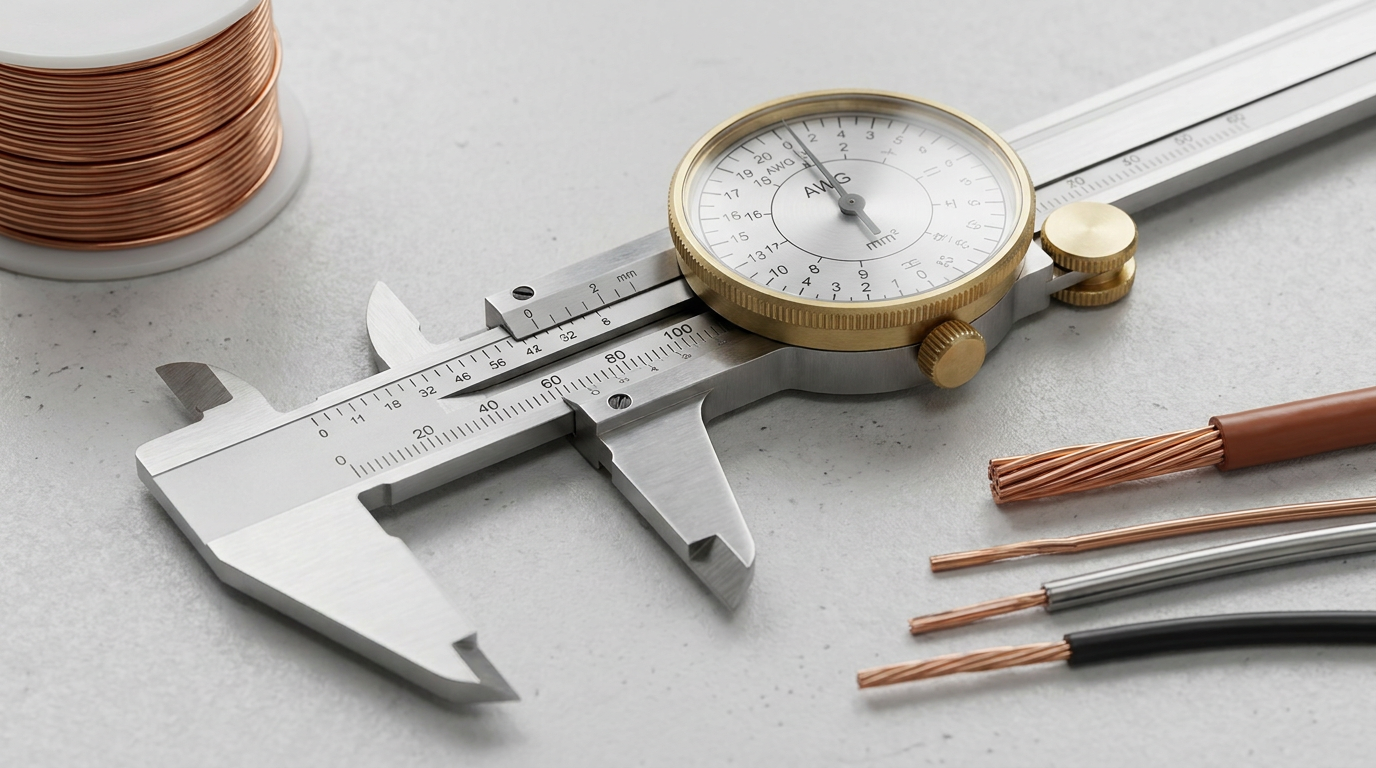
AWG to mm² works by converting the AWG conductor diameter into cross-sectional area. The diameter follows a logarithmic gauge scale, so each step in AWG changes conductor size by a fixed ratio. Once diameter is known, the area is calculated using the circular area formula.
Conversion Formula and Practical Method
The mathematical conversion starts with the AWG diameter, then converts that diameter into conductor area. This is useful when you need to compare awg to mm, awg to mm2 cable conversion, or calculate equivalent cable sizes for electrical design.
The standard formulas are:
- Calculate conductor diameter in inches:
d(in) = 0.005 × 92^((36 - AWG) / 39) - Convert inches to millimeters:
d(mm) = d(in) × 25.4 - Calculate area in square millimeters:
Area(mm²) = π × [d(mm) / 2]²
For most cable selection tasks, a verified conversion table is faster and less error-prone than calculating manually every time.
Based on our internal data and market analysis, here is the breakdown:
| Task | Best Method | Why It Matters |
|---|---|---|
| Quick cable comparison | Use a conversion chart | Reduces specification mistakes |
| Engineering calculation | Use the formula | Provides exact theoretical area |
| Procurement matching | Use nearest standard metric size | Aligns with supplier availability |
| Safety verification | Check ampacity table | Confirms current-carrying capacity |
cwcables Pro Tip: When customers ask me how to convert awg to mm, I always clarify whether they need conductor diameter in mm or conductor area in mm². Those are different values, and mixing them can lead to undersized cables.
What are the benefits of AWG to mm²?
The main benefit of AWG to mm² conversion is clearer communication between U.S. and international cable standards. It helps engineers select equivalent cables, reduces purchasing errors, supports compliance checks, and improves confidence when comparing conductor size, current rating, resistance, and mechanical performance.
Why Conversion Matters in Cable Selection
AWG to mm² conversion is especially important when a project includes imported equipment, export products, multinational drawings, or replacement parts from different regions. A correct conversion helps ensure that the chosen cable can safely carry the required current without excessive voltage drop or overheating.
Key benefits include:
- Easier comparison between UL-style and IEC-style cable specifications
- Better cable substitution decisions during procurement
- Reduced risk of using undersized conductors
- Improved communication between engineers, installers, and suppliers
- More accurate evaluation of voltage drop and conductor resistance
- Faster quoting for custom cable assemblies
- Better documentation for international projects
Based on our internal data and market analysis, here is the breakdown:
| Benefit | Practical Impact |
|---|---|
| Standard alignment | Helps compare North American and metric cable sizes |
| Procurement accuracy | Reduces wrong-size cable orders |
| Safety improvement | Supports proper conductor sizing |
| Cost control | Avoids overbuying unnecessarily large cable |
| Engineering clarity | Improves design and documentation consistency |
cwcables Pro Tip: I recommend confirming the final cable by application, not just by conversion. A 14 AWG conductor is close to 2.08 mm², but many projects will specify 2.5 mm² as the practical metric replacement depending on standards and safety margin.
How to maintain a AWG to mm²?
Maintaining AWG to mm² accuracy means keeping conversion references updated, checking cable datasheets, and verifying that conductor size, material, and strand count match the application. The conversion itself does not require maintenance, but the selection process must be controlled and documented.
Keeping Conversion Data Reliable
Because AWG and metric cable sizes are standardized differently, maintaining accurate conversion data is essential for engineering teams, purchasing departments, and installation contractors. The goal is to prevent mismatches between drawings, quotations, and actual cable deliveries.
Recommended practices include:
- Use a verified AWG to mm² chart from a trusted cable supplier or standard reference.
- Confirm whether the cable uses copper, tinned copper, aluminum, or another conductor material.
- Check whether the cable is solid or stranded, as flexibility and diameter can vary.
- Review insulation thickness and overall cable diameter, not just conductor size.
- Match the cable to ampacity, voltage, temperature, and installation conditions.
- Keep an approved conversion table in your project documentation.
- Ask the supplier to confirm the nominal conductor area on the datasheet.
Based on our internal data and market analysis, here is the breakdown:
| Maintenance Area | What to Check | Frequency |
|---|---|---|
| Conversion chart | Accuracy against standard tables | Before each new project |
| Cable datasheet | Conductor area and material | Every purchase |
| Engineering drawings | AWG and mm² consistency | At design review |
| Supplier quote | Exact cable construction | Before order approval |
| Installed cable | Marking and size verification | During inspection |
cwcables Pro Tip: In my workflow, I keep one approved awg to mm2 cable conversion table for the team and require every quotation to list both AWG and mm² when projects involve mixed standards.
What is the price of AWG to mm²?
AWG to mm² conversion itself has no direct price because it is a sizing calculation or reference. The actual cost depends on the cable size selected, conductor material, copper market price, insulation type, certification requirements, order quantity, and whether the cable is standard or custom-made.
Pricing Factors Behind Converted Cable Sizes
When a cable is converted from AWG to mm², the chosen metric equivalent can affect the final cost. For example, moving from a theoretical 2.08 mm² conductor to a commonly available 2.5 mm² cable may increase copper content but improve availability and safety margin.
Based on our internal data and market analysis, here is the breakdown:
| Cost Factor | Effect on Price |
|---|---|
| Conductor size | Larger mm² means more metal and higher cost |
| Copper vs. aluminum | Copper usually costs more but offers higher conductivity |
| Strand count | Fine-stranded flexible cables often cost more |
| Insulation material | PVC, XLPE, silicone, and PUR have different pricing |
| Certification | UL, CE, RoHS, CPR, or other approvals can affect cost |
| Quantity | Larger orders usually reduce unit price |
| Custom design | Special colors, shielding, jackets, or printing add cost |
Typical buying guidance:
- Small signal wires such as 24–20 AWG are usually low-cost per meter.
- Power conductors such as 14–10 AWG cost more due to copper content.
- Specialty cables with shielding, high-temperature insulation, or approvals cost significantly more.
- Custom cables from cwcables can be optimized to balance performance, compliance, and budget.
cwcables Pro Tip: When I estimate cable cost after AWG to mm² conversion, I check whether the nearest standard metric size is readily available. Choosing a common stock size often saves more money than specifying an exact theoretical equivalent.
Key Features & Comparison
AWG to mm² comparison tables make cable selection faster by showing approximate conductor area, metric equivalents, and typical usage. They are most useful when combined with ampacity, voltage drop, insulation rating, and installation conditions, because conductor area alone does not fully define cable performance.
Practical Size Comparison for Common Cables
The table below provides a practical reference for common conductor sizes. Values are approximate and should be confirmed against the relevant cable standard, manufacturer datasheet, and application requirements.
Based on our internal data and market analysis, here is the breakdown:
| AWG | Area mm² | Nearest Common Metric Size | Typical Use | Selection Note |
|---|---|---|---|---|
| 26 AWG | 0.129 mm² | 0.14 mm² | Signal, sensors, electronics | Not ideal for higher current |
| 24 AWG | 0.205 mm² | 0.20 mm² | Data, control, low-power circuits | Common in communication cables |
| 22 AWG | 0.326 mm² | 0.34 mm² | Controls, instrumentation | Good balance of size and strength |
| 20 AWG | 0.518 mm² | 0.50 mm² | Internal wiring, panels | Common metric match |
| 18 AWG | 0.823 mm² | 0.75 mm² / 1.0 mm² | Appliances, controls | Choose based on current and standard |
| 16 AWG | 1.31 mm² | 1.5 mm² | Power leads, machinery | Metric equivalent often upsized |
| 14 AWG | 2.08 mm² | 2.5 mm² | Branch wiring, equipment power | 2.5 mm² is common in IEC markets |
| 12 AWG | 3.31 mm² | 4.0 mm² | Higher-current circuits | Often rounded up for safety |
| 10 AWG | 5.26 mm² | 6.0 mm² | Motors, power distribution | Check voltage drop carefully |
| 8 AWG | 8.37 mm² | 10 mm² | Heavy-duty power | Larger terminals may be required |
Key comparison points:
- AWG is a gauge number; mm² is a physical area.
- Smaller AWG numbers mean larger conductors.
- Metric equivalents are often rounded to commercially available sizes.
- Ampacity must be verified separately from size conversion.
- Cable flexibility depends on strand construction, not only area.
cwcables Pro Tip: I prefer rounding up to the next standard metric size when safety margin, long cable runs, or voltage drop are concerns. The small material cost increase can prevent overheating and performance issues later.
Cost & Buying Factors
When buying cable after AWG to mm² conversion, focus on total application fit rather than size alone. The best choice balances conductor area, current load, voltage rating, insulation material, flexibility, compliance marks, operating temperature, environmental exposure, and supplier reliability.
What to Check Before Ordering
A correct awg to mm2 cable conversion helps narrow the options, but buying decisions should also consider performance and installation requirements. This is especially important for industrial automation, renewable energy, automotive, robotics, marine, and export-oriented equipment.
Use this buying checklist:
- Confirm the original AWG size and required metric equivalent.
- Decide whether exact area matching or standard metric rounding is preferred.
- Check rated voltage and current requirements.
- Verify ambient temperature and conductor temperature rating.
- Select insulation and jacket material based on environment.
- Confirm flexibility requirements and minimum bend radius.
- Review approvals such as UL, CE, RoHS, REACH, or CPR where needed.
- Check shielding, twisting, drain wire, or armor requirements.
- Confirm packaging, labeling, color coding, and cable marking.
- Request a datasheet or sample before bulk purchase.
Based on our internal data and market analysis, here is the breakdown:
| Buying Factor | Why It Matters | Example Decision |
|---|---|---|
| Current rating | Prevents overheating | Upsize from 2.08 mm² to 2.5 mm² |
| Voltage drop | Protects system performance | Use larger cable for long runs |
| Flexibility | Improves installation life | Choose fine-stranded cable |
| Environment | Prevents jacket failure | Use PUR or silicone instead of PVC |
| Certification | Supports compliance | Specify UL or CE-rated cable |
| Supplier support | Reduces sourcing risk | Work with cwcables for custom specs |
cwcables Pro Tip: Before placing a production order, I ask for the real cable datasheet and not just the AWG conversion value. The datasheet confirms insulation, conductor class, approvals, and tolerances that a simple conversion chart cannot show.
Conclusion
AWG to mm² conversion is essential for comparing cable sizes across North American and metric standards. It supports safer cable selection, clearer purchasing, and better engineering communication. For best results, pair the conversion with ampacity, voltage drop, insulation, certification, and application requirements.
Final Selection Guidance
A conversion chart is a strong starting point, but it should not be the only basis for cable selection. The right cable must satisfy electrical, mechanical, environmental, and compliance requirements. For projects involving mixed standards, documenting both AWG and mm² values helps avoid confusion during design, sourcing, and installation.
Before finalizing your cable choice:
- Use a verified AWG to mm² conversion reference.
- Round to standard metric sizes when required by local practice.
- Confirm ampacity and voltage drop for the full cable run.
- Review cable insulation, jacket, temperature, and flexibility.
- Match certifications to your target market.
- Work with a supplier that can verify construction and provide documentation.
Based on our internal data and market analysis, here is the breakdown:
| Final Check | Recommended Action |
|---|---|
| Size conversion | Confirm AWG, diameter, and mm² area |
| Electrical safety | Verify ampacity and voltage drop |
| Mechanical fit | Check flexibility and cable diameter |
| Compliance | Confirm required standards and markings |
| Supplier support | Request datasheets, samples, or custom guidance |
cwcables Pro Tip: If you are unsure which metric cable size to choose after converting from AWG, send the application details to cwcables. I would rather verify the cable before production than see a project delayed by the wrong conductor size.