

Drag chain cable failure usually starts long before a machine stops. Repeated bending, poor cable selection, incorrect chain layout, excessive speed, and unmanaged torsion gradually damage insulation, shielding, and copper strands. When these issues are ignored, they lead to broken cable conductors, signal loss, overheating, downtime, and premature replacement costs in automated equipment.
What is drag chain cable failure?
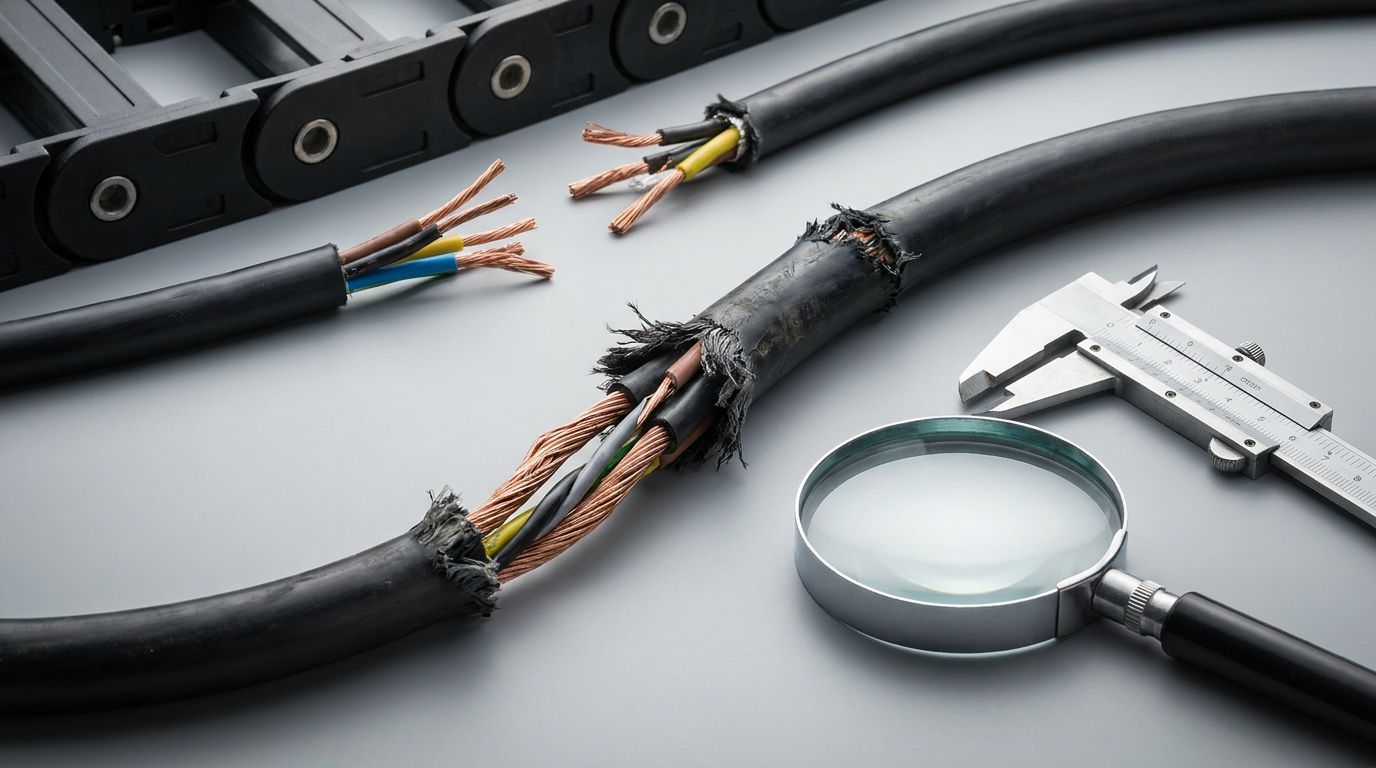
Drag chain cable failure is the loss of electrical, signal, or mechanical performance caused by repeated motion inside an energy chain. It often appears as intermittent faults, cracked jackets, broken cable conductors, shielding damage, or insulation wear. Most failures come from using unsuitable cables, incorrect bend radius, poor installation, or accumulated drag chain fatigue.
Failure Definition and Typical Symptoms
Drag chain cable failure occurs when a moving cable can no longer withstand continuous flexing, sliding, acceleration, and mechanical stress. Unlike static cable damage, this failure usually develops gradually because the cable is exposed to thousands or millions of bending cycles.
Common symptoms include:
- Intermittent encoder or sensor signals
- Servo drive alarms during machine movement
- Visible jacket cracking or flattening
- Increased electrical resistance
- Broken copper strands inside the conductor
- Shield braid separation or reduced EMC protection
- Heat buildup near high-current conductors
- Unexpected machine stops at specific travel positions
A failed drag chain cable may look normal from the outside while the internal conductor strands are already fractured. This is why intermittent faults are especially common in CNC machines, robots, gantries, packaging lines, and automated handling systems.
| Failure Sign | Likely Cause | Typical Result |
|---|---|---|
| Intermittent signal loss | Broken strands or shield fatigue | Random machine faults |
| Jacket cracking | Poor flex material or low temperature | Moisture and abrasion risk |
| Cable twisting | No torsion control or wrong installation | Conductor and shield stress |
| Chain noise or binding | Overfilled or misaligned drag chain | Faster cable wear |
| Heat buildup | Undersized conductor or excessive current | Insulation aging |
cwcables Pro Tip: I always recommend checking both the cable and the chain layout. Replacing a failed cable without correcting bend radius, fill rate, or torsion usually causes the same failure to return.
How Does drag chain cable failure Work?
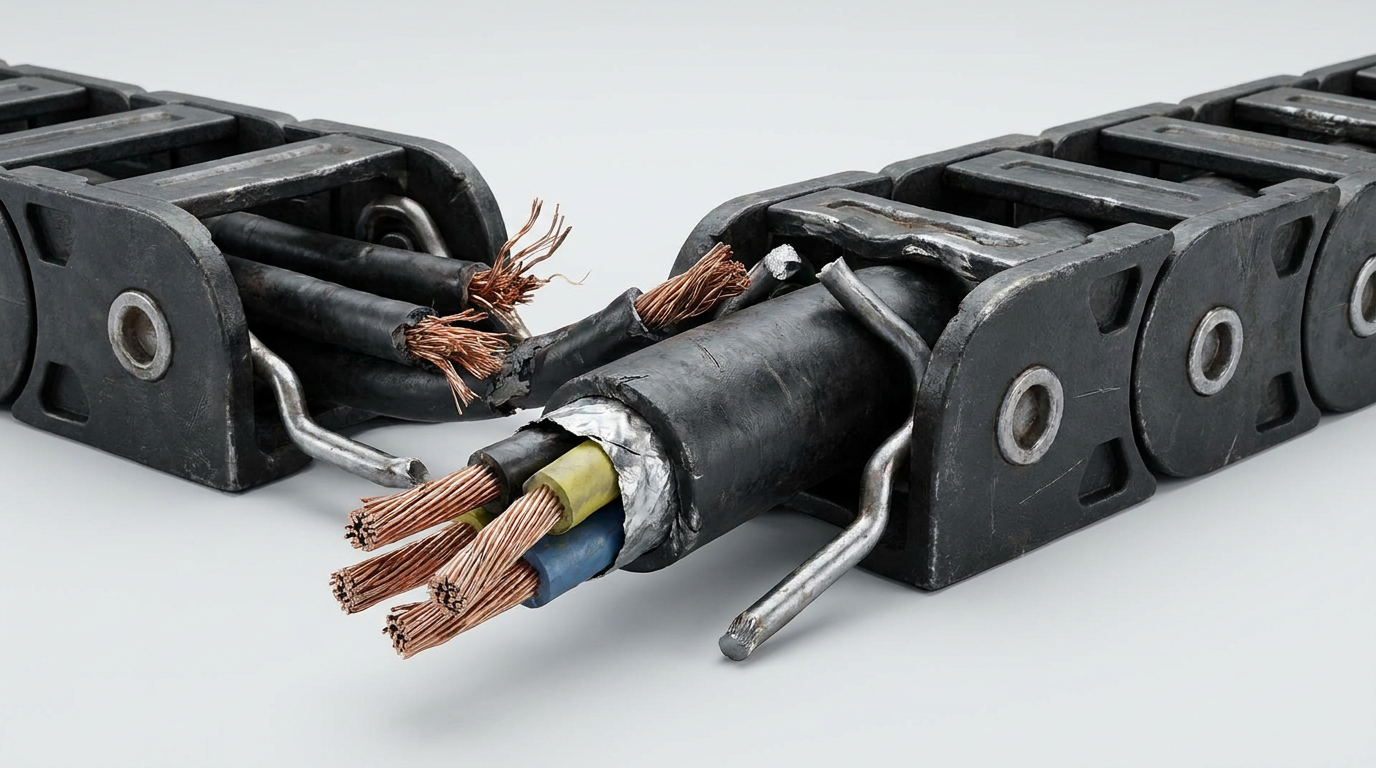
Drag chain cable failure works through repeated mechanical stress. Each machine cycle bends, pulls, compresses, and sometimes twists the cable. Over time, copper strands harden, shields loosen, jackets abrade, and insulation weakens. Once the accumulated drag chain fatigue exceeds the cable’s design limit, electrical faults or complete conductor breaks occur.
Mechanical Stress Accumulation Inside the Chain
A drag chain cable fails because dynamic motion creates repeated strain in specific cable layers. The conductor, insulation, filler, shield, and outer jacket must all move together. If one layer slides, stretches, or compresses differently, internal stress increases.
The failure process usually follows these stages:
- Repeated bending begins
The cable flexes around the chain radius during every travel cycle.
- Internal strand movement increases
Fine copper strands rub against each other and begin to harden.
- Insulation and jacket experience compression
Low-grade materials may crack, flatten, or lose elasticity.
- Shielding becomes unstable
Braids or foils can separate, reducing signal protection.
- Electrical resistance changes
Partial conductor breaks cause intermittent current or signal problems.
- Complete failure occurs
The cable may lose power, communication, feedback, or safety function.
Key mechanical factors that accelerate drag chain fatigue include:
- Bend radius smaller than the cable manufacturer’s recommendation
- Excessive chain speed or acceleration
- Cable movement without separators
- Twisting during installation
- Overfilled drag chain compartments
- Mixing hydraulic hoses, power cables, and signal cables incorrectly
- Using static cable instead of continuous-flex cable
- Operating outside rated temperature or chemical exposure limits
cwcables Pro Tip: I look for failures at the moving bend first, not just at the connector. In many machines, the conductor breaks at the point of highest repeated curvature while the terminal end still appears secure.
What are the benefits of drag chain cable failure?
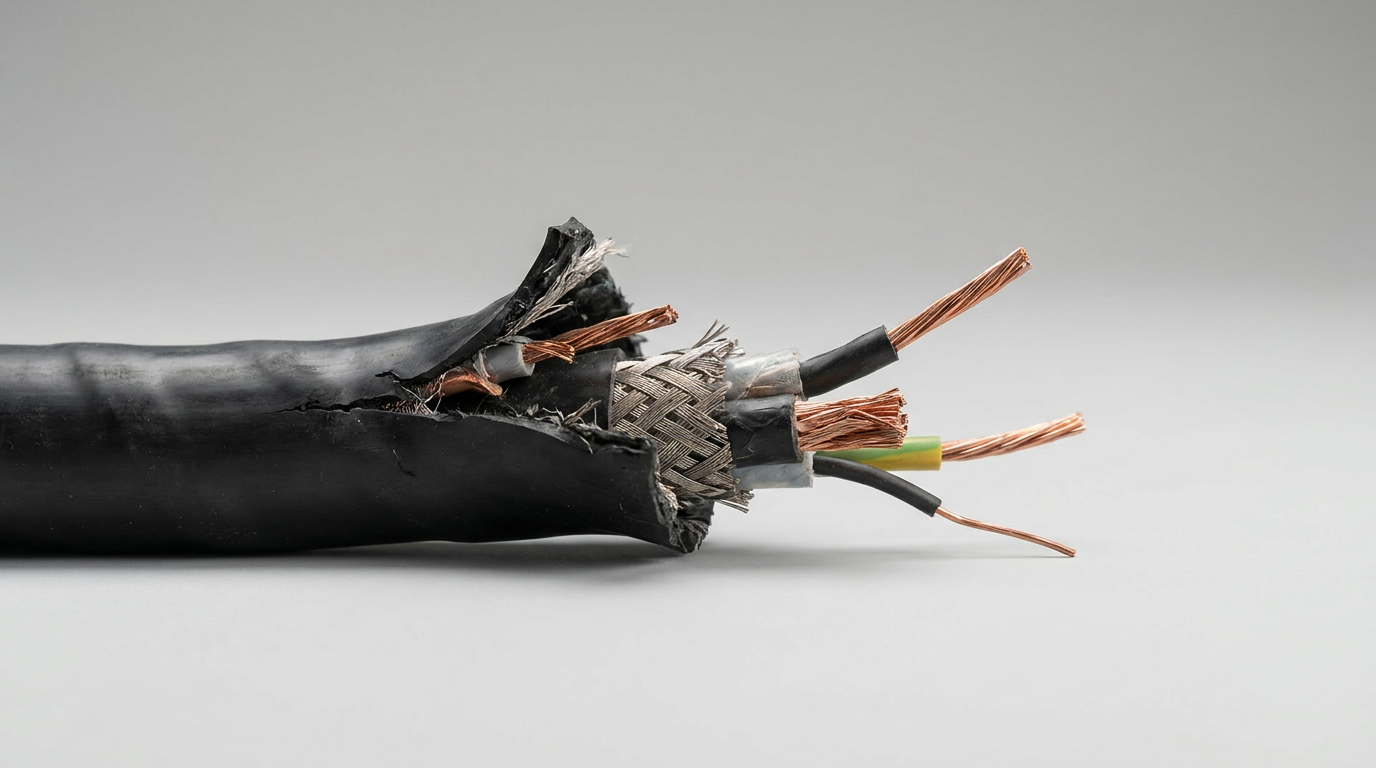
The benefit is not the failure itself, but the insight gained from analyzing it. Understanding drag chain cable failure helps engineers identify weak design points, prevent repeated downtime, choose better continuous-flex cables, improve chain layout, and reduce maintenance cost. Failure analysis turns an unexpected breakdown into measurable reliability improvement.
Reliability Lessons from Failure Analysis
Studying a failed drag chain cable gives valuable information about the machine’s motion system. A cable does not usually fail randomly; it reveals whether the installation, chain geometry, cable construction, or operating environment is unsuitable.
Benefits of proper failure analysis include:
- Better cable selection
Engineers can choose high-flex, torsion-resistant, oil-resistant, or shielded cable based on the actual motion profile.
- Reduced downtime
Early identification of broken cable conductors prevents sudden machine stoppage.
- Improved drag chain design
Separators, correct fill ratio, and proper bend radius reduce internal abrasion.
- Longer service life
Matching cable construction to cycle count extends replacement intervals.
- More stable signal transmission
Shield and conductor improvements reduce encoder, bus, and sensor faults.
- Lower total cost of ownership
Preventing repeat failures is cheaper than emergency repairs and production loss.
Based on our internal data and market analysis, here is the breakdown:
| Failure Analysis Finding | Corrective Action | Reliability Benefit |
|---|---|---|
| Broken cable conductors | Use fine-strand continuous-flex cable | Longer flex life |
| Jacket abrasion | Add separators and reduce chain fill | Lower mechanical wear |
| Signal interference | Upgrade shielded cable design | More stable communication |
| Torsional deformation | Use torsion-rated cable | Better robotic motion performance |
| Heat damage | Increase conductor size or improve routing | Safer operation |
cwcables Pro Tip: I treat every failed cable as a diagnostic report. If the break pattern is clean and localized, I check bend radius. If the cable is twisted along its length, I investigate installation tension and torsional stress.
How to maintain a drag chain cable failure?
Maintaining against drag chain cable failure means preventing fatigue before it becomes a breakdown. Regular inspection, correct chain fill, clean movement, proper bend radius, and secure strain relief are essential. Maintenance should focus on early warning signs such as jacket wear, cable twisting, intermittent faults, and abnormal chain noise.
Preventive Maintenance Checklist
Effective maintenance combines visual inspection, electrical testing, and mechanical correction. The goal is to identify drag chain fatigue before it creates broken cable conductors or insulation failure.
Recommended maintenance steps:
- Inspect the outer jacket
Look for cracks, cuts, flattening, discoloration, or abrasion marks.
- Check cable position in the chain
Cables should move freely without crossing, binding, or twisting.
- Verify bend radius
Confirm the actual chain radius meets or exceeds the cable’s minimum dynamic bend radius.
- Monitor chain fill rate
Avoid overpacking; cables need space to move independently.
- Use separators where needed
Separate power, signal, pneumatic, and hydraulic lines to prevent abrasion.
- Test electrical continuity
Check for resistance changes, intermittent opens, or shield degradation.
- Inspect strain relief
Fix cables only at approved points and avoid clamping the moving section too tightly.
- Clean the drag chain area
Remove chips, dust, oil buildup, and debris that can increase friction.
- Record cycle-related failures
Track whether faults occur at specific travel positions or machine speeds.
Maintenance frequency should increase for high-speed automation, welding robots, outdoor systems, oil-exposed environments, and applications with continuous operation.
cwcables Pro Tip: I recommend moving the machine slowly through its full travel during inspection. Many intermittent cable faults only appear at one bend position, so static testing alone can miss the real problem.
What is the price of drag chain cable failure?
The price of drag chain cable failure includes more than the cable replacement cost. It can involve machine downtime, emergency labor, lost production, damaged components, troubleshooting time, and repeated failures if the root cause remains unresolved. In many industrial systems, downtime costs far exceed the price of a proper continuous-flex cable.
Cost Components and Pricing Impact
The total cost of failure depends on the machine type, cable complexity, urgency, and production value. A simple sensor cable failure may be inexpensive to replace, while a servo, encoder, or bus cable failure in a critical automation line can be costly.
Based on our internal data and market analysis, here is the breakdown:
| Cost Factor | Low Impact Scenario | High Impact Scenario |
|---|---|---|
| Replacement cable | Standard control cable | Custom servo, encoder, or bus cable |
| Labor | Scheduled maintenance | Emergency troubleshooting |
| Downtime | Non-critical machine | Main production line stopped |
| Diagnostics | Visible jacket damage | Hidden intermittent conductor break |
| Secondary damage | No component damage | Drive, connector, or signal module affected |
| Repeat failure risk | Root cause corrected | Same chain issue remains |
Typical cost drivers include:
- Cable length and conductor count
- Shielding and EMC requirements
- Voltage and current rating
- Servo, feedback, Ethernet, or fieldbus compatibility
- Jacket material, such as PUR, PVC, or TPE
- Oil, coolant, flame, UV, or chemical resistance
- Minimum bend radius and cycle-life rating
- Connector molding or custom termination
Choosing a lower-cost cable may look attractive initially, but if it is not designed for dynamic chain movement, it can cause repeated drag chain cable failure and higher long-term expense.
cwcables Pro Tip: I advise customers to compare cable cost against one hour of machine downtime. In most automated plants, a correctly specified continuous-flex cable pays for itself quickly by preventing unexpected stoppages.
Key Features & Comparison
The key features that prevent drag chain cable failure are high-flex conductor design, abrasion-resistant jacket material, stable shielding, low-friction insulation, correct bend radius rating, and torsion control. Comparing these features helps determine whether a cable is suitable for continuous movement or likely to suffer early drag chain fatigue.
Continuous-Flex Cable Features Compared with Standard Cable
A cable used in a drag chain must be engineered for dynamic motion. Standard static cables may function during installation, but they are not built for repeated bending cycles. The difference is especially important in high-speed automation and servo applications.
Based on our internal data and market analysis, here is the breakdown:
| Feature | Standard Static Cable | Drag Chain Continuous-Flex Cable | Why It Matters |
|---|---|---|---|
| Conductor structure | Coarser strands | Fine-strand or extra-fine-strand copper | Reduces broken cable conductors |
| Insulation design | General-purpose material | Low-friction, flex-rated insulation | Limits internal wear |
| Jacket material | Basic PVC or similar | PUR, TPE, or flex-rated PVC | Improves abrasion and oil resistance |
| Shielding | Standard braid or foil | Flex-stable braid construction | Maintains EMC protection during motion |
| Bend radius | Larger static radius | Rated dynamic bend radius | Prevents over-bending damage |
| Torsion resistance | Usually limited | Available in torsion-rated versions | Supports robotics and rotating axes |
| Cycle life | Not optimized | Tested for repeated motion | Reduces drag chain fatigue |
| Application fit | Fixed wiring | Moving energy chain systems | Improves service reliability |
Important selection features include:
- Dynamic bend radius rating
- Maximum travel speed and acceleration
- Cable weight and outer diameter
- Oil, coolant, and chemical resistance
- Shield coverage and transfer impedance
- Flame-retardant or halogen-free requirements
- Compatibility with connectors and drive systems
- Manufacturer test data for flex cycles
cwcables Pro Tip: I do not select drag chain cable by voltage rating alone. The mechanical data—bend radius, strand design, jacket compound, and motion rating—usually determines whether the cable will survive in a moving chain.
Cost & Buying Factors
Buying the right cable requires balancing upfront price with lifecycle reliability. The lowest-cost cable is not always economical if it causes downtime, signal instability, or repeated replacement. Key buying factors include motion type, bend radius, conductor size, shielding, jacket material, certification needs, and environmental exposure.
Practical Buying Guide for Dynamic Cable Applications
A good purchasing decision starts with the machine’s motion profile. Before choosing a cable, define how the chain moves, how often it cycles, and what electrical function the cable must perform.
Use this buying checklist:
- Identify the application type
Power, control, servo, encoder, sensor, Ethernet, bus, or hybrid cable.
- Confirm motion requirements
Travel distance, speed, acceleration, bend radius, and expected cycle count.
- Check the operating environment
Oil, coolant, weld spatter, dust, chips, UV, moisture, temperature, or chemicals.
- Select the correct conductor design
Fine-strand copper is preferred for continuous flexing.
- Choose suitable jacket material
PUR is common for abrasion and oil resistance; TPE may suit demanding flex and temperature conditions.
- Review shielding requirements
Servo and communication cables often need stable shielding for noise protection.
- Match certifications
Consider UL, CE, RoHS, flame-retardant, or halogen-free requirements where applicable.
- Evaluate supplier support
A reliable cable supplier should help review bend radius, chain layout, and failure history.
Based on our internal data and market analysis, here is the breakdown:
| Buying Factor | Budget Risk if Ignored | Recommended Action |
|---|---|---|
| Bend radius | Premature conductor fatigue | Match cable to chain radius |
| Shield quality | Communication errors | Use flex-rated shielding |
| Jacket material | Abrasion or oil damage | Select environment-rated jacket |
| Chain fill | Cable rubbing and heat | Keep proper clearance |
| Cable type | Early failure in motion | Use continuous-flex cable |
| Supplier guidance | Wrong specification | Request application review |
cwcables Pro Tip: When customers ask for a quote, I prefer to review the machine stroke, bend radius, speed, and environment first. That prevents under-specifying the cable and helps avoid repeat failures.
Conclusion
Drag chain cable failure is usually preventable when the cable, chain, and motion profile are designed as one system. The most common causes are incorrect cable type, tight bend radius, overfilled chains, torsion, abrasion, and unmanaged fatigue. Careful selection and routine inspection greatly improve machine uptime and cable life.
Final Recommendations for Reducing Cable Breakage
A reliable drag chain system depends on both product quality and installation discipline. Even a high-quality cable can fail early if the chain is too small, the bend radius is incorrect, or the cable is forced to twist during movement.
To reduce failure risk:
- Use continuous-flex cables instead of static cables
- Confirm the minimum dynamic bend radius
- Avoid overfilling the drag chain
- Separate power, signal, and fluid lines where needed
- Prevent twisting during installation
- Use proper strain relief outside the moving section
- Inspect for abrasion, jacket cracking, and intermittent faults
- Replace cables based on condition and cycle history, not only after failure
- Work with a supplier that understands dynamic cable applications
cwcables can support cable selection for automation, robotics, CNC equipment, packaging machinery, and other moving-chain systems where reliability matters.
cwcables Pro Tip: My strongest recommendation is simple: solve the cause, not just the symptom. If a cable breaks in a drag chain, inspect the full motion system before installing the replacement.