

Choosing the right ethernet cable connector affects network reliability, installation speed, sealing performance, and long-term maintenance cost. RJ45 is common for offices and IT rooms, while an M12 Connector is preferred for industrial Ethernet, automation, robotics, transportation, and outdoor systems. This guide compares practical connector options so engineers, buyers, and installers can specify the right solution with confidence.
What is ethernet cable connector,M12 Connector?
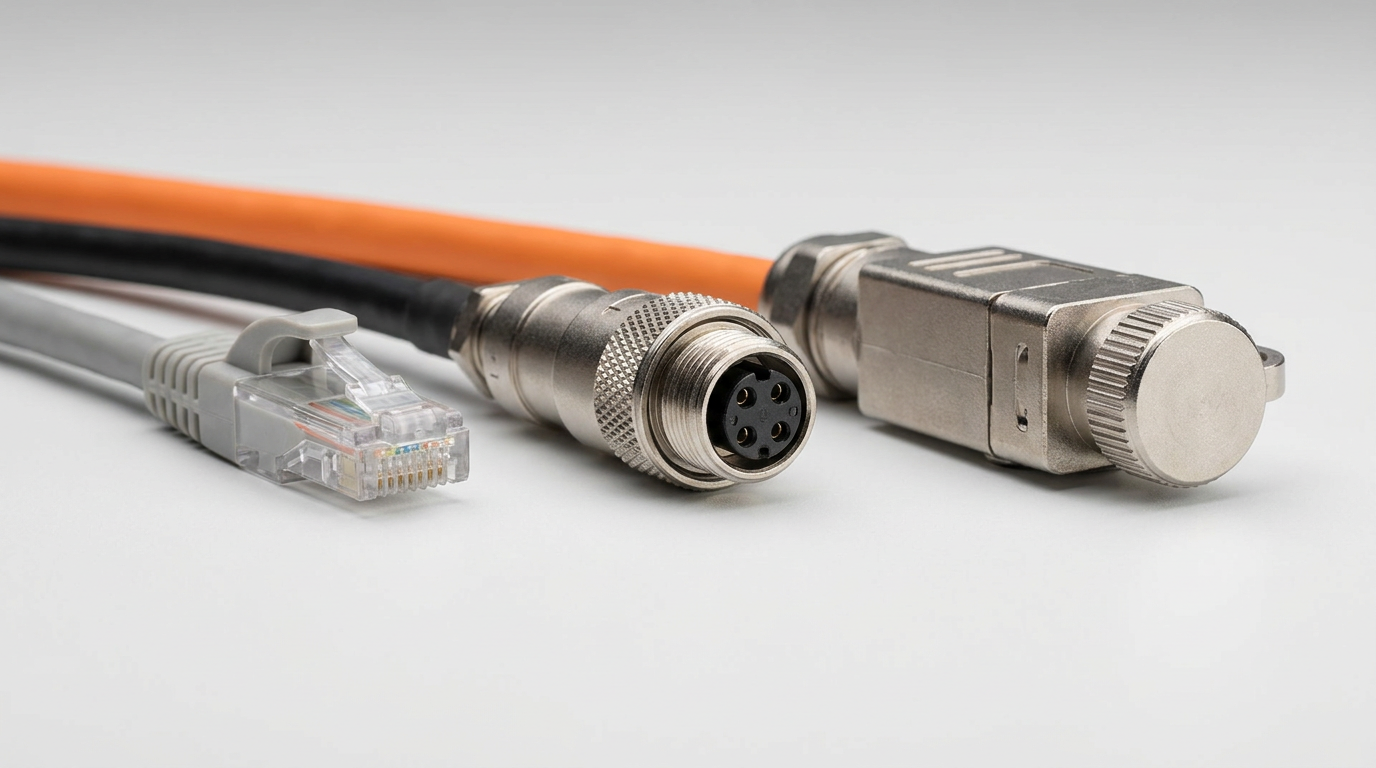
An ethernet cable connector is the termination interface that links a network cable to devices such as switches, sensors, controllers, cameras, and computers. An M12 Connector is a rugged circular Ethernet connector designed for harsh industrial environments where vibration, moisture, dust, and mechanical stress can make standard RJ45 connections unreliable.
Definition and Connector Types
An ethernet cable connector provides the physical connection point for data transmission. In commercial networks, the most recognizable option is the RJ45 plug, typically used with Cat5e, Cat6, Cat6A, and higher-grade twisted-pair cables. In industrial environments, the M12 Connector is widely used because it offers threaded locking, high ingress protection, and stronger resistance to vibration.
Based on our internal data and market analysis, here is the breakdown:
| Connector Type | Typical Use | Locking Method | Environmental Protection | Common Ethernet Role |
|---|---|---|---|---|
| RJ45 | Offices, data centers, commercial systems | Clip latch | Low to moderate | Standard LAN connection |
| Industrial RJ45 | Cabinets, factories, protected equipment | Reinforced latch or housing | Moderate | Industrial panel networking |
| M12 D-coded | Industrial Ethernet, sensors, automation | Threaded coupling | High | 100 Mbps Ethernet |
| M12 X-coded | Gigabit industrial Ethernet, cameras, machines | Threaded coupling | High | 1 Gbps to 10 Gbps applications |
| Push-pull industrial connector | High-speed field installation | Push-pull lock | Moderate to high | Fast deployment networks |
cwcables Pro Tip: I recommend using RJ45 only where the connector is protected from vibration, washdown, and repeated movement. For exposed factory equipment, machine vision, or outdoor Ethernet, I usually specify M12 because the mechanical lock is far more dependable.
How Does ethernet cable connector,M12 Connector Work?
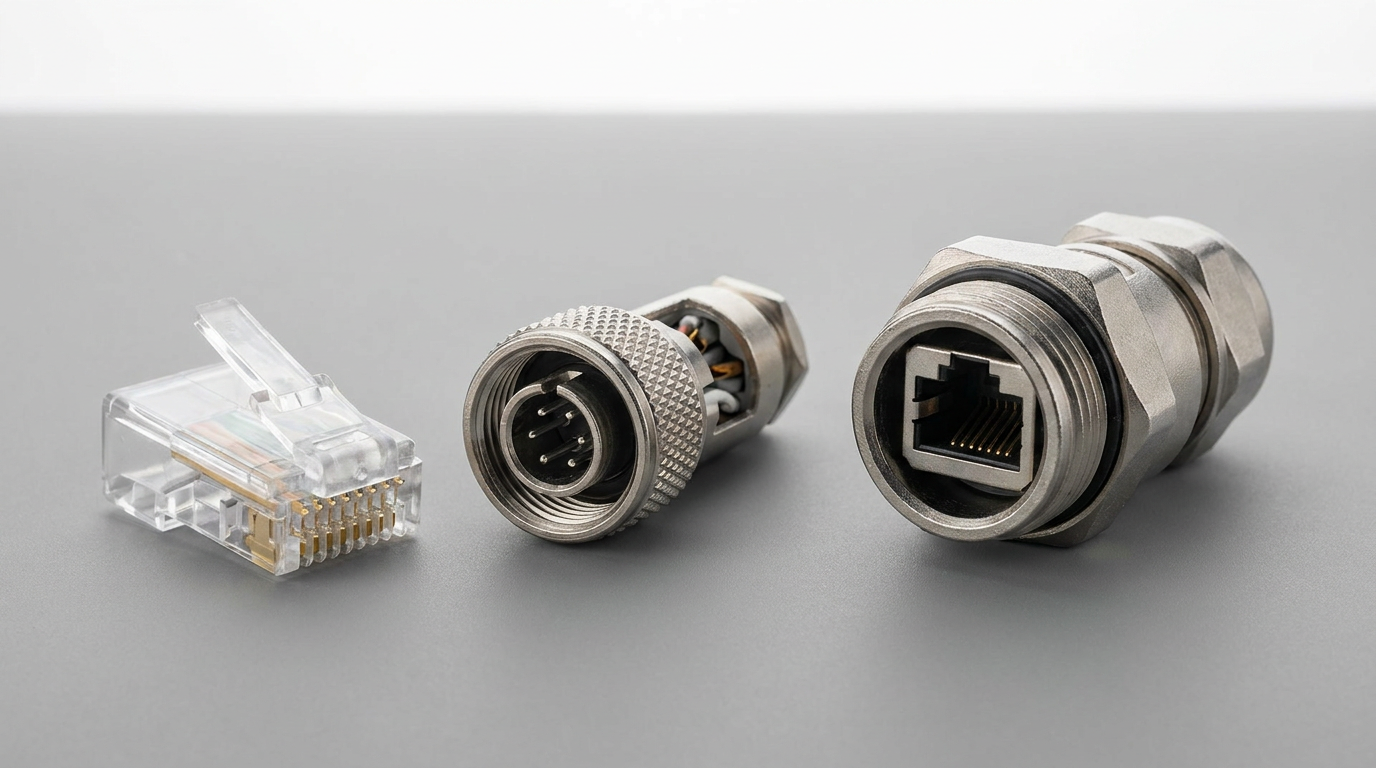
An ethernet cable connector works by aligning conductive contacts with the twisted pairs inside an Ethernet cable, allowing digital signals to pass between devices. An M12 Connector performs the same function but adds circular pin alignment, shielding continuity, and threaded mechanical locking to maintain stable communication in demanding industrial conditions.
Signal Transmission and Mechanical Locking
Ethernet connectors do more than simply “plug in.” They preserve pair alignment, impedance, shielding, and contact pressure so data signals can move with minimal interference. RJ45 connectors rely on eight contacts and a plastic latch. M12 Ethernet connectors use coded pin layouts, metal coupling nuts, and sealed housings to maintain electrical and mechanical integrity.
A typical connection process includes:
- The cable conductors are terminated to connector contacts.
- The connector mates with a matching port or receptacle.
- Contacts press together to create a low-resistance electrical path.
- Shielding connects through the shell or dedicated shield structure.
- The locking mechanism prevents accidental disconnection.
- The seal protects the interface from dust, oil, water, and vibration.
For industrial Ethernet, coding is critical. D-coded M12 connectors are commonly used for 100 Mbps Ethernet, while X-coded M12 connectors support higher bandwidth by improving pair separation and shielding performance.
cwcables Pro Tip: I always check the coding before ordering M12 Ethernet assemblies. A D-coded plug will not mate correctly with an X-coded interface, and choosing the wrong coding can limit speed or prevent installation entirely.
What are the benefits of ethernet cable connector,M12 Connector?
The main benefits of an ethernet cable connector,M12 Connector include stable data transmission, secure mating, vibration resistance, better sealing, and improved service life in harsh environments. Compared with standard RJ45, M12 is better suited for automation lines, mobile equipment, outdoor devices, washdown areas, and industrial control networks.
Practical Advantages in Industrial Networks
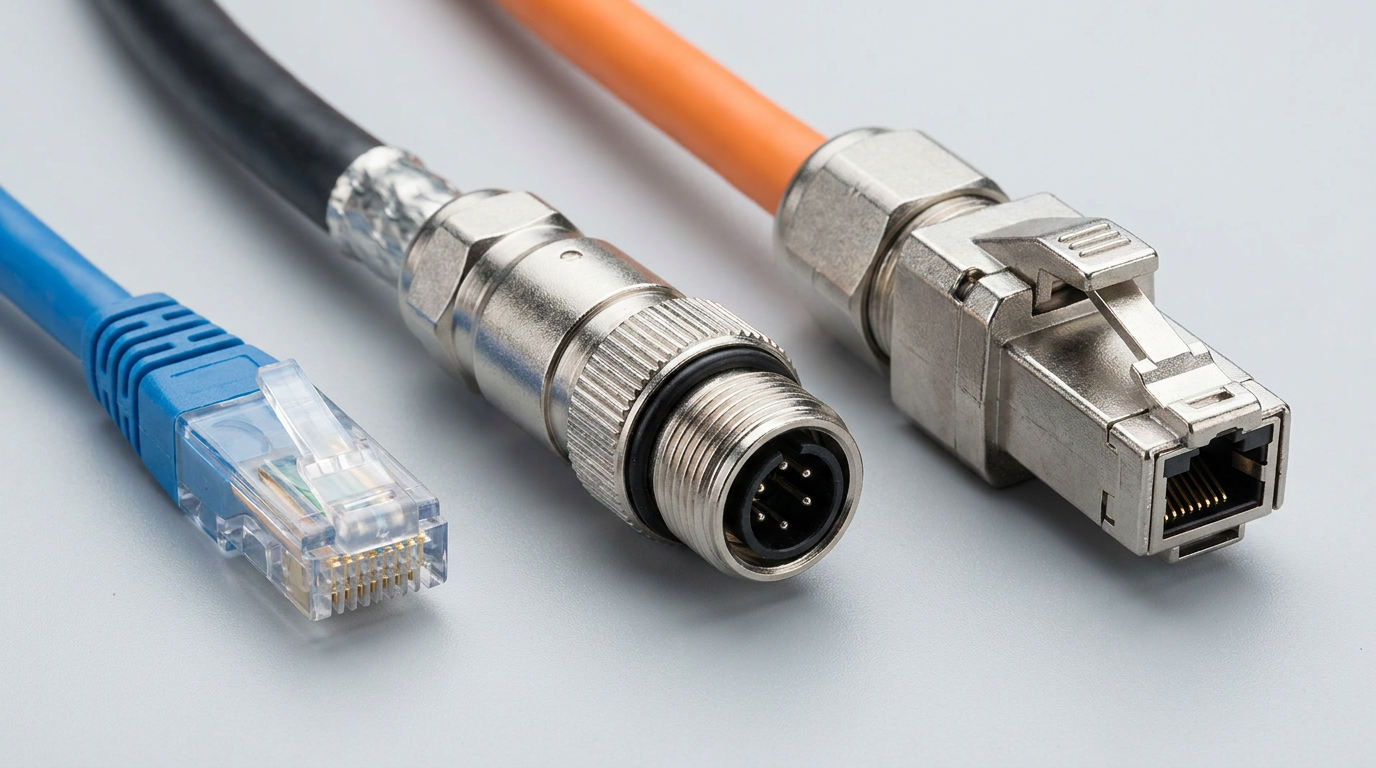
The advantage of an M12 Connector is not only electrical performance. Its real value appears when equipment is exposed to vibration, dust, liquid, frequent maintenance, and mechanical strain. The threaded coupling keeps the connector attached, while molded or shielded cable assemblies can reduce downtime caused by loose or contaminated connections.
Key benefits include:
- Improved connection security: Threaded locking resists vibration and accidental pull-out.
- Higher environmental protection: Many M12 assemblies support IP67 or higher when properly mated.
- Better mechanical durability: Circular housings handle industrial handling better than plastic latch connectors.
- Strong EMI resistance: Shielded designs help protect signal quality near motors, drives, and power cables.
- Flexible installation options: Straight, right-angle, panel-mount, and molded cable assemblies are available.
- Application-specific coding: D-coded and X-coded options support different Ethernet speed requirements.
cwcables Pro Tip: I look at the entire operating environment before choosing the connector. If there is movement, coolant, dust, vibration, or outdoor exposure, the extra cost of M12 is usually much lower than the cost of troubleshooting network faults later.
How to maintain a ethernet cable connector,M12 Connector?
To maintain an ethernet cable connector,M12 Connector, inspect the shell, contacts, seals, cable jacket, locking threads, and strain relief regularly. Keep connectors clean, dry, correctly torqued, and properly capped when unplugged. Good maintenance prevents intermittent Ethernet faults, corrosion, signal loss, and premature cable assembly failure.
Inspection and Maintenance Checklist
Maintenance should focus on both electrical and mechanical condition. Ethernet failures in the field are often intermittent, making them difficult to diagnose. Loose locking nuts, damaged seals, bent contacts, and contaminated mating faces can all create unstable communication even when the cable looks acceptable from the outside.
Use this maintenance checklist:
- Inspect the connector face: Look for bent pins, debris, corrosion, or damaged insulation.
- Check the coupling nut: Confirm that the M12 thread is fully engaged and not cross-threaded.
- Verify sealing components: Replace assemblies with cracked, flattened, or missing seals.
- Examine cable strain relief: Watch for jacket cuts, kinks, crushing, or excessive bending.
- Clean carefully: Use approved electronic contact cleaners and avoid abrasive tools.
- Cap unused ports: Protect open M12 or RJ45 ports from dust, oil, and moisture.
- Test after service: Use a cable tester or network diagnostic tool after maintenance work.
For moving machinery, inspection intervals should be shorter because flexing and vibration accelerate wear. For stationary control cabinets, visual checks during scheduled preventive maintenance are usually sufficient.
cwcables Pro Tip: I never recommend unplugging industrial Ethernet connectors unnecessarily. Every mating cycle can introduce contamination or wear, so planned inspection is better than repeated disconnection during troubleshooting.
What is the price of ethernet cable connector,M12 Connector?
The price of an ethernet cable connector,M12 Connector depends on connector type, coding, cable category, shielding, IP rating, length, jacket material, and whether it is field-wireable or overmolded. RJ45 parts are generally lower cost, while industrial M12 assemblies cost more because they provide rugged sealing and mechanical protection.
Typical Pricing Variables
Pricing varies widely because a connector is only one part of the final assembly. A simple RJ45 plug may be inexpensive, but a shielded M12 X-coded molded cable assembly with an oil-resistant jacket and IP67 protection requires more precision components and manufacturing control.
Based on our internal data and market analysis, here is the breakdown:
| Item | Typical Cost Level | Main Cost Drivers | Best Fit |
|---|---|---|---|
| Standard RJ45 plug | Low | Material, shielding, category rating | Office Ethernet |
| Shielded RJ45 connector | Low to medium | Metal shell, shield termination | EMI-sensitive LAN |
| Field-wireable M12 D-coded | Medium | Housing, contacts, sealing, labor | On-site industrial termination |
| Molded M12 D-coded cable | Medium | Cable length, jacket, IP rating | Factory automation |
| Molded M12 X-coded cable | Medium to high | High-speed design, shielding, precision | Gigabit industrial Ethernet |
| Custom industrial cable assembly | Variable | Length, jacket, wiring, certification | OEM and special equipment |
The cheapest connector is not always the lowest-cost choice. In industrial networks, downtime, replacement labor, and troubleshooting time often matter more than the connector’s purchase price.
cwcables Pro Tip: I advise buyers to compare total installed cost, not only unit price. A factory-molded M12 cable assembly may cost more upfront, but it often reduces wiring errors, service time, and field failures.
Key Features & Comparison
RJ45 and M12 Ethernet connectors serve different environments. RJ45 is compact, economical, and ideal for protected commercial networking, while M12 offers stronger locking, sealing, and vibration resistance for industrial Ethernet. The best choice depends on speed, protection level, installation conditions, maintenance access, and equipment interface requirements.
RJ45, M12, and Industrial Connector Comparison
Based on our internal data and market analysis, here is the breakdown:
| Feature | Standard RJ45 | Industrial RJ45 | M12 D-coded | M12 X-coded |
|---|---|---|---|---|
| Common Speed | 100 Mbps to 10 Gbps, depending on cable category | 100 Mbps to 10 Gbps | Typically 100 Mbps | 1 Gbps to 10 Gbps, depending on design |
| Locking Design | Plastic latch | Reinforced latch or housing | Threaded coupling | Threaded coupling |
| Vibration Resistance | Low | Medium | High | High |
| Dust/Water Protection | Limited unless enclosed | Moderate with housing | High when mated | High when mated |
| Installation Area | Office, rack, patch panel | Industrial cabinets | Field devices, sensors, controls | Cameras, high-speed automation |
| Connector Size | Compact | Medium | Compact circular | Compact circular |
| Field Serviceability | Easy | Moderate | Moderate | Moderate |
| Cost Level | Low | Medium | Medium | Medium to high |
| Best Use Case | Protected LAN | Factory cabinet networks | Rugged 100 Mbps Ethernet | Rugged high-speed Ethernet |
RJ45 remains the most practical connector where equipment is stationary, protected, and easy to access. M12 is preferred when the network connection is part of a machine, vehicle, outdoor device, or field-mounted industrial system. Industrial RJ45 can be a middle-ground option inside enclosures or protected automation panels.
cwcables Pro Tip: I choose the connector by failure risk, not habit. If the connection is inside a sealed control cabinet, RJ45 may be fine. If it is mounted on a machine frame or exposed device, I move to M12 immediately.
Cost & Buying Factors
When buying an ethernet cable connector,M12 Connector, evaluate electrical performance, cable category, connector coding, IP rating, jacket material, shielding, length, mating cycles, and supplier consistency. A reliable supplier such as cwcables can help match the connector assembly to the real operating environment, not just the datasheet requirement.
Specification Factors That Affect Cost and Reliability
A good purchasing decision starts with the application. The same connector family can include many variations, and a small specification mistake can cause compatibility problems, communication limits, or premature failure. Industrial buyers should confirm both network requirements and physical installation conditions before placing an order.
Key buying factors include:
- Ethernet speed requirement: Confirm whether the system needs 100 Mbps, 1 Gbps, or higher bandwidth.
- Connector coding: Match D-coded, X-coded, or other M12 coding to the device interface.
- Cable category: Select Cat5e, Cat6, Cat6A, or other ratings according to network speed and distance.
- Shielding requirement: Use shielded assemblies near motors, drives, welders, or high-power cables.
- Ingress protection: Choose IP67 or higher for washdown, outdoor, or dusty environments.
- Jacket material: Consider PVC, PUR, TPE, or other jackets depending on oil, abrasion, flex, and temperature.
- Cable length and routing: Avoid excessive length, tight bend radius, and unsupported hanging cable.
- Assembly type: Decide between field-wireable connectors and molded assemblies.
- Certification needs: Check application requirements such as RoHS, UL, CE, or industry-specific standards.
- Supplier support: Work with a manufacturer that can support drawings, samples, and repeatable production quality.
For OEMs and system integrators, custom cable assemblies can simplify installation and reduce wiring variation across production batches.
cwcables Pro Tip: I always ask for the mating device model, operating environment, and cable routing path before recommending a connector. Those three details prevent most selection mistakes.
Conclusion
RJ45, industrial RJ45, and M12 Ethernet connectors each have a clear role. RJ45 is cost-effective for protected networks, while M12 is the stronger choice for harsh industrial Ethernet. For reliable performance, choose the connector based on speed, environment, sealing, vibration, shielding, and long-term maintenance needs.
Final Selection Guidance
The best ethernet cable connector is the one that fits both the electrical requirement and the physical environment. RJ45 is ideal for offices, data cabinets, and protected equipment. Industrial RJ45 improves durability in controlled factory areas. M12 Connector options provide the rugged sealing and secure coupling needed for automation, transportation, robotics, machine vision, and outdoor Ethernet.
A practical selection path is:
- Use RJ45 for standard LAN, IT infrastructure, and protected indoor equipment.
- Use industrial RJ45 for cabinet-mounted or semi-protected factory networks.
- Use M12 D-coded for rugged 100 Mbps industrial Ethernet.
- Use M12 X-coded for higher-speed industrial Ethernet and demanding data applications.
- Use custom cable assemblies when installation time, repeatability, and environmental performance are critical.
cwcables can support connector selection, cable assembly design, and application-specific Ethernet connectivity for commercial and industrial projects.
cwcables Pro Tip: If you are unsure between RJ45 and M12, I recommend choosing based on the harshest condition the cable will face over its service life. Designing for the real environment is the safest way to avoid network downtime.