

In most cases, you do not need a special cable for Power over Ethernet, but you do need the right Ethernet cable quality, category, and installation practices. PoE runs power and data through the same network cable, so cable construction matters. For most homes, offices, and security camera systems, Cat5e or better is the practical standard.
What is power over ethernet cable?
A power over ethernet cable is a standard Ethernet network cable used to carry both data and electrical power to compatible devices. It is commonly used for IP cameras, VoIP phones, wireless access points, and smart building devices. The cable itself is usually Cat5e, Cat6, or better—not a completely different cable type.
Definition and Common Uses
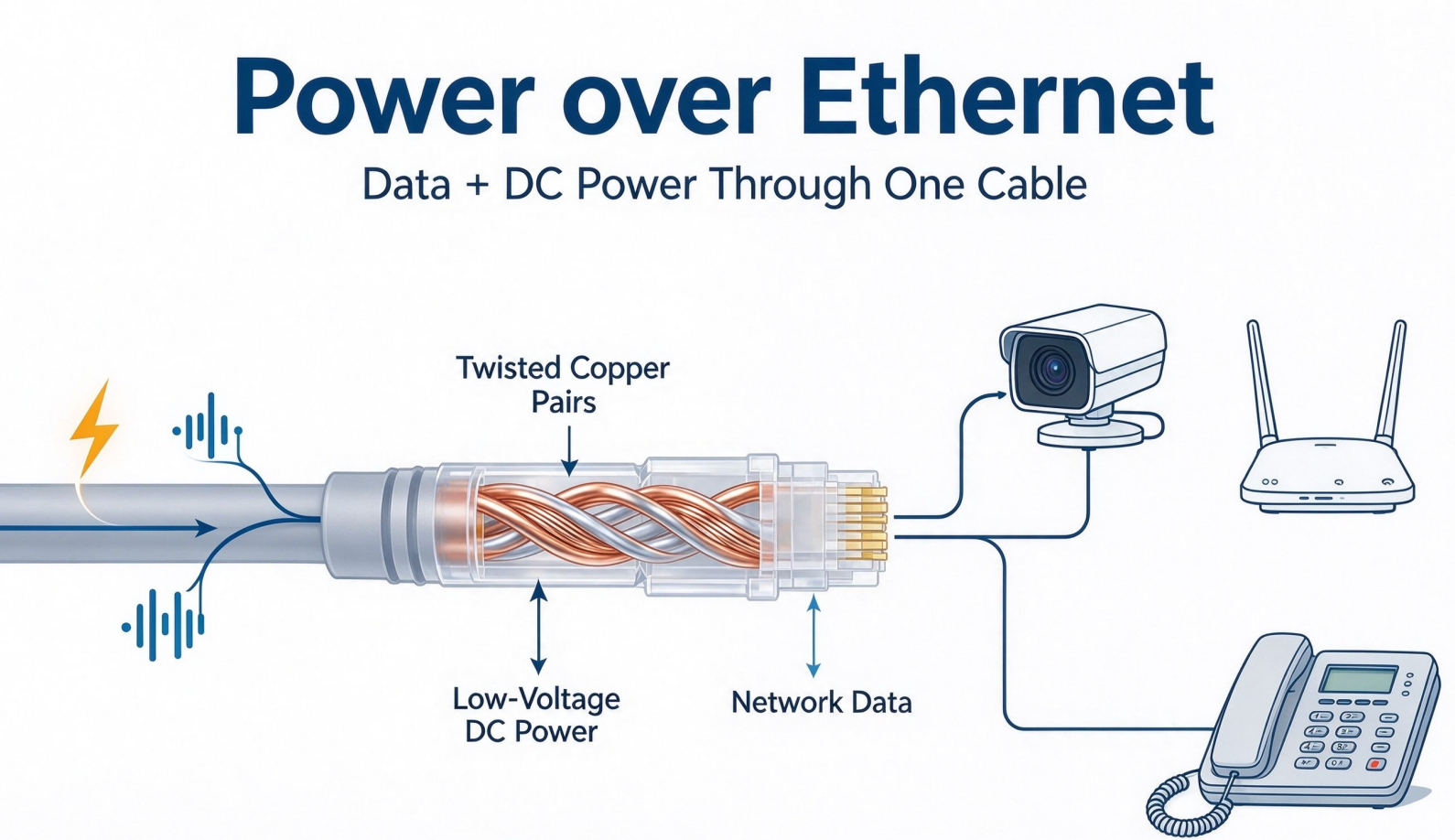
A power over ethernet cable connects PoE-enabled equipment to a PoE switch, PoE injector, or PoE-capable network device. The key idea is simple: one cable handles both network communication and low-voltage power delivery.
This reduces the need for separate power adapters near each device, which is especially helpful for ceilings, walls, outdoor camera locations, and hard-to-reach installations.
Based on our internal data and market analysis, here is the breakdown:
| Cable Type | Suitable for PoE? | Typical Use | Recommendation |
|---|---|---|---|
| Cat5 | Sometimes | Older networks, short runs | Use only for basic low-power PoE if cable quality is verified |
| Cat5e | Yes | IP cameras, phones, access points | Good baseline choice |
| Cat6 | Yes | Higher bandwidth PoE networks | Strong recommended option |
| Cat6A | Yes | High-power PoE, longer high-performance runs | Best for demanding commercial installs |
| Flat or ultra-thin Ethernet | Sometimes | Temporary or light-duty use | Avoid for high-power PoE unless rated properly |
A cat5 power over ethernet cable may work in some older installations, but Cat5e or Cat6 is generally safer and more reliable for modern PoE devices.
cwcables Pro Tip: I recommend choosing Cat6 for new PoE installations whenever budget allows. It gives you better performance headroom, lower signal loss, and stronger long-term reliability than older Cat5 cable.
How Does power over ethernet cable Work?
A power over ethernet cable works by sending low-voltage DC power and network data through the twisted copper pairs inside an Ethernet cable. The power source equipment detects whether the connected device supports PoE, then safely delivers power according to the device’s required PoE standard.
Power and Data Delivery Process
PoE is designed to be safe and controlled. A PoE switch or injector does not simply push power into every connected cable. It first checks whether the connected device is PoE-compatible, then negotiates the correct power level.
The basic process works like this:
- The PoE switch or injector connects to the Ethernet cable.
- The power sourcing equipment checks for a valid PoE device.
- If the device is compatible, power negotiation begins.
- DC power is delivered over selected wire pairs in the cable.
- Data continues to move through the cable at the same time.
- The device operates without needing a separate wall power adapter.
Modern PoE standards include IEEE 802.3af, 802.3at, and 802.3bt. These standards support different power levels, from basic VoIP phones to higher-power devices such as PTZ security cameras and Wi-Fi 6 access points.
Based on our internal data and market analysis, here is the breakdown:
| PoE Standard | Common Name | Max Power at Source | Typical Devices |
|---|---|---|---|
| IEEE 802.3af | PoE | 15.4W | VoIP phones, basic IP cameras |
| IEEE 802.3at | PoE+ | 30W | Wireless access points, advanced cameras |
| IEEE 802.3bt Type 3 | PoE++ | 60W | PTZ cameras, access controls |
| IEEE 802.3bt Type 4 | High-Power PoE | 90W+ | Lighting, displays, high-power endpoints |
cwcables Pro Tip: I always check the PoE standard of the device before selecting cable and switch hardware. A camera that needs PoE+ may not run correctly on a basic PoE port, even if the cable looks fine.
What are the benefits of power over ethernet cable?
The main benefits of a power over ethernet cable are simpler installation, fewer power adapters, centralized power management, cleaner wiring, and flexible device placement. It is especially valuable for security cameras, wireless access points, and phones because devices can be installed where network access is needed, not just where outlets exist.
Practical Advantages for Homes and Businesses
PoE is popular because it simplifies low-voltage network design. Instead of installing both electrical wiring and network cabling at every endpoint, one Ethernet cable can do both jobs when paired with compatible equipment.
Key benefits include:
- Cleaner installation: One cable instead of separate power and data wiring.
- Flexible placement: Install devices on ceilings, walls, poles, or outdoor enclosures.
- Centralized backup power: Connect the PoE switch to a UPS to keep devices running during short outages.
- Remote power control: Reboot devices from the switch without physically unplugging them.
- Lower installation complexity: Reduced need for electrical outlets near every device.
- Scalability: Add devices by expanding the network switch or patch panel layout.
For a PoE cable for security Camera installations, these benefits are especially important. Cameras are often installed in locations where outlets are unavailable or inconvenient, such as soffits, warehouses, gates, and parking areas.
Based on our internal data and market analysis, here is the breakdown:
| Use Case | Why PoE Helps | Recommended Cable |
|---|---|---|
| Security cameras | One cable for video data and power | Cat5e or Cat6 |
| Wireless access points | Ceiling mounting without local outlet | Cat6 |
| VoIP phones | Simple desk deployment | Cat5e or Cat6 |
| Access control | Centralized low-voltage power | Cat6 |
| Smart building devices | Easier expansion and control | Cat6 or Cat6A |
cwcables Pro Tip: I prefer running PoE devices back to a central switch location. It makes troubleshooting, battery backup, labeling, and future upgrades much easier than scattering power adapters around the building.
How to maintain a power over ethernet cable?
To maintain a power over ethernet cable, protect it from sharp bends, moisture, physical damage, poor terminations, and excessive heat. Regularly inspect connectors, test cable runs, confirm device power draw, and avoid overloading bundles with high-power PoE cables that may generate additional heat.

Maintenance Checklist for Reliable PoE Performance
PoE cable maintenance is mostly about preserving signal quality and safe power delivery. A well-installed cable can last many years, but poor handling or environmental exposure can cause intermittent device failures.
Use this maintenance checklist:
- Inspect connectors regularly for bent pins, corrosion, loose plugs, or damaged locking tabs.
- Avoid tight bends that can damage twisted pairs and reduce data performance.
- Use outdoor-rated cable for exterior cameras or exposed runs.
- Keep cables away from heat sources and high-voltage electrical lines.
- Label both ends of every PoE run for easier troubleshooting.
- Test long cable runs with a cable tester or certification tool.
- Check PoE budget on the switch to ensure connected devices are not drawing more power than available.
- Replace damaged patch cords rather than trying to reuse questionable cables.
Cable bundling also matters. High-power PoE can increase heat inside large cable bundles, especially in commercial installations. Using quality copper conductors and proper cable management helps reduce risk.
Based on our internal data and market analysis, here is the breakdown:
| Maintenance Area | Common Problem | Best Practice |
|---|---|---|
| Connectors | Loose or corroded contacts | Replace damaged plugs or patch cords |
| Cable jacket | Cuts, cracks, UV damage | Use correct indoor/outdoor rating |
| Bend radius | Internal conductor stress | Avoid sharp bends and tight staples |
| Cable bundles | Heat buildup | Use quality cable and avoid overpacked pathways |
| Device power | Intermittent shutdowns | Verify switch PoE budget and standard |
cwcables Pro Tip: I never ignore intermittent PoE device dropouts. They often point to a weak connector, poor termination, underpowered switch, or cable damage that should be fixed before the failure becomes permanent.
What is the price of power over ethernet cable?
The price of a power over ethernet cable depends on category, length, conductor material, shielding, jacket rating, and whether it is a patch cable or bulk cable. Cat5e is usually the lower-cost option, while Cat6, Cat6A, shielded, outdoor-rated, and pure copper cables cost more.

Pricing Factors and Typical Ranges
PoE cable pricing varies because not all Ethernet cables are built the same. A short indoor patch cable costs far less than a shielded outdoor-rated bulk cable designed for camera runs.
Based on our internal data and market analysis, here is the breakdown:
| Cable Option | Typical Relative Cost | Best For | Buying Note |
|---|---|---|---|
| Cat5e patch cable | Low | Basic PoE devices, short runs | Good value for simple installations |
| Cat6 patch cable | Medium | Cameras, APs, office networks | Better long-term choice |
| Cat6A patch cable | Higher | High-performance PoE and 10G networks | Useful for demanding environments |
| Outdoor-rated cable | Higher | Exterior cameras, exposed runs | Choose UV and weather-resistant jacket |
| Shielded cable | Higher | Electrically noisy areas | Requires proper grounding |
| Bulk solid copper cable | Varies by length | Permanent wall or ceiling runs | Preferred for structured cabling |
When comparing PoE cable vs Ethernet cable pricing, remember that PoE does not always require a special cable label. The more important factors are cable category, conductor quality, jacket rating, and whether the cable is suitable for the installation environment.
Avoid copper-clad aluminum cable for serious PoE deployments. Pure copper conductors provide better conductivity, less heat buildup, and more reliable power delivery.
cwcables Pro Tip: I would rather buy a slightly better cable once than replace a weak cable later. For PoE cameras and access points, pure copper Cat6 is usually the best balance of price, performance, and reliability.
Key Features & Comparison
A good power over ethernet cable should support stable data transmission, safe power delivery, proper distance performance, and the environment where it is installed. The most important comparison is not whether it says “PoE cable,” but whether it has the right category, conductor material, shielding, and jacket rating.
PoE Cable vs Ethernet Cable Comparison
Based on our internal data and market analysis, here is the breakdown:
| Feature | Standard Ethernet Cable | Power over Ethernet Cable Use | What to Choose |
|---|---|---|---|
| Cable category | Cat5e, Cat6, Cat6A | Same categories can support PoE | Cat5e minimum, Cat6 preferred |
| Power delivery | Not always used for power | Carries data and DC power together | Use quality copper cable |
| Device compatibility | Data-only or PoE depending on hardware | Requires PoE switch/injector and PoE device | Match device PoE standard |
| Conductor material | Copper or copper-clad aluminum | Pure copper strongly preferred | Avoid CCA for PoE |
| Distance | Up to 100 meters for Ethernet standards | Also typically up to 100 meters | Keep runs within spec |
| Shielding | Optional | Useful in noisy environments | Use shielded cable only when needed |
| Jacket rating | Indoor, riser, plenum, outdoor | Must match installation location | Outdoor cable for exterior cameras |
| Security camera use | Data connection only unless powered separately | Ideal for IP cameras | Cat5e or Cat6 outdoor-rated when exposed |
The phrase “PoE cable vs Ethernet cable” can be confusing because PoE usually uses ordinary Ethernet cable. The difference is the application and supporting equipment. If the cable is properly rated and well made, it can carry both data and power.
For a PoE cable for security Camera systems, focus on outdoor rating, copper conductors, reliable terminations, and the required PoE standard for the camera model.
cwcables Pro Tip: I check four things before approving a PoE cable: category, copper conductor, jacket rating, and run length. If those are right, most PoE problems are avoided before installation starts.
Cost & Buying Factors
When buying a power over ethernet cable, consider cable category, conductor quality, length, indoor or outdoor rating, shielding, fire rating, device power requirements, and future upgrades. The cheapest cable is not always the best value if it causes voltage drop, heat, signal loss, or early replacement.
Buying Guide for Better PoE Results
The best cable choice depends on where the cable will be installed and what device it will power. A short patch cable inside a network rack has different requirements than a 200-foot outdoor security camera run.
Use these buying factors:
- Cable category: Choose Cat5e as a minimum; Cat6 is better for new installs.
- Conductor type: Select pure copper for dependable PoE power delivery.
- Cable length: Stay within the 100-meter Ethernet limit, including patch cords.
- Jacket rating: Use riser, plenum, or outdoor-rated cable as required by code and environment.
- Shielding: Use shielded cable in high-interference areas, but ensure proper grounding.
- PoE standard: Match the cable and switch to the device’s power requirements.
- Installation type: Use solid conductor cable for permanent runs and stranded patch cable for flexible connections.
- Future growth: Consider Cat6 or Cat6A if bandwidth and power demands may increase.
Based on our internal data and market analysis, here is the breakdown:
| Buying Scenario | Recommended Choice | Reason |
|---|---|---|
| Basic indoor IP camera | Cat5e or Cat6 copper | Reliable and cost-effective |
| New office cabling | Cat6 copper | Strong performance and upgrade path |
| Outdoor security camera | Outdoor-rated Cat6 copper | Better durability and PoE reliability |
| High-power PoE device | Cat6 or Cat6A copper | Better thermal and performance margin |
| Noisy industrial area | Shielded Cat6 or Cat6A | Helps reduce interference |
| Budget temporary setup | Cat5e patch cable | Acceptable for short, low-power use |
cwcables recommends treating PoE cabling as infrastructure, not an accessory. A better cable can reduce troubleshooting time, protect device uptime, and support future network upgrades.
cwcables Pro Tip: I always buy cable based on the hardest part of the installation, not the easiest. If even one section runs outdoors, near interference, or over a long distance, the cable specification should reflect that.
Conclusion
You usually do not need a special cable for Power over Ethernet, but you do need a properly rated Ethernet cable. Cat5e can work, Cat6 is often the better choice, and pure copper conductors are strongly recommended for reliable power delivery, especially for security cameras and high-power PoE devices.
Final Recommendation
For most PoE installations, the safest practical choice is a quality Cat6 Ethernet cable with pure copper conductors. If the cable is outdoors, choose an outdoor-rated jacket. If the area has electrical interference, consider shielded cable with proper grounding.
the simple decision path:
- For basic indoor PoE devices: Use Cat5e or Cat6 copper cable.
- For new installations: Choose Cat6 for better long-term value.
- For outdoor cameras: Use outdoor-rated Cat6 copper cable.
- For high-power PoE: Use Cat6 or Cat6A and confirm switch power budget.
- For permanent cabling: Use solid copper cable and professional terminations.
- For patching: Use quality factory-made patch cables from a reliable supplier.
A power over ethernet cable is not a mysterious specialty product. It is a correctly selected Ethernet cable used with PoE-compatible equipment. For dependable results, match the cable to the device, distance, power level, and environment.
cwcables Pro Tip: If you are unsure which cable to choose, I suggest starting with Cat6 pure copper from cwcables. It covers most PoE needs well and gives you a practical balance of cost, performance, and installation confidence.