

사이에서 선택 산업용 이더넷 그리고 필드버스 is a factory architecture decision that affects speed, diagnostics, scalability, cable selection, downtime, and long-term automation costs. Industrial Ethernet is usually preferred for high-data, connected, and scalable production environments, while Fieldbus remains valuable for proven, deterministic, device-level control in legacy or cost-sensitive systems.
What is Industrial Ethernet vs Fieldbus?
Industrial Ethernet vs Fieldbus refers to the comparison between modern Ethernet-based industrial communication networks and traditional serial-based automation networks. Industrial Ethernet supports higher bandwidth, IT/OT integration, and advanced diagnostics, while Fieldbus is widely used for reliable device-level control in established PLC, sensor, actuator, and process automation systems.
Protocol Definition and Factory Role
Industrial Ethernet is an adaptation of 이더넷 technology for harsh industrial environments. It uses industrial protocols such as 프로피넷, EtherNet/IP, EtherCAT, Modbus TCP, and POWERLINK to connect PLC, drives, robots, HMIs, I/O modules, vision systems, and supervisory platforms.
Fieldbus is a family of industrial communication systems designed for connecting field devices over serial or dedicated communication networks. Common examples include PROFIBUS, CANopen, DeviceNet, FOUNDATION Fieldbus, AS-i, and 모드버스 RTU.
내부 데이터와 시장 분석을 바탕으로 분석한 내용은 다음과 같습니다.
| 범주 | 산업용 이더넷 | 필드버스 |
|---|---|---|
| 주요 목적 | High-speed industrial networking | Device-level field communication |
| 일반적인 토폴로지 | 별, 선, 고리, 나무 | Bus, trunk-and-spur, daisy chain |
| Data speed | Usually higher, from Mbps to Gbps | Usually lower, from kbps to Mbps |
| Integration | Strong IT/OT and cloud readiness | Strong PLC and field-device reliability |
| 케이블 유형 | Industrial Ethernet cable, often Cat5e/Cat6/Cat6A | Fieldbus cable, often shielded twisted pair |
| 최적의 핏 | Smart factories, robotics, motion, data-heavy systems | Legacy systems, process control, simple I/O networks |
cwcables 프로 팁: I recommend defining the communication layer before selecting cable. An Industrial Ethernet cable and a Fieldbus cable may look similar, but impedance, shielding, pair structure, and jacket design can be very different in real installations.
How Does Industrial Ethernet vs Fieldbus Work?
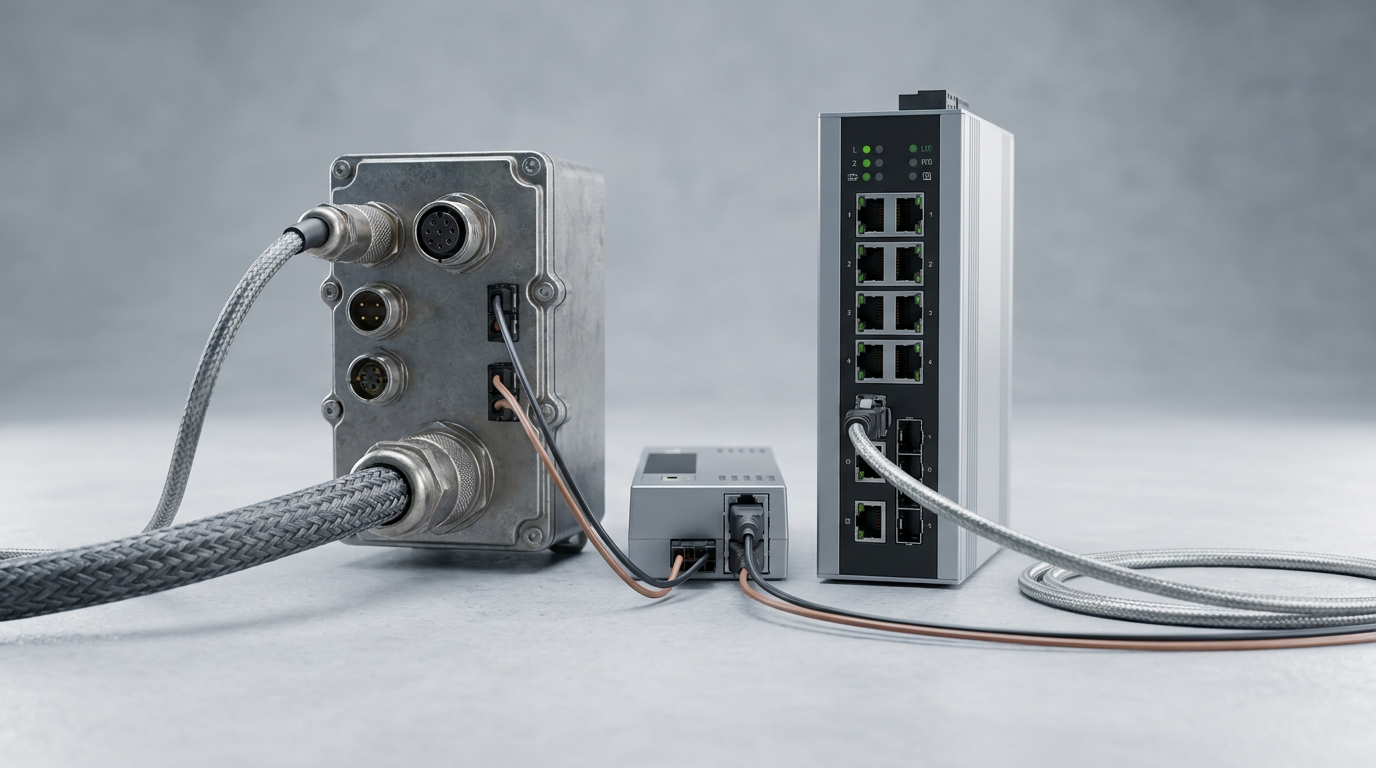
Industrial Ethernet works by transmitting industrial control data through Ethernet-based packets over ruggedized network infrastructure. Fieldbus works by sending structured device data over serial or bus-based communication lines. Both connect controllers and field devices, but they differ in bandwidth, timing method, topology, diagnostics, and integration capability.
Communication Flow in Automation Networks
Industrial Ethernet typically uses switches, managed network devices, IP addressing, and protocol-specific timing mechanisms to exchange data between PLCs, controllers, drives, sensors, and enterprise systems. Some protocols prioritize real-time traffic to support motion control and synchronized automation.
Fieldbus networks often use a master-slave, producer-consumer, or token-passing structure. Devices communicate over a shared bus or segment, which can simplify wiring but may limit total bandwidth and expansion flexibility.
A typical communication path looks like this:
- Controller sends a command to a remote I/O module, drive, valve island, or sensor node.
- Network protocol formats the data according to Ethernet-based or Fieldbus-specific rules.
- Cable and connectors transmit signals through shielded industrial cabling.
- Device receives and processes data for control, status, alarms, or feedback.
- Diagnostics return to the controller for monitoring, troubleshooting, and maintenance.
- Supervisory systems collect data when the architecture supports higher-level integration.
cwcables 프로 팁: I always check the required update time first. If your application involves synchronized motion, robots, or high-speed inspection, Industrial Ethernet is often the safer route. If it is a stable valve, sensor, or process loop network, Fieldbus may still be perfectly appropriate.
What are the benefits of Industrial Ethernet vs Fieldbus?
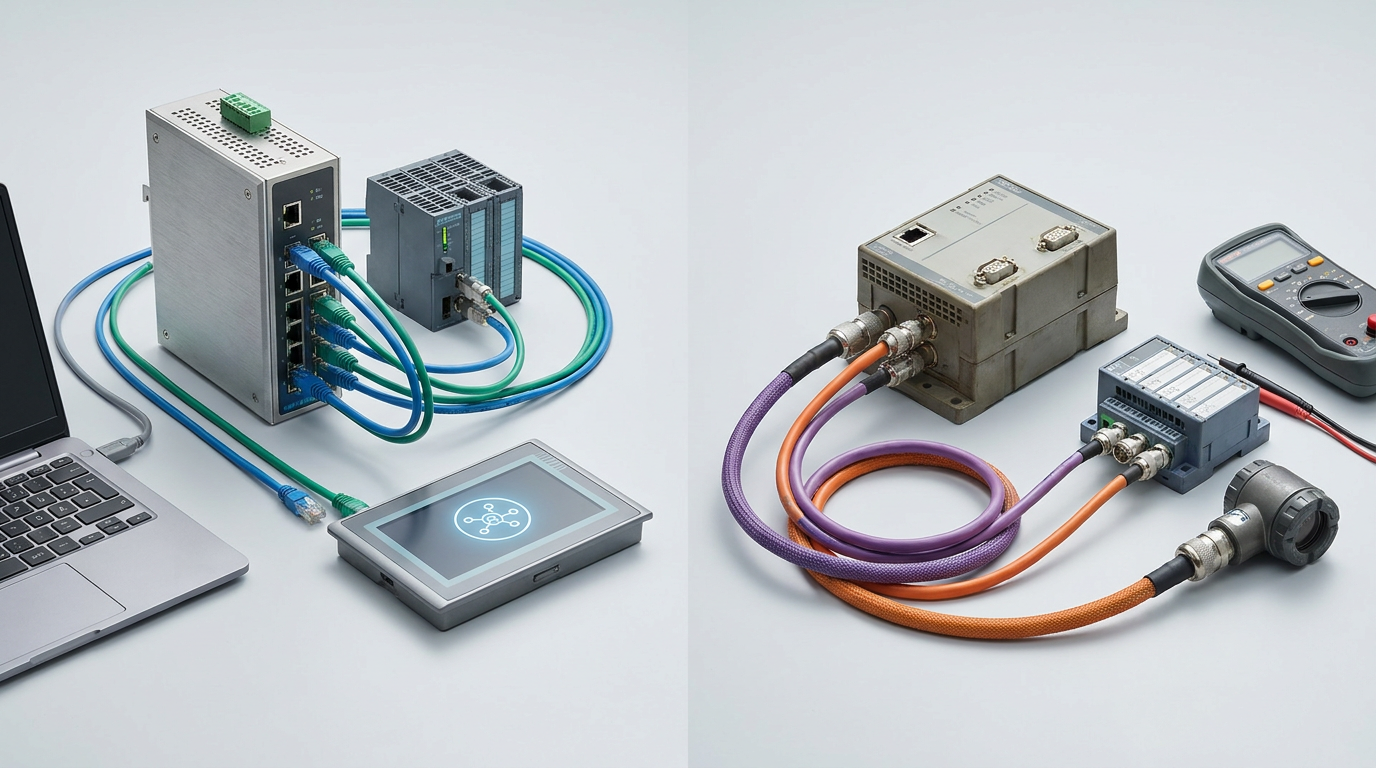
The main benefit of comparing Industrial Ethernet vs Fieldbus is selecting the network that best matches your factory’s performance, reliability, budget, and maintenance goals. Industrial Ethernet offers speed, scalability, and data visibility, while Fieldbus offers simplicity, proven reliability, and compatibility with many installed automation systems.
Practical Advantages for Factory Operations
Industrial Ethernet supports modern automation strategies because it can move more data across the plant floor and connect easily with SCADA, MES, cloud platforms, edge gateways, and predictive maintenance systems. It also provides strong diagnostic visibility when paired with managed switches and industrial network monitoring tools.
Fieldbus remains valuable because it is stable, familiar, and often easier to maintain in plants with existing PLC infrastructure. Many Fieldbus systems run for years with minimal changes, especially in process automation, packaging, material handling, and utility systems.
내부 데이터와 시장 분석을 바탕으로 분석한 내용은 다음과 같습니다.
| 혜택분야 | Industrial Ethernet Advantage | Fieldbus Advantage |
|---|---|---|
| 속도 | Higher bandwidth for complex automation | Sufficient for many device-level signals |
| 확장성 | Easier expansion through switches and IP networks | Simple segment-based expansion |
| 진단 | Rich network and device diagnostics | Reliable device status and fault codes |
| 호환성 | Strong with IIoT and smart factory systems | Strong with legacy PLCs and instruments |
| 설치 | Flexible topologies and standardized infrastructure | Simple bus wiring in many applications |
| Long-term value | Better for digital transformation | Better for extending existing assets |
cwcables 프로 팁: I suggest avoiding a “newer is always better” mindset. Industrial Ethernet is powerful, but a well-designed Fieldbus network can outperform a poorly planned Ethernet installation, especially when grounding, shielding, and cable routing are ignored.
How to maintain Industrial Ethernet vs Fieldbus?
Maintaining Industrial Ethernet vs Fieldbus requires regular inspection of cables, connectors, grounding, shielding, device diagnostics, and network configuration. Industrial Ethernet maintenance focuses more on switches, IP settings, bandwidth, and cybersecurity, while Fieldbus maintenance focuses more on segment health, termination, signal quality, and device compatibility.
Maintenance Checklist for Stable Communication
A good maintenance program prevents intermittent faults, communication dropouts, unexplained PLC errors, and costly downtime. The cable system is especially important because industrial networks are exposed to vibration, oil, heat, 전자기 간섭, flexing, washdown, and mechanical stress.
다음 유지 관리 체크리스트를 사용하세요.
- Inspect cable jackets for cuts, crushing, abrasion, chemical exposure, and excessive bending.
- 커넥터 조임 확인 on M12, RJ45, terminal block, D-sub, or circular connectors.
- Verify shielding and grounding to reduce electromagnetic interference.
- Confirm termination resistors on Fieldbus segments where required.
- Review switch status for Industrial Ethernet networks, including port errors and link speed.
- Document IP addresses and device nodes to prevent duplicate addressing or configuration conflicts.
- Test signal quality after equipment moves, cable replacement, or cabinet modifications.
- Replace marginal cables early before intermittent communication becomes unplanned downtime.
cwcables 프로 팁: I treat communication cable as a wear item in high-flex and high-vibration areas. If a robot, drag chain, or moving axis is involved, choose an Industrial Ethernet cable or Fieldbus cable rated specifically for continuous flexing.
What is the price of Industrial Ethernet vs Fieldbus?
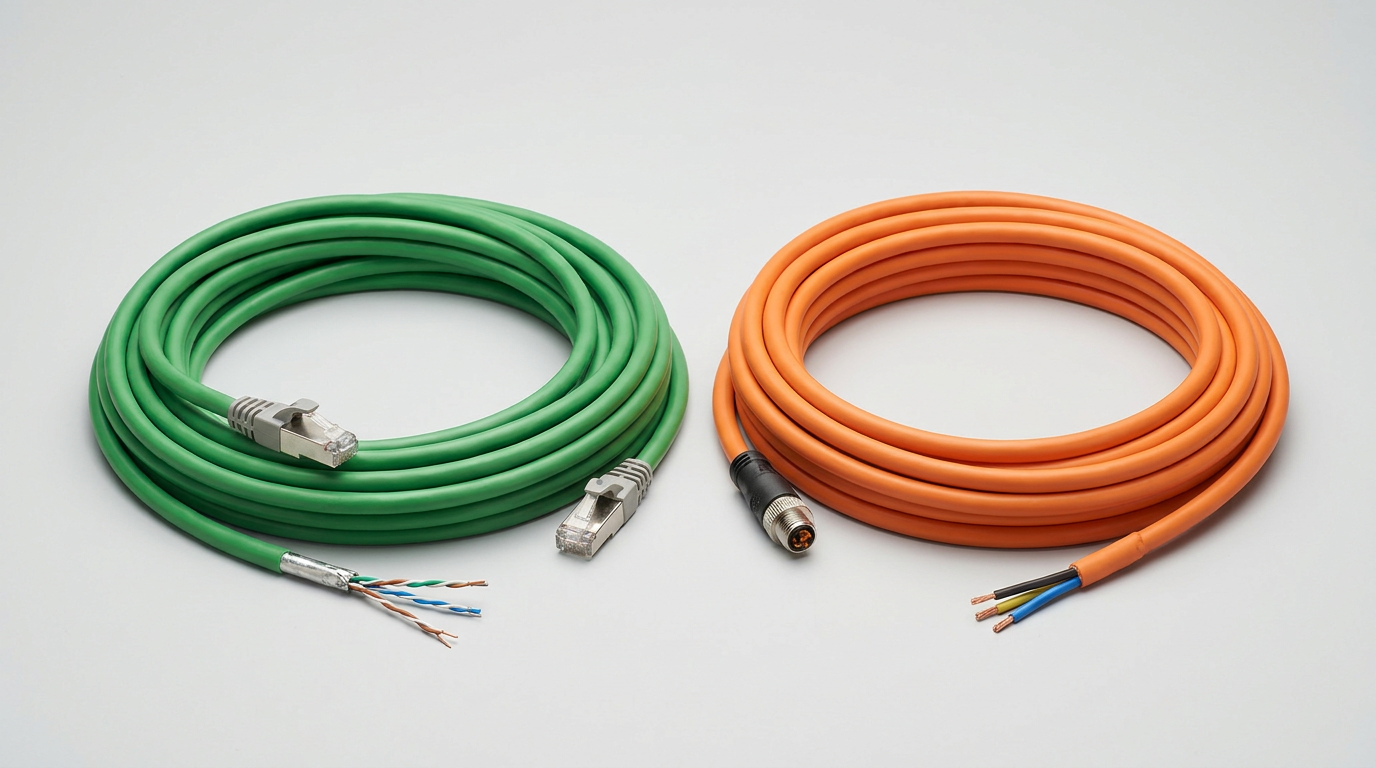
The price of Industrial Ethernet vs Fieldbus depends on cable type, protocol, connectors, device count, switches, gateways, installation labor, and certification requirements. Fieldbus can be lower-cost for simple or existing systems, while Industrial Ethernet may cost more upfront but deliver better scalability and data value over time.
Pricing Components and Budget Ranges
The network protocol itself is only one part of the total cost. A complete factory communication budget should include cables, connectors, PLC communication modules, switches, gateways, termination components, engineering time, commissioning, testing, documentation, and spare parts.
내부 데이터와 시장 분석을 바탕으로 분석한 내용은 다음과 같습니다.
| 비용 요소 | 산업용 이더넷 | 필드버스 |
|---|---|---|
| 케이블 비용 | Medium to high depending on category, shielding, and jacket | Low to medium depending on bus type and shielding |
| Connector cost | Medium, especially for rugged M12 or IP-rated connectors | Low to medium depending on connector standard |
| Network hardware | Switches, routers, media converters may be required | Fewer active devices in many bus systems |
| Engineering cost | Higher for managed networks and cybersecurity | Lower for familiar legacy architectures |
| Expansion cost | Often efficient and flexible | May require segment planning or gateways |
| Long-term ROI | Strong when data collection and scalability matter | Strong when preserving stable existing systems |
cwcables 프로 팁: I recommend comparing total installed cost, not just cable price. A cheaper cable can become expensive if it causes downtime, failed commissioning, poor shielding performance, or premature replacement.
주요 기능 및 비교
Industrial Ethernet and Fieldbus differ most in bandwidth, topology, diagnostics, scalability, timing behavior, and integration with higher-level systems. Industrial Ethernet is better for connected, data-rich, and future-ready factories, while Fieldbus is often better for stable, cost-controlled, and legacy-compatible device communication.
Side-by-Side Technical Comparison
내부 데이터와 시장 분석을 바탕으로 분석한 내용은 다음과 같습니다.
| 특징 | 산업용 이더넷 | 필드버스 | Selection Guidance |
|---|---|---|---|
| 대역폭 | High, often 100 Mbps to 1 Gbps or more | Lower, typically kbps to low Mbps | Choose Ethernet for data-heavy systems |
| Real-time performance | Strong with protocols like PROFINET IRT, EtherCAT, and EtherNet/IP CIP Motion | Strong for deterministic device-level control | Match timing needs to protocol capability |
| 토폴로지 | Star, line, ring, tree, redundant networks | Bus, trunk-and-spur, daisy chain | Ethernet offers more layout flexibility |
| 진단 | Advanced port, packet, device, and topology diagnostics | Good device and segment diagnostics | Ethernet provides broader visibility |
| Cable options | Industrial Ethernet cable, shielded Cat5e/Cat6/Cat6A, M12 or RJ45 | Fieldbus cable, shielded twisted pair, protocol-specific cable | Use protocol-rated cable, not generic cable |
| 거리 | Varies by copper/fiber and protocol | Varies by bus type, speed, and segment design | Fiber helps with long Ethernet runs |
| 내노이즈성 | Excellent with proper shielding and grounding | Excellent when segment design is correct | Installation quality matters more than label |
| Legacy compatibility | May require gateways or upgrades | Excellent in existing systems | Fieldbus is often best for brownfield plants |
| Smart factory readiness | 매우 강함 | Moderate, often via gateways | Ethernet supports IIoT strategies better |
| 일반적인 애플리케이션 | Robotics, drives, machine vision, SCADA, high-speed I/O | Sensors, valves, instruments, remote I/O, process loops | Use application criticality as the deciding factor |
Industrial Ethernet is not simply “office Ethernet used in a factory.” It requires ruggedized cable construction, industrial-grade connectors, noise-resistant shielding, and environmental protection. Likewise, Fieldbus is not outdated by default; it remains a dependable choice when the process is stable and bandwidth requirements are modest.
cwcables 프로 팁: I look at the next five years, not just today’s machine. If you expect more sensors, traceability, analytics, or remote monitoring, Industrial Ethernet usually gives you more room to grow.
비용 및 구매 요인
The best buying decision depends on the full automation environment: protocol support, cable route, EMI exposure, flexing, temperature, chemical contact, connector type, installation labor, and future expansion. Industrial Ethernet may require more planning, while Fieldbus often offers a practical path for maintaining proven systems.
How to Choose the Right Network and Cable
When buying communication cable or planning an automation network, focus on technical fit rather than protocol popularity. The right choice should support stable communication, easy maintenance, safe installation, and long service life.
다음 구매 요인을 고려하세요.
- Protocol requirement: Confirm whether your PLC, drives, I/O, and instruments require PROFINET, EtherNet/IP, EtherCAT, PROFIBUS, CANopen, DeviceNet, Modbus, or another protocol.
- 케이블 등급: Choose an Industrial Ethernet cable or Fieldbus cable designed for the actual environment, including oil resistance, UV exposure, flame rating, washdown, or outdoor use.
- 차폐 설계: Use foil, braid, or combined shielding when EMI from motors, VFDs, welders, or power cables is present.
- 플렉스 등급: Select continuous-flex cable for drag chains, robotics, moving gantries, and automated handling systems.
- 커넥터 스타일: Match M12, RJ45, terminal, D-sub, or other connector types to the device and enclosure rating.
- 설치 거리: Check maximum segment length, transmission speed, and whether copper or fiber is more appropriate.
- Future expansion: Plan spare ports, cabinet space, cable pathways, and network addressing before production starts.
- 공급업체 지원: Work with a cable supplier that understands industrial automation, not just generic data cable.
cwcables 프로 팁: I recommend sharing your protocol, machine layout, bend radius, environment, and connector needs before ordering cable. At cwcables, that information helps us guide customers toward a cable construction that fits the actual factory conditions.
결론
Industrial Ethernet is usually the stronger choice for high-speed, scalable, connected, and data-driven factories, while Fieldbus remains a dependable option for stable, device-level, and legacy-compatible automation. The best protocol is the one that meets your control requirements, environment, maintenance capacity, and long-term factory roadmap.
최종 선정 안내
The Industrial Ethernet vs Fieldbus decision should be made from both an automation and cabling perspective. A high-performance protocol can still fail if the cable is wrong, and a legacy protocol can remain highly reliable when installed correctly.
다음의 빠른 결정 경로를 사용하세요.
- Choose Industrial Ethernet if you need high bandwidth, plant-wide visibility, smart factory integration, machine vision, robotics, motion control, or easier expansion.
- Choose Fieldbus if you need reliable field-device communication, compatibility with existing PLC systems, lower upgrade disruption, or proven performance in stable production lines.
- Use gateways carefully when connecting legacy Fieldbus devices to Industrial Ethernet networks.
- Specify the correct cable based on protocol, shielding, jacket, flexibility, and environmental exposure.
- Plan for maintenance with labeled cables, documented topology, spare components, and periodic network checks.
For factories upgrading equipment or building new lines, cwcables can support the selection of Industrial Ethernet cable and Fieldbus cable options that match your protocol, installation environment, and performance goals.
cwcables 프로 팁: I advise customers to standardize cable types wherever possible. Standardization reduces spare-part complexity, speeds troubleshooting, and makes future network upgrades much easier.