

Cat5 and Cat7 cables differ mainly in speed, bandwidth, shielding, and use case. A cat5 ethernet cable is older and suitable for basic networks, while a cat7 ethernet cable is built for higher-speed, lower-noise connections in demanding environments. For most modern installations, Cat7 offers stronger performance, though Cat6a may be the more standardized alternative in some regions.
Qu'est-ce qu'un câble Ethernet cat7 ?
A cat7 ethernet cable is a high-performance paire torsadée network cable designed to support up to 10 Gbps speeds over distances up to 100 meters, with bandwidth up to 600 MHz. Compared with cat5 ethernet cable, it uses stronger shielding to reduce interference and improve signal reliability in dense or high-noise environments.
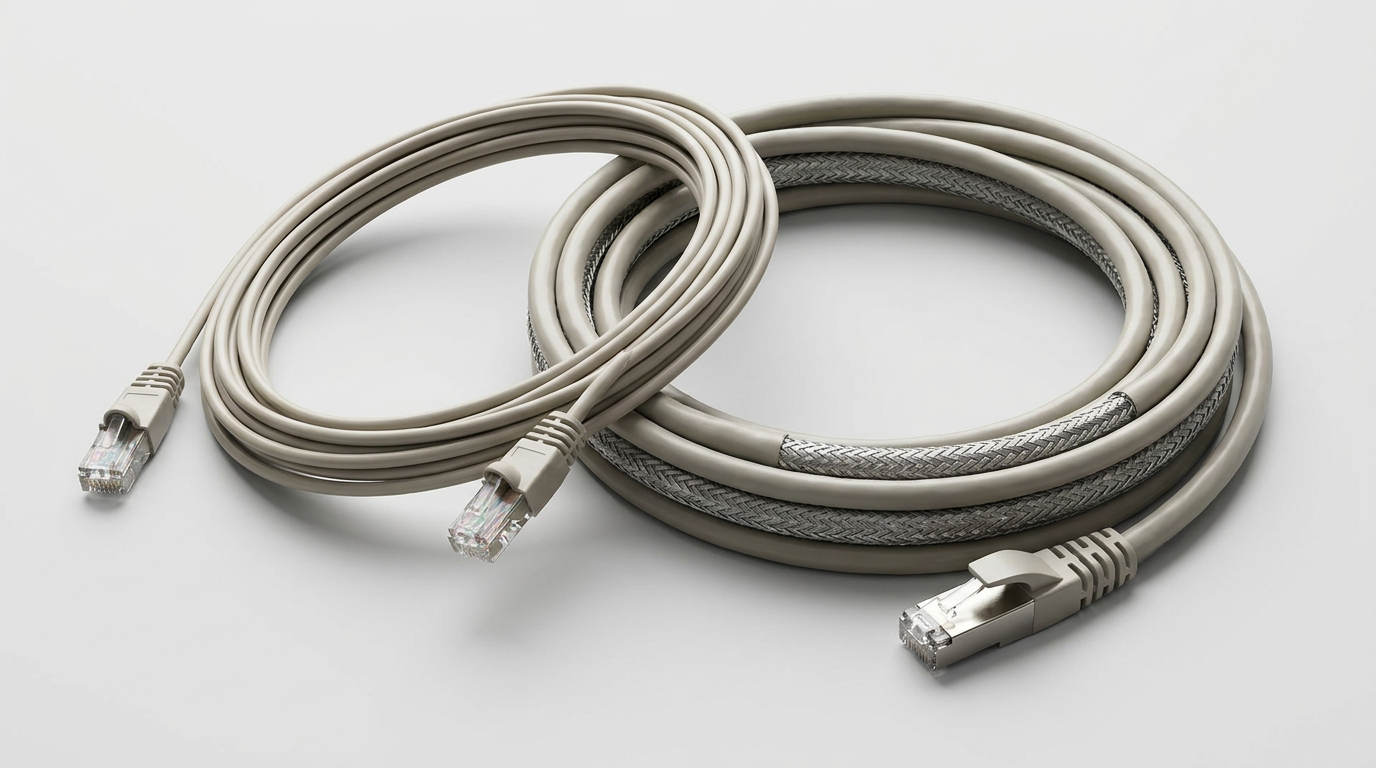
Cat7 Cable Definition and Use Cases
Cat7, also known as Category 7, is specified under ISO/IEC Class F standards. It was designed for high-speed Ethernet applications where shielding, signal stability, and bandwidth headroom matter. Unlike basic Cat5 cable, Cat7 typically uses individually shielded wire pairs plus an overall shield, often described as S/FTP construction.
Sur la base de nos données internes et de notre analyse de marché, voici la répartition :
| Fonctionnalité | Câble Ethernet Cat5 | Câble Ethernet Cat7 |
|---|---|---|
| Vitesse maximale typique | 100 Mbps officially | Jusqu'à 10 Gbit/s |
| Bande passante | Jusqu'à 100 MHz | Jusqu'à 600 MHz |
| Blindage | Généralement non blindé | Fortement blindé |
| Utilisation courante | Basic legacy networks | High-speed, interference-sensitive networks |
| Environnement d'installation | Maisons, petits bureaux | Data rooms, commercial spaces, gaming setups, media systems |
| Préparation à l'avenir | Faible | Haut |
Cat7 is often chosen for environments with many cables running together, nearby electrical equipment, or applications requiring stable throughput. However, buyers should know that many Cat7 patch cables use Connecteurs RJ45 for compatibility, even though the original Cat7 specification was associated with GG45 or TERA connectors.
Conseil de pro cwcables : I recommend Cat7 when shielding and long-term performance matter, but I always verify connector type, cable jacket rating, and real certification before buying. A cable labeled “Cat7” should clearly state its construction, shielding, and compliance details.
Comment fonctionne le câble Ethernet cat7 ?
A cat7 ethernet cable works by transmitting data through four twisted copper wire pairs while using advanced shielding to reduce interférence électromagnétique et diaphonie. This allows cleaner signals, higher bandwidth, and more reliable performance than cat5 ethernet cable, especially in installations with power cables, multiple network runs, or high-speed equipment.
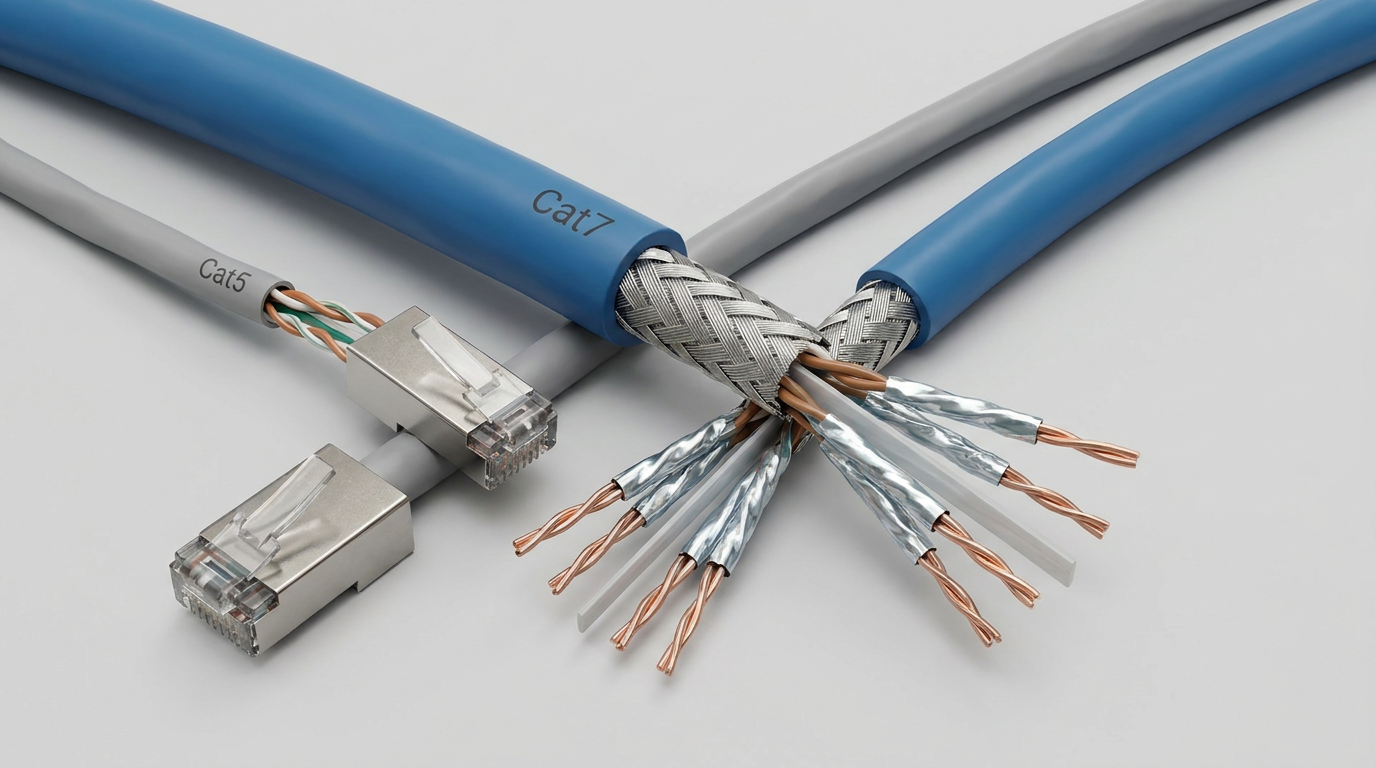
Signal Transmission and Shielding Design
Ethernet cables carry digital signals through balanced copper pairs. The twisting helps cancel noise, while shielding provides an additional layer of protection. In Cat7 cable, each pair is usually foil-shielded, and the cable may also include braided overall shielding.
This design helps maintain signal quality at higher frequencies, which is why Cat7 can support far greater bandwidth than Cat5.
Les principaux éléments de travail comprennent :
- Twisted copper pairs: Reduce internal signal interference and maintain balanced transmission.
- Pair shielding: Protects each pair from crosstalk caused by neighboring pairs.
- Overall cable shield: Blocks external electromagnetic interference from power lines, motors, lighting systems, and nearby electronics.
- Higher frequency handling: Supports up to 600 MHz bandwidth for demanding network traffic.
- Compatibilité ascendante : Most RJ45 Cat7 patch cables can connect to standard Ethernet ports, though performance depends on the entire network chain.
To achieve full 10 Gbps performance, the cable must be paired with compatible switches, routers, network cards, and properly terminated connectors. A Cat7 cable connected to a 1 Gbps router will still operate only at 1 Gbps.
Conseil de pro cwcables : I always remind buyers that the cable alone does not increase internet speed. Your router, switch, modem, network card, and service plan must all support the target speed before Cat7 performance becomes noticeable.
What are the benefits of cat7 ethernet cable?
The main benefits of cat7 ethernet cable are higher bandwidth, better shielding, stronger resistance to interference, and improved future readiness. Compared with cat5 ethernet cable, Cat7 is better suited for 10 Gbps networking, high-density cable runs, gaming, streaming, offices, and environments where consistent signal quality is important.
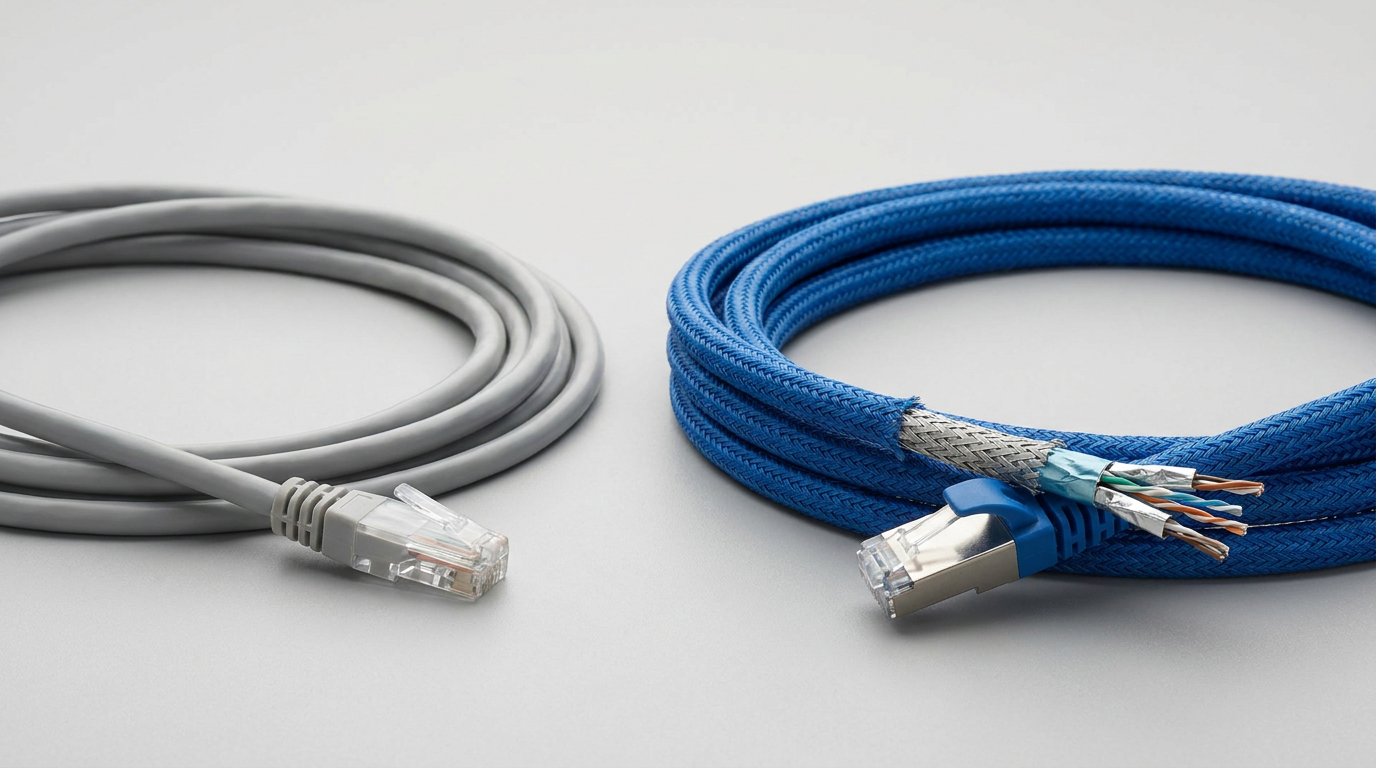
Performance Advantages in Modern Networks
Cat7 is built for more demanding network conditions than older cable categories. Its shielding is especially useful when cables are routed near electrical wiring, industrial equipment, fluorescent lighting, or many other Ethernet cables.
Benefits include:
- Higher speed capability
Cat7 can support up to 10 Gbps over 100 meters when installed correctly with compatible hardware. - Greater bandwidth
With up to 600 MHz bandwidth, Cat7 provides more frequency capacity than Cat5, Cat5e, or Cat6. - Reduced crosstalk
Shielding around each pair helps prevent signal leakage between internal wire pairs. - Improved EMI protection
External shielding helps block electromagnetic interference from nearby equipment. - Better long-term value
For users upgrading network infrastructure, Cat7 may provide more headroom for future devices and applications. - Stable performance for demanding applications
It can help with high-resolution media streaming, NAS storage, workstation networks, and low-latency setups.
| Avantage | Pourquoi c'est important |
|---|---|
| Prise en charge de 10 Gbit/s | Handles faster local networks and high-speed data transfers |
| Bande passante de 600 MHz | Provides more capacity for demanding traffic |
| Heavy shielding | Helps maintain stable signals in noisy environments |
| Lower crosstalk | Reduces packet errors and retransmissions |
| Préparation à l'avenir | Supports more advanced equipment upgrades |
Conseil de pro cwcables : I suggest Cat7 for performance-sensitive installations, but I do not recommend overspending if your network is only basic web browsing. For simple home internet, Cat5e or Cat6 may already be enough.
How to maintain a cat7 ethernet cable?
To maintain a cat7 ethernet cable, avoid sharp bends, excessive pulling, crushed jackets, moisture exposure, and poor connector handling. Because Cat7 relies heavily on shielding, proper grounding, clean terminations, and careful routing are important. Good maintenance helps preserve speed, reduce errors, and extend service life.
Care Practices for Long-Term Reliability
Cat7 cable is durable, but improper handling can reduce performance. Shielded cables are more sensitive to termination quality than unshielded cables because the shielding system must remain continuous and properly connected.
Follow these maintenance steps:
- Évitez les virages serrés : Keep the bend radius gentle to prevent conductor or shield damage.
- N'écrasez pas le câble : Avoid stapling too tightly, stepping on cables, or pinching them under furniture.
- Keep away from moisture: Use outdoor-rated or direct-burial cable if the run is exposed.
- Separate from power lines: Even shielded cable should not run tightly parallel to electrical wiring for long distances.
- Inspect connectors regularly: Loose, bent, or corroded plugs can cause speed drops and packet loss.
- Use proper cable management: Velcro ties are preferred over tight plastic zip ties.
- Test after installation: Use a network cable tester to confirm continuity, pairing, and performance.
For shielded Cat7 installations, grounding should be handled correctly. Improper grounding may reduce shielding effectiveness or introduce unwanted electrical noise. In commercial installations, follow local electrical and low-voltage cabling codes.
Conseil de pro cwcables : I never pull Cat7 cable by the connector. I pull from the jacket, keep tension controlled, and test the run after installation. Most cable problems I see come from rough handling, not from the cable itself.
What is the price of cat7 ethernet cable?
The price of cat7 ethernet cable depends on length, shielding quality, conductor material, jacket rating, connector type, and certification. Short patch cables may cost only a few dollars, while bulk or commercial-grade Cat7 cable costs more. Pure copper, certified, shielded cable is typically more expensive than basic cat5 ethernet cable.
Price Ranges and Cost Drivers
Cat7 pricing varies because not all cables sold as Cat7 are built to the same standard. The biggest price differences usually come from conductor material, shielding type, jacket rating, and whether the cable is a finished patch cable or bulk installation cable.
Sur la base de nos données internes et de notre analyse de marché, voici la répartition :
| Type de câble | Utilisation typique | General Price Expectation |
|---|---|---|
| Short Cat7 patch cable | Router, PC, console, switch | Faible coût |
| Long Cat7 patch cable | Room-to-room or rack connections | Coût modéré |
| Bulk Cat7 cable | Permanent wall or ceiling runs | Higher upfront cost |
| Outdoor-rated Cat7 | Exterior or exposed routes | Coût plus élevé |
| Pure copper certified Cat7 | Professional installations | Premium cost |
Important cost factors include:
- Longueur: Longer cables use more copper and shielding material.
- Matériau conducteur : Pure copper costs more than copper-clad aluminum, but performs better.
- Blindage : S/FTP construction is more expensive than unshielded cable.
- Évaluation de la veste : Plenum, riser, outdoor, and UV-rated jackets increase cost.
- Attestation : Verified performance and compliance usually cost more but reduce risk.
- Qualité du connecteur : Shielded RJ45 plugs and molded boots can affect price and durability.
Conseil de pro cwcables : I recommend avoiding the cheapest “Cat7” listings if they do not specify pure copper conductors, shielding type, and jacket rating. A slightly higher-quality cable often saves troubleshooting time later.
Principales caractéristiques et comparaison
Cat5 and Cat7 differ in technical capability, installation quality, and long-term usefulness. Cat5 is a legacy cable for basic networking, while Cat7 is designed for much higher bandwidth and stronger interference protection. The best choice depends on your speed requirement, equipment, budget, and installation environment.
Cat5 vs Cat7 Technical Comparison
Sur la base de nos données internes et de notre analyse de marché, voici la répartition :
| Catégorie | Câble Ethernet Cat5 | Câble Ethernet Cat7 |
|---|---|---|
| Statut standard | Older legacy category | Classe F ISO/CEI |
| Maximum speed | 100 Mbps officially | Jusqu'à 10 Gbit/s |
| Bande passante | 100 MHz | 600 MHz |
| Maximum distance for rated performance | Jusqu'à 100 m | Jusqu'à 100 m |
| Blindage | Généralement UTP | Usually S/FTP |
| Protection contre la diaphonie | Basique | Excellent |
| Résistance EMI | Limité | Fort |
| Type de connecteur | RJ45 | Often RJ45 on patch cables; GG45/TERA in original standard |
| Meilleure utilisation | Older routers, basic office networks | High-speed LAN, dense cable runs, media systems |
| Coût | Inférieur | Plus haut |
| Préparation à l'avenir | Limité | Fort |
| Acheteur type | Basic home or legacy user | Power user, installer, office, data-focused network |
Cat5 is rarely recommended for new installations because Cat5e and Cat6 are widely available and offer better performance at reasonable cost. Cat7 can be useful when interference protection is a priority, but for standards-based enterprise installations, Cat6a is also commonly considered because it supports 10 Gbps and is broadly recognized under TIA standards.
In practical terms, Cat7 is not automatically necessary for every home network. If your internet plan is under 1 Gbps and your devices do not support multi-gig speeds, the difference may not be noticeable. However, for network storage, 10 Gbps switches, content creation workflows, or electrically noisy environments, Cat7 can provide meaningful advantages.
Conseil de pro cwcables : I compare the entire network before choosing cable. If the switch ports are only 1 Gbps, Cat7 will not create 10 Gbps speeds, but it can still provide better shielding and a cleaner physical layer.
Facteurs de coût et d’achat
When buying cat7 ethernet cable, focus on verified specifications rather than the category label alone. Price should be evaluated alongside conductor quality, shielding, length, jacket rating, connector construction, and installation environment. Cat7 costs more than cat5 ethernet cable, so it makes sense when performance and interference resistance justify the upgrade.
How to Choose the Right Cable for the Budget
A smart purchase starts with matching the cable to the network goal. Paying for Cat7 makes sense for high-performance networks, but the cable must be genuine and appropriate for the installation.
Tenez compte de ces facteurs d’achat :
- Exigence de vitesse
If you only need basic internet access, Cat5e or Cat6 may be enough. If you need 10 Gbps, consider Cat7 or Cat6a. - Lieu d'installation
Use riser-rated cable for vertical in-wall runs, plenum-rated cable for air-handling spaces, and outdoor-rated cable for exterior exposure. - Besoins de protection
Choose Cat7 when cables run near electrical wiring, machinery, large cable bundles, or other interference sources. - Conductor quality
Pure copper is preferred for performance and durability. Avoid copper-clad aluminum for professional installations. - Compatibilité des connecteurs
Make sure RJ45 patch cables match your router, switch, computer, patch panel, or wall jack. - Certification and labeling
Look for clear specifications, not vague marketing claims.
| Facteur d'achat | Pourquoi cela affecte le coût | Recommandation |
|---|---|---|
| Longueur du câble | More material increases price | Buy the right length without excessive slack |
| Blindage | Adds material and labor cost | Choose S/FTP for noisy environments |
| Évaluation de la veste | Sécurité et conformité aux codes | Assortissez la veste à l'emplacement d'installation |
| Qualité du cuivre | Better conductivity and reliability | Préférez le cuivre pur |
| Attestation | Confirms performance claims | Choose verified products when possible |
| Accompagnement de la marque | Reduces purchase risk | Buy from reliable suppliers such as cwcables |
Conseil de pro cwcables : I always buy cable based on the installation environment first, then speed. The wrong jacket rating or poor shielding choice can matter more than the category number printed on the cable.
Conclusion
The main difference is that Cat5 is older, slower, and less protected from interference, while Cat7 is faster, more shielded, and better suited for high-performance networks. If you are upgrading a demanding setup, cat7 ethernet cable can be a strong choice, especially when purchased from a trusted supplier.
Final Recommendation for Choosing Between Cat5 and Cat7
Cat5 served older networks well, but it is no longer the best choice for most new installations. Cat7 offers significantly higher bandwidth, stronger shielding, and better support for modern high-speed networking. However, the right decision depends on the equipment and environment.
Use this quick guide:
- Choisir Cat5 only for legacy systems or very basic temporary connections.
- Choisir Cat5e ou Cat6 for affordable everyday home and office networking.
- Choisir Cat6a for widely standardized 10 Gbps structured cabling.
- Choisir Chat7 when shielding, bandwidth headroom, and interference resistance are top priorities.
- Choose a trusted source such as cwcables when you need clear specifications and dependable cable quality.
For buyers comparing Cat5 and Cat7, the upgrade is most valuable when your network needs more than basic connectivity. If you are building a faster, cleaner, and more future-ready network, Cat7 is the stronger technical option.
Conseil de pro cwcables : I would not install Cat5 in a new network unless there is a very specific legacy reason. For long-term value, I would choose a modern cable category that matches your speed goals, environment, and budget.