

Choosing the right moving Câble Ethernet is less about softness and more about motion rating, bend radius, blindage, and conductor life. A standard flexible cable handles occasional movement during installation or service, while a continuous flex cable is engineered for repetitive motion in chaînes de traînage, robotique, gantries, and automation systems. Understanding the difference helps prevent signal loss, jacket cracking, conductor fatigue, and unexpected downtime.
What is flexible vs continuous flex ethernet cable?
Flexible Ethernet cable is designed to bend more easily than standard cable, but it is not always built for constant motion. Continuous-flex Ethernet cable is engineered for repeated rolling, torsional, or robotic movement, using specialized conductors, jackets, and stranding to maintain network performance through millions of flex cycles.
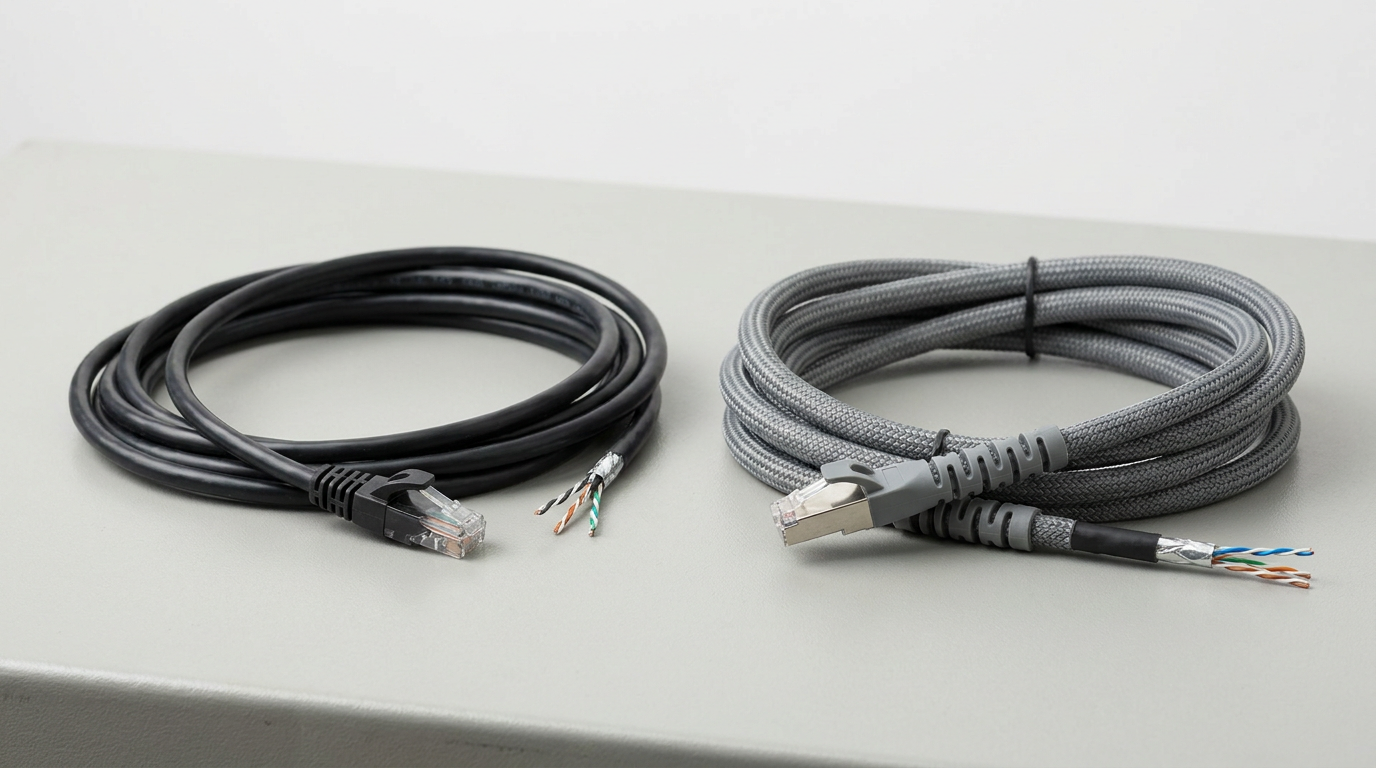
Core Definition and Application Difference
A flexible Ethernet cable is typically used where routing convenience matters: control panels, patching, equipment cabinets, portable devices, and installations that may need occasional repositioning. It offers easier handling than rigid cable but may still fail prematurely if exposed to repeated mechanical motion.
A continuous-flex Ethernet cable is built for applications where the cable moves as part of machine operation. This includes drag chains, pick-and-place robots, machine vision systems, Équipement CNC, packaging lines, and automated guided systems.
Sur la base de nos données internes et de notre analyse de marché, voici la répartition :
| Type de câble | Objectif principal | Motion Frequency | Cas d'utilisation typique | Risk if Misused |
|---|---|---|---|---|
| Câble Ethernet standard | Installation fixe | None or very rare | Office, building wiring | Conductor breakage under movement |
| Câble Ethernet flexible | Easy routing and occasional movement | Faible | Patch panels, cabinets, portable setups | Fatigue in repetitive motion |
| Continuous-Flex Ethernet Cable | Mouvements répétés de la machine | Haut | Drag chains, robots, automation | Best option for dynamic systems |
| Torsion-Rated Ethernet Cable | Twisting movement | High rotational stress | Robotic arms, rotary axes | Non-torsion cable may fail quickly |
Conseil de pro cwcables : I recommend treating “flexible” as an installation feature and “continuous-flex” as a service-life rating. If the cable moves every machine cycle, choose continuous-flex from the start.
How Does flexible vs continuous flex ethernet cable Work?
Flexible cable works by using materials and conductor designs that allow easier bending during routing. Continuous-flex cable goes further, combining fine-stranded conductors, motion-rated insulation, abrasion-resistant jackets, and optimized shielding so Ethernet data remains stable while the cable repeatedly bends, rolls, or twists.
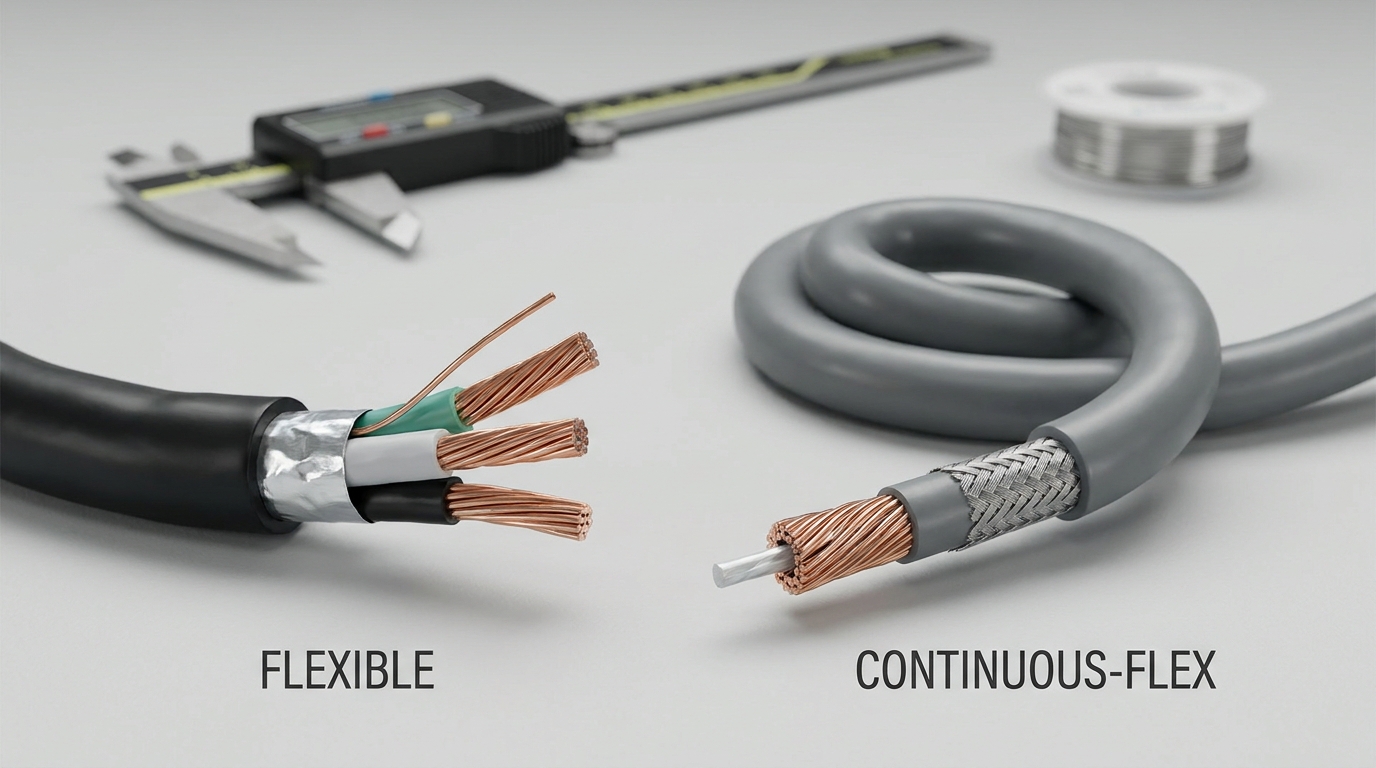
Mechanical and Electrical Working Principle
Ethernet cable performance depends on maintaining conductor geometry, impédance, shielding integrity, and pair balance. When a cable bends repeatedly, copper conductors can work-harden, insulation can deform, and shielding can separate or fracture. These changes may cause perte de paquets, intermittent connectivity, or complete conductor failure.
Continuous-flex designs reduce these risks through controlled stranding, carefully selected jacket compounds, and internal construction that distributes stress evenly.
Les principaux éléments de travail comprennent :
- Conducteurs en cuivre à brins fins reduce fatigue during repeated bending.
- Special insulation compounds help maintain pair spacing and electrical performance.
- Blindage par feuille ou tresse protects data signals in electrically noisy industrial environments.
- Low-friction jacket materials reduce wear inside cable carriers and drag chains.
- Longueur de pose optimisée helps prevent pair deformation during motion.
- Defined minimum bend radius ensures the cable is not over-stressed during operation.
Conseil de pro cwcables : I always check both the electrical category and the mechanical rating. A cable can meet Cat5e, Cat6, or Cat6A performance on paper but still be wrong for a moving axis.
What are the benefits of flexible vs continuous flex ethernet cable?
The main benefit is matching cable construction to movement severity. Flexible Ethernet cable improves handling and routing in low-motion installations, while continuous-flex Ethernet cable delivers longer service life, fewer communication faults, better uptime, and greater reliability in automated systems where cables move repeatedly.
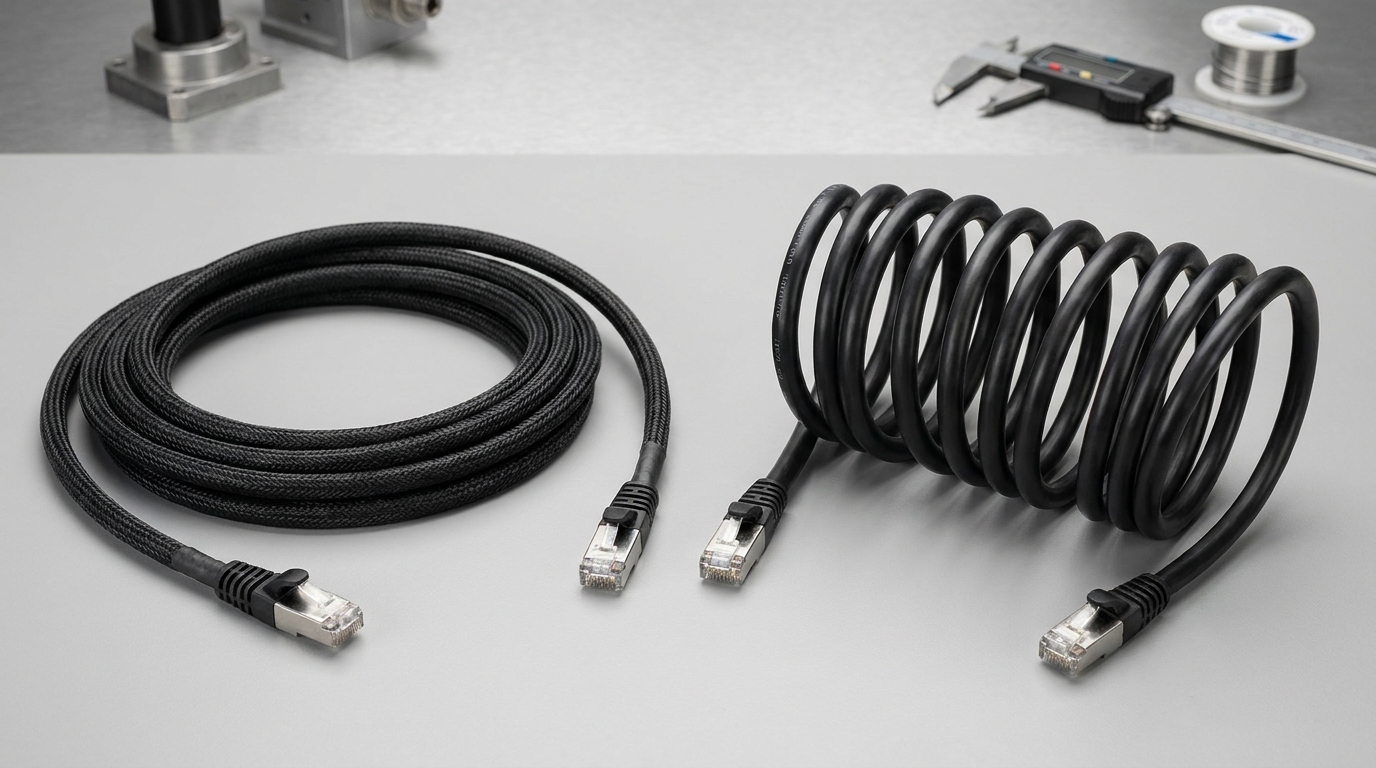
Practical Benefits by Use Environment
Selecting between flexible and continuous-flex Ethernet cable prevents both overbuying and under-specifying. Flexible cable is cost-effective when motion is occasional. Continuous-flex cable is more expensive, but it reduces replacement labor, troubleshooting time, and production interruptions in dynamic applications.
Sur la base de nos données internes et de notre analyse de marché, voici la répartition :
| Avantage | Câble Ethernet flexible | Continuous-Flex Ethernet Cable |
|---|---|---|
| Installation plus facile | Excellent | Excellent |
| Gère les flexions répétées | Limité | Excellent |
| Adéquation de la chaîne porte-câbles | Usually not recommended | Conçu pour cela |
| Long-term automation uptime | Modéré | Haut |
| Resistance to conductor fatigue | Modéré | Haut |
| Typical upfront cost | Inférieur | Plus haut |
| Best value in moving machinery | Limité | Fort |
For industrial users, the biggest benefit of continuous-flex cable is predictable performance. It helps prevent intermittent faults that are difficult to diagnose, especially in machine vision, PLC communication, servo networks, and high-speed industrial Ethernet systems.
Conseil de pro cwcables : I look at the cost of downtime before looking at cable price. In automation, one unplanned stop can cost far more than upgrading to a proper continuous flex cable.
How to maintain a flexible vs continuous flex ethernet cable?
Maintenance depends on motion exposure. Flexible Ethernet cable should be protected from sharp bends, crushing, and repeated movement. Continuous-flex Ethernet cable should be inspected for jacket wear, correct bend radius, cable carrier alignment, strain relief, and connector integrity to preserve signal quality and mechanical life.
Liste de contrôle d’inspection et de maintenance préventive
Even the best moving ethernet cable can fail early if installed incorrectly. Most failures come from over-tight bending, poor strain relief, twisting inside a drag chain, excessive tensile load, or abrasion against machine surfaces.
Utilisez cette liste de contrôle de maintenance :
- Verify bend radius: Keep the cable within the manufacturer’s recommended minimum bend radius.
- Inspectez la veste : Look for cracking, flattening, cuts, swelling, or abrasion.
- Check cable carrier alignment: Ensure the cable moves smoothly without binding or crossing over itself.
- Avoid overfilling drag chains: Crowded carriers increase friction and heat buildup.
- Confirm strain relief: Do not allow pulling force to transfer directly to connectors.
- Inspecter les connecteurs : Vérifier RJ45, M12, or industrial Ethernet connectors for looseness or corrosion.
- Monitor network errors: Packet loss, link drops, and intermittent communication may indicate cable fatigue.
- Replace damaged cables promptly: Do not wait for complete failure in critical systems.
Conseil de pro cwcables : I prefer scheduled inspection over reactive replacement. If a continuous-flex cable is in a high-cycle axis, include it in the machine’s preventive maintenance plan.
What is the price of flexible vs continuous flex ethernet cable?
Flexible Ethernet cable usually costs less because it is built for easier handling rather than high-cycle motion. Continuous-flex Ethernet cable costs more due to specialized conductors, jackets, shielding, testing, and motion-rated construction, but it often provides better lifetime value in machines that move constantly.
Facteurs de tarification typiques
Cable price varies by category rating, shielding, jacket material, conductor design, certifications, length, connector type, and flex-cycle rating. A simple flexible patch cable may be economical, while a continuous-flex Cat6A shielded cable with molded industrial connectors can cost significantly more.
Sur la base de nos données internes et de notre analyse de marché, voici la répartition :
| Facteur | Option à moindre coût | Option plus coûteuse | Pourquoi c'est important |
|---|---|---|---|
| Catégorie Ethernet | Cat5e | Cat6A or higher | Higher bandwidth and stricter electrical control |
| Blindage | PTU | F/UTP, S/FTP, braid shield | Meilleure protection EMI |
| Veste | PVC | PUR, TPE, matériaux résistants à l'huile | Better abrasion and chemical resistance |
| Évaluation du mouvement | Flexible | Flexion continue | Longer service life in movement |
| Style de connecteur | Norme RJ45 | Industriel RJ45 ou M12 | Better ruggedness |
| Cable assembly | Câble en vrac | Custom terminated assembly | Reduces field labor and errors |
In general, choose flexible cable when the application is mostly stationary. Choose continuous-flex cable when the cable is expected to bend, roll, or travel repeatedly during normal operation.
Conseil de pro cwcables : I advise customers not to compare only price per foot. Compare expected replacement frequency, machine downtime, connector labor, and troubleshooting cost.
Principales caractéristiques et comparaison
The key difference is duty cycle. Flexible Ethernet cable is easier to bend and route, while continuous-flex Ethernet cable is purpose-built for repeated motion. The right choice depends on bend frequency, environment, shielding needs, cable carrier use, and required network speed.
Feature-by-Feature Selection Table
Sur la base de nos données internes et de notre analyse de marché, voici la répartition :
| Fonctionnalité | Câble Ethernet flexible | Continuous-Flex Ethernet Cable | Meilleur choix quand |
|---|---|---|---|
| Capacité de mouvement | Mouvement occasionnel | Mouvement dynamique répété | Use continuous-flex for moving machine axes |
| Résistance à la flexion | Bien | Excellent | Continuous bending is expected |
| Flex-cycle life | Not always specified | Rated for high cycle counts | Long service life is required |
| Drag chain use | Généralement limité | Commonly supported | Cable runs inside a cable carrier |
| Conductor construction | Stranded or flexible | Fine-stranded, motion-optimized | Fatigue resistance matters |
| Durabilité de la veste | Standard à amélioré | Abrasion, oil, and motion resistant | Industrial exposure is present |
| Protection EMI | Blindage en option | Often shielded for automation | Motors, drives, or welders are nearby |
| Coût d'installation | Inférieur | Plus haut | Budget is the top priority |
| Lifetime cost | Good in static use | Better in moving systems | Downtime must be minimized |
| Applications typiques | Cabinets, panels, field patching | Robotics, CNC, packaging, conveyors | Application includes repetitive motion |
The safest selection rule is simple: if the cable only moves during installation or maintenance, flexible cable is usually enough. If the cable moves during machine operation, choose continuous-flex Ethernet cable.
Conseil de pro cwcables : I always ask one question first: “Will this cable move while the machine is running?” If the answer is yes, I start with a continuous-flex specification.
Facteurs de coût et d’achat
Buying the right cable requires balancing upfront cost with mechanical risk, electrical performance, and downtime exposure. Flexible cable is suitable for low-motion budgets, while continuous-flex cable is the better investment for automation, robotics, and any application where Ethernet communication must survive repeated movement.
Buying Criteria for Reliable Selection
Before purchasing, define the actual operating conditions. Many cable failures happen because buyers select only by Ethernet category, such as Cat6, without checking mechanical life, bend radius, or environmental resistance.
Tenez compte de ces facteurs d’achat :
- Type de mouvement : Bending, rolling, twisting, torsion, or combined movement.
- Fréquence des cycles : Occasional movement versus thousands or millions of cycles.
- Cable carrier requirements: Drag chain dimensions, fill rate, and travel distance.
- Performances du réseau : Cat5e, Cat6, Cat6A ou supérieur en fonction de la vitesse et de la bande passante.
- Besoins de blindage : Choose shielded cable near motors, VFD, welders, or high-noise equipment.
- Matière de la veste : PUR or TPE may be better for oil, abrasion, and industrial environments.
- Type de connecteur : RJ45 may work in cabinets; M12 is often preferred in rugged machinery.
- Besoins de conformité : Check UL, RoHS, CE, or application-specific standards.
- Assistance fournisseur : Work with a cable provider that understands automation environments.
For cwcables customers, the best buying decision usually starts with the machine motion profile, not just the cable category.
Conseil de pro cwcables : I recommend documenting bend radius, travel length, cycle rate, and environmental exposure before requesting a quote. That gives the supplier enough information to specify the correct moving ethernet cable.
Conclusion
Flexible Ethernet cable and continuous-flex Ethernet cable are not interchangeable in demanding motion applications. Flexible cable supports easier routing and occasional movement, while continuous-flex cable is engineered for repeated machine motion. Choosing correctly improves uptime, protects signal integrity, and reduces long-term maintenance cost.
Guide de sélection finale
Use flexible Ethernet cable for low-motion applications where convenience, routing, and cost efficiency are the main goals. Use continuous-flex Ethernet cable when the cable is part of a moving system, especially in automation, robotics, drag chains, and industrial Ethernet networks.
A simple decision guide:
- Choose flexible Ethernet cable for patching, panels, equipment cabinets, and occasional movement.
- Choose continuous-flex Ethernet cable for drag chains, robotic arms, CNC equipment, packaging lines, and moving machine axes.
- Choose shielded continuous-flex cable when motion and electrical noise are both present.
- Choose rugged industrial connectors when vibration, moisture, or mechanical stress may affect the connection.
- Consult cwcables when the application involves high cycles, tight bend radius, or harsh industrial environments.
Conseil de pro cwcables : If you are unsure, I would rather help you specify the cable before installation than troubleshoot intermittent Ethernet failures after the machine is running.