

Moving machinery needs cable chain cable that can survive repeated bending, acceleration, abrasion, and tight installation spaces without signal loss or premature conductor fatigue. Choosing the right construction, jacket, shielding, and bend radius helps prevent downtime in automation, robotique, Équipement CNC, cranes, and material-handling systems where ordinary cable often fails quickly.
What is cable chain cable?
Cable chain cable is a flexible electrical cable designed to run inside a drag chain, energy chain, or porte-câble on moving machinery. It is built with fine-stranded conductors, specialized insulation, optimized twisting, and durable jackets so it can bend repeatedly while carrying power, control, data, or signal connections reliably.
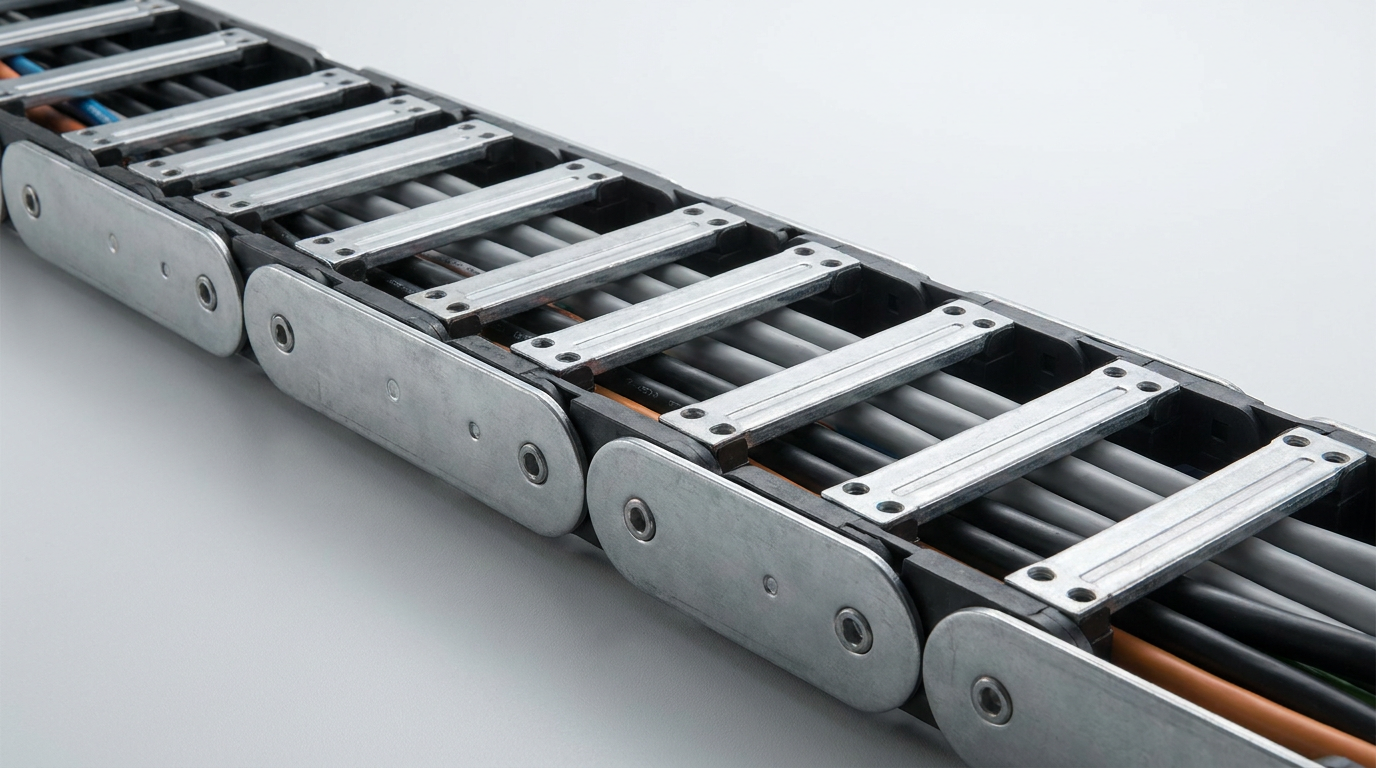
Cable Chain Cable Fundamentals
A cable chain cable is engineered for dynamic motion rather than static installation. In moving equipment, cables are repeatedly flexed along the same path. Standard cable may twist, crack, or develop conductor breakage under these conditions, while chain-rated cable is designed to distribute mechanical stress evenly.
Sur la base de nos données internes et de notre analyse de marché, voici la répartition :
| Type de câble | Meilleure utilisation | Capacité de flexion | Risque typique en cas de mauvaise utilisation |
|---|---|---|---|
| Câble standard | Câblage fixe | Faible | Conductor breakage in motion |
| Câble souple | Mouvement occasionnel | Moyen | Jacket fatigue over time |
| Câble de chaîne de câble | Continuous drag-chain motion | Haut | Lowest when correctly selected |
| Câble d'asservissement | Motors and drives | Haut | EMI issues if shielding is poor |
| Data chain cable | Communication industrielle | Haut | Signal loss if bend radius is ignored |
Cable chain cable is commonly used in robotic arms, gantry systems, machine tools, packaging lines, automated warehouses, and transfer systems. The key difference is not only flexibility, but controlled flexibility: the internal structure prevents conductors from migrating, rubbing, or compressing unevenly during millions of cycles.
Conseil de pro cwcables : I always check whether the application is continuous flex, torsion, or simple reciprocating motion before recommending a cable, because each movement pattern needs a different internal cable design.
How Does cable chain cable Work?
Cable chain cable works by moving in a controlled bend inside a cable carrier while maintaining electrical continuity. Its fine-stranded conductors, low-friction insulation, balanced lay length, shielding, and abrasion-resistant jacket reduce mechanical stress so the cable can flex repeatedly without kinking, twisting, or breaking prematurely.
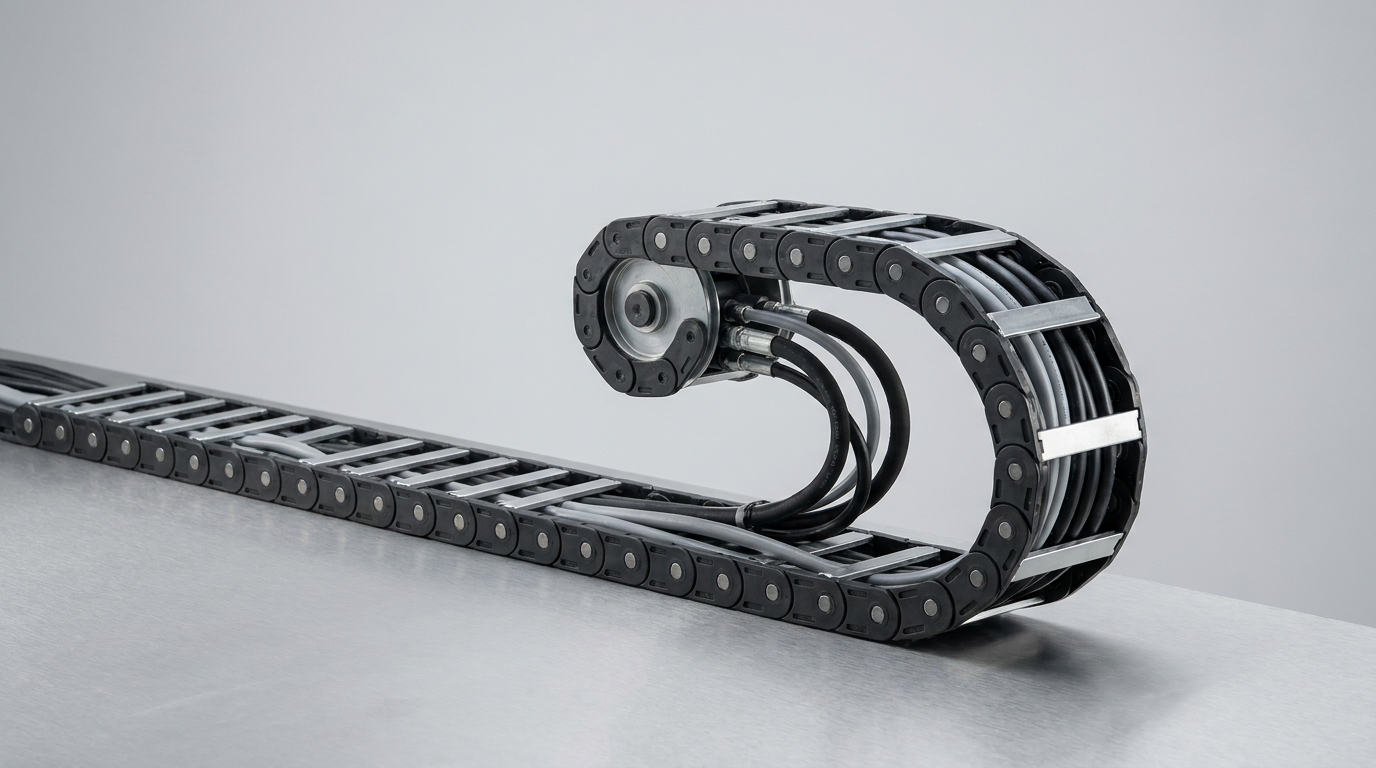
Dynamic Flexing Mechanism
Inside a cable chain, the cable travels back and forth along a guided path. The cable must bend smoothly at the chain radius while avoiding compression on the inside curve and excessive stretching on the outside curve. Proper construction keeps these forces balanced and helps extend service life.
The working process can be understood in simple steps:
- The machine axis moves and pulls the cable carrier along its travel path.
- The cable bends only within the designed radius of the chain.
- Fine copper strands flex together instead of snapping under repeated stress.
- Insulation layers reduce internal friction between conductors.
- Shielding, if present, protects signals from interférence électromagnétique.
- The outer jacket resists abrasion against the cable carrier and nearby components.
- The cable returns to its original position without permanent deformation.
Correct installation is just as important as cable construction. Cables should lie freely in the carrier, with enough clearance to move slightly but not so much space that they collide aggressively during travel.
Conseil de pro cwcables : I avoid overfilling the drag chain; even the best cable chain cable can fail early if it is squeezed tightly, twisted during installation, or forced below its minimum bend radius.
What are the benefits of cable chain cable?
The main benefits of cable chain cable are longer service life, lower downtime, stable power and signal transmission, improved safety, and better resistance to bending, abrasion, oil, and industrial environments. It helps moving machinery operate consistently while reducing maintenance costs and unexpected cable-related failures.
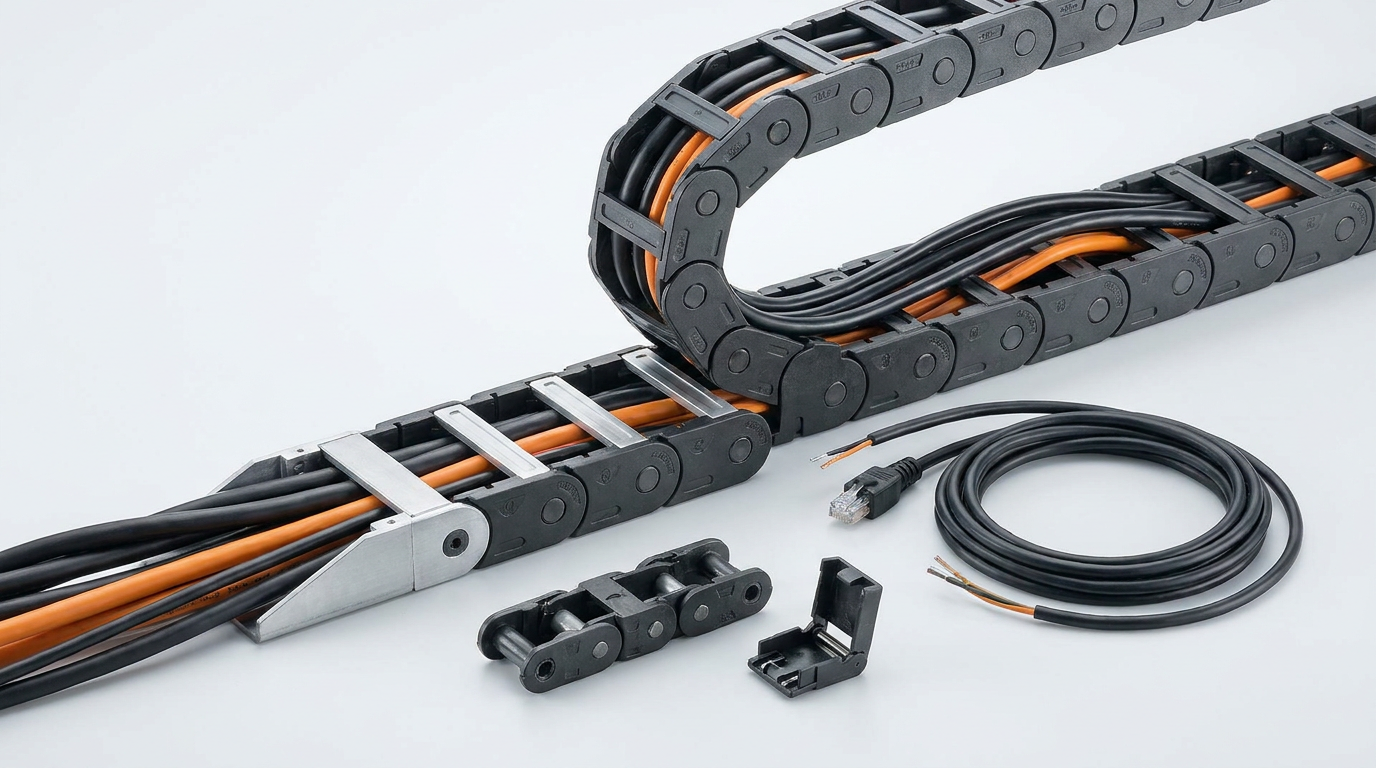
Performance Advantages in Moving Machinery
Cable failures in automation systems are expensive because they often stop production immediately. A properly selected cable chain cable reduces this risk by matching the mechanical and electrical demands of the machine.
Les principaux avantages comprennent :
- High flex life: Designed for repeated bending cycles in cable carriers.
- Reliable electrical performance: Maintains stable conductivity during continuous movement.
- Temps d'arrêt réduits : Helps prevent unexpected stops from conductor fatigue or jacket damage.
- Intégrité du signal améliorée : Shielded options support encoders, sensors, servomoteurs, and industrial networks.
- Résistance à l'abrasion : Jackets are built to withstand contact with chain separators and carrier surfaces.
- Chemical and oil resistance: Suitable options are available for harsh factory environments.
- Space efficiency: Smaller cable diameters can fit compact automation systems.
- Meilleure sécurité : Reduced risk of exposed conductors, shorts, and intermittent electrical faults.
For high-speed systems, the benefits become even more important because acceleration, deceleration, and vibration increase mechanical stress. In these applications, cable choice directly affects machine reliability.
Conseil de pro cwcables : I recommend looking beyond the purchase price and calculating downtime risk; one failed cable in a production line can cost far more than choosing the correct chain-rated cable from the start.
How to maintain a cable chain cable?
To maintain a cable chain cable, inspect the jacket, bend radius, chain fill, separators, strain relief, and connector points regularly. Look for abrasion, twisting, flattening, cracking, or intermittent signals. Preventive maintenance helps identify mechanical stress before it becomes conductor failure or machine downtime.
Inspection and Preventive Maintenance
Cable chain systems should be checked as part of routine machine maintenance, especially in high-cycle automation. Many cable problems begin gradually, showing visible signs before complete failure occurs.
Utilisez cette liste de contrôle de maintenance :
- Inspecter la gaine extérieure for cuts, cracks, flattening, swelling, or heavy abrasion.
- Vérifier le mouvement du câble inside the chain to confirm the cable can move freely without binding.
- Vérifier le rayon de courbure against the cable manufacturer’s minimum specification.
- Look for twisting along the cable length, especially near connectors and strain relief points.
- Check chain separators to ensure cables and hoses do not rub aggressively.
- Inspecter les connecteurs for looseness, contamination, corrosion, or vibration damage.
- Monitor signals for intermittent faults, encoder errors, or communication dropouts.
- Clean the chain path if chips, dust, oil sludge, or debris accumulate.
- Remplacez rapidement les câbles endommagés before they cause unplanned shutdowns.
Maintenance frequency depends on speed, stroke length, environment, and duty cycle. A high-speed gantry may need more frequent checks than a low-speed indexing system.
Conseil de pro cwcables : I mark the cable position during installation, then check later whether it has shifted or twisted; movement outside the expected path is often an early warning sign of incorrect routing.
What is the price of cable chain cable?
The price of cable chain cable depends on conductor size, core count, shielding, jacket material, voltage rating, data protocol, flex-life rating, certifications, and order quantity. Basic control cable may be economical, while servo, encoder, bus, or high-flex specialty cables usually cost more due to advanced construction.
Pricing Variables That Matter
There is no single price for cable chain cable because applications vary widely. A small sensor cable for a compact automation axis costs much less than a shielded servo cable for a high-power motor in a high-speed drag chain.
Sur la base de nos données internes et de notre analyse de marché, voici la répartition :
| Facteur de coût | Impact sur le prix | Pourquoi c'est important |
|---|---|---|
| Taille du conducteur | Moyen à élevé | Des sections de cuivre plus grandes augmentent le coût du matériau |
| Nombre de cœurs | Moyen | Plus de conducteurs nécessitent plus d'isolation et de traitement |
| Blindage | Moyen | Braided or foil shields improve EMC performance |
| Matériau de la veste | Moyen | PUR, TPE, and special compounds cost more than basic PVC |
| Évaluation de la flexibilité | Haut | Higher cycle life requires advanced design and materials |
| Certifications | Moyen | UL, CE, oil resistance, and flame ratings may add cost |
| Data performance | Haut | Ethernet, bus, and encoder cables require precise impedance control |
| Volume de commande | Variable | Larger quantities can reduce unit cost |
For budgeting, it is best to define the electrical load, movement type, travel distance, bend radius, and environment before requesting pricing. This avoids under-specifying the cable and replacing it too soon.
Conseil de pro cwcables : I always ask for the machine stroke length, chain radius, speed, and cycle rate before quoting, because those details decide whether a standard flexible cable is enough or a higher-grade cable chain cable is required.
Principales caractéristiques et comparaison
Key features of cable chain cable include fine-stranded copper conductors, high-flex insulation, optimized core layout, optional shielding, oil-resistant jackets, abrasion resistance, and controlled bend performance. Comparing these features helps determine whether a cable is suitable for control, power, servo, data, or sensor applications in moving machinery.
Comparaison des fonctionnalités pour la sélection
Cable chain cable should be selected by matching mechanical motion with electrical requirements. Power transmission, data accuracy, signal noise resistance, and environmental durability all influence the final specification.
Sur la base de nos données internes et de notre analyse de marché, voici la répartition :
| Fonctionnalité | Basic Flexible Cable | Standard Cable Chain Cable | High-Flex Cable Chain Cable | Meilleure application |
|---|---|---|---|---|
| Flex cycle capability | Faible à moyen | Haut | Très élevé | Continuous automation |
| Rayon de courbure | Plus grand | Modéré | Plus petit | Compact machine axes |
| Conception du conducteur | Standard échoué | Fin échoué | Fils extra-fins | Repeated dynamic motion |
| Durabilité de la veste | Usage général | Abrasion resistant | High abrasion and oil resistant | Harsh industrial use |
| Options de blindage | Limité | Disponible | Advanced shield designs | Servo, encoder, data lines |
| Stabilité du signal | Modéré | Bien | Excellent | Communication industrielle |
| Niveau de coût | Faible | Moyen | Plus haut | Critical moving systems |
| Durée de vie dans la chaîne porte-câbles | Limité | Long | Longest | High-cycle machinery |
When comparing options, the most important question is not simply whether the cable is flexible. The cable must be specifically rated for movement inside a chain and must match the bend radius, acceleration, and environmental exposure of the machine.
Conseil de pro cwcables : I do not judge a cable chain cable by jacket softness alone; a soft cable can still fail early if the conductor lay, shielding, and insulation system are not designed for continuous flexing.
Facteurs de coût et d’achat
When buying cable chain cable, consider motion type, cycle life, bend radius, stroke length, voltage, current, signal type, shielding, jacket material, certifications, and installation space. The right choice balances upfront cost with reliability, because underspecified cable often leads to downtime, troubleshooting, and replacement expense.
Liste de contrôle d'achat pratique
A good purchasing decision starts with the machine requirements, not just the cable size. Two cables with the same number of cores and conductor gauge may perform very differently in a moving cable carrier.
Avant de commander, confirmez :
- Type de demande : Control, power, servo, encoder, sensor, Ethernet, or bus communication.
- Motion pattern: Linear travel, torsion, robotic movement, vertical movement, or high-speed reciprocation.
- Rayon de courbure minimum : Must match both the cable and cable carrier design.
- Durée du voyage : Longer travel may require special support or gliding chain designs.
- Vitesse et accélération : High dynamics require higher flex performance.
- Environnement: Oil, coolant, weld spatter, UV, chemicals, temperature, or abrasion exposure.
- Exigence de blindage : Essential for sensitive signals, drives, and communication cables.
- Besoins de conformité : UL, CE, RoHS, flame retardancy, or machine-specific standards.
- Compatibilité des connecteurs : Confirm outer diameter, termination method, and strain relief.
- Lead time and quantity: Custom cables may need planning for production schedules.
A reliable supplier should help interpret these requirements and recommend a cable construction that fits the machine instead of offering only the cheapest option.
Conseil de pro cwcables : I recommend sharing photos or drawings of the cable chain layout when requesting support, because routing details often reveal risks that are not obvious from an electrical specification alone.
Conclusion
Cable chain cable is essential for moving machinery because it protects power, control, and data connections from repeated flexing stress. By choosing the right flex rating, jacket, shielding, bend radius, and installation method, manufacturers can improve machine uptime, reduce maintenance, and extend cable service life.
Guide de sélection finale
The best cable chain cable is the one matched to the complete operating condition. Electrical ratings matter, but mechanical movement is usually what determines service life in drag-chain applications.
For a reliable selection, focus on these final points:
- Confirm the cable is designed for continuous movement in a cable carrier.
- Match the minimum bend radius to the chain design.
- Select shielding for servo, encoder, VFD, and communication applications.
- Choose jacket material based on oil, abrasion, temperature, and chemical exposure.
- Avoid overfilling the cable chain.
- Use proper separators and strain relief.
- Inspect the system regularly after installation.
- Work with a supplier that understands moving machinery applications.
For projects involving automation, robotics, CNC systems, packaging equipment, or material handling, cwcables can help identify cable chain cable options suited to your operating conditions and performance expectations.
Conseil de pro cwcables : I treat cable chain cable as a reliability component, not just a wiring item; when the cable is correctly specified and installed, the entire moving system becomes more predictable and easier to maintain.