

Choosing between 24 AWG and 26 AWG Cat5e cable comes down to distance, flexibility, installation type, and power requirements. In general, 24 AWG Cat5e is better for permanent runs, longer links, and PoE, while 26 AWG Cat5e is better for short patch cords where flexibility and easier cable management matter most.
What is 24 awg vs 26 awg cat5e,cat5e conductor size,cat5e wire gauge?
24 AWG vs 26 AWG Cat5e describes the conductor thickness inside the Ethernet cable. In the AWG system, a smaller number means a thicker copper conductor. Therefore, 24 AWG cat5e has larger conductors than 26 AWG Cat5e, giving it lower resistance, better long-distance performance, and stronger PoE support.
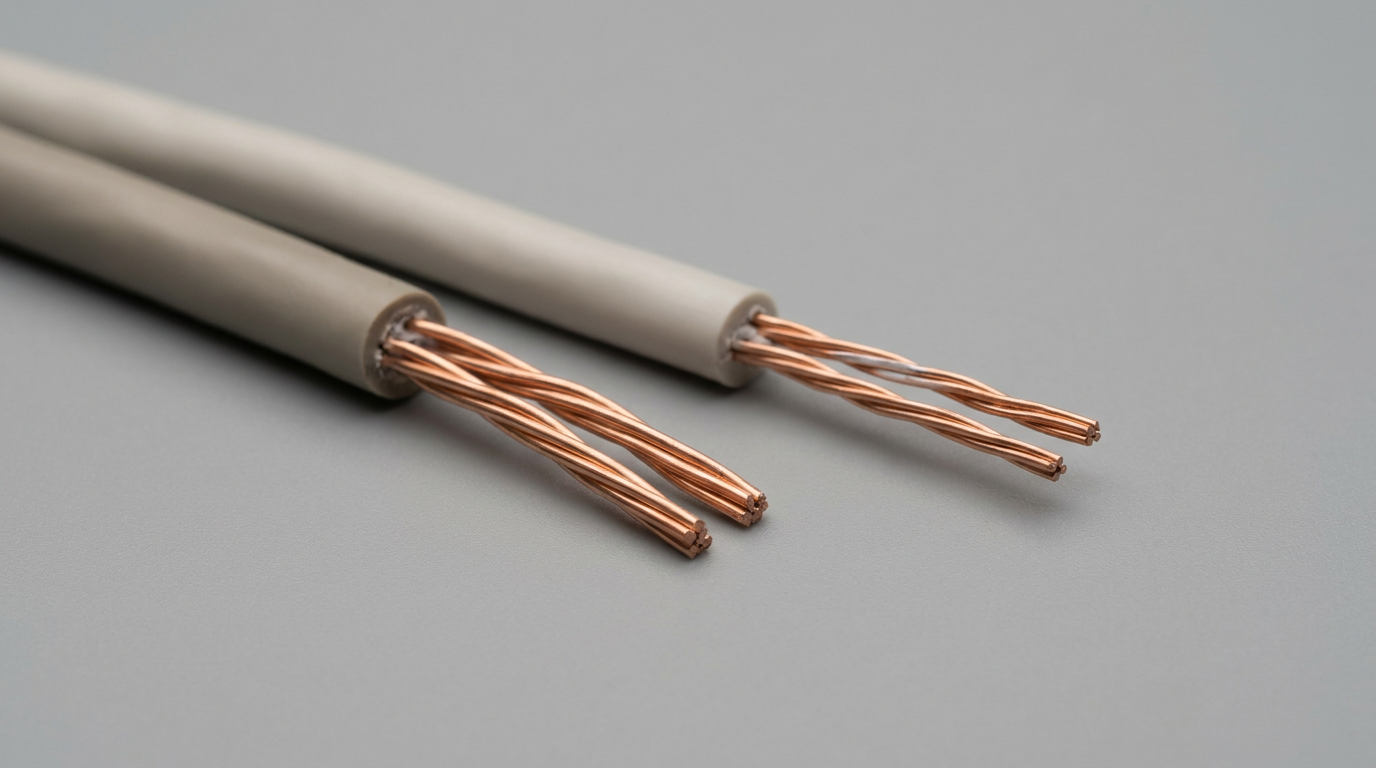
Conductor Gauge Basics
Cat5e cable uses four twisted pairs of copper conductors to transmit Ethernet signals. The cat5e conductor size affects resistance, insertion loss, flexibility, heat buildup, and suitability for Alimentación a través de Ethernet. Both 24 AWG and 26 AWG can meet Cat5e performance requirements when properly manufactured, but they are optimized for different use cases.
Según nuestros datos internos y análisis de mercado, aquí está el desglose:
| Artículo | 24 AWG Cat5e | 26 AWG Cat5e |
|---|---|---|
| Approx. conductor diameter | 0.511 mm | 0.405 mm |
| Approx. copper area | 0.205 mm² | 0.129 mm² |
| Relative conductor size | Más grande | Menor |
| Electrical resistance | Más bajo | Más alto |
| Flexibilidad | Moderado | Más alto |
| Mejor uso | Horizontal runs, PoE, longer links | Patch cords, short connections, dense racks |
| Typical installation role | In-wall or structured cabling | Equipment-to-patch-panel connection |
Because 24 AWG uses more copper, it usually performs better over longer distances and under electrical load. Because 26 AWG is thinner, it bends more easily and is often preferred for short patch cables in cabinets, workstations, and high-density network environments.
Consejo profesional de cwcables: I recommend using 24 AWG for any cable that will stay in place for years, especially behind walls, above ceilings, or in PoE applications. Use 26 AWG mainly when you need a short, flexible patch lead.
How Does 24 awg vs 26 awg cat5e,cat5e conductor size,cat5e wire gauge Work?
Cat5e wire gauge works by influencing how efficiently the cable carries electrical signals. Thicker 24 AWG conductors create less resistance and less voltage drop, helping preserve signal quality over distance. Thinner 26 AWG conductors are easier to route but experience higher resistance, making them better suited for shorter Ethernet connections.
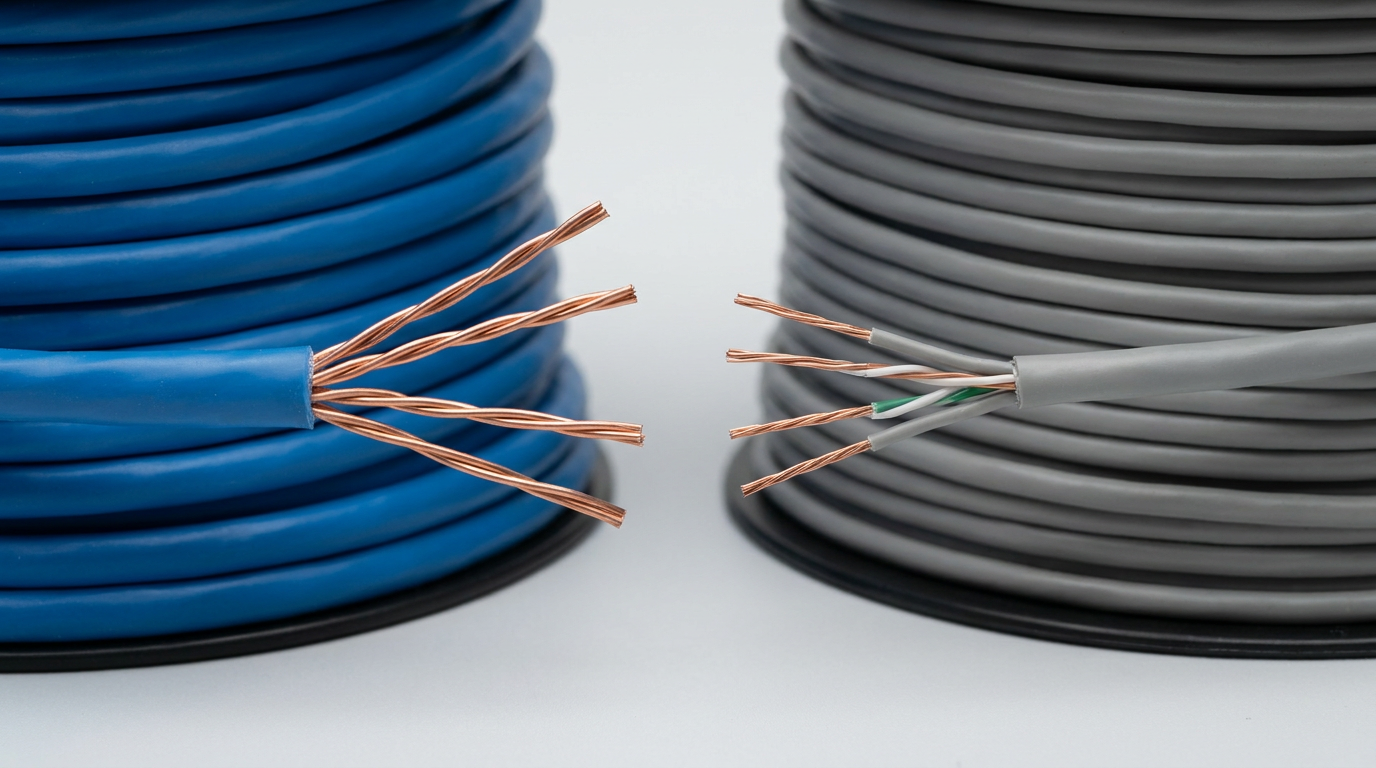
Signal Transmission and Resistance
Ethernet signals travel through copper conductors as balanced electrical signals across pares trenzados. The twist pattern helps reduce interferencia electromagnética, while the conductor size affects how much signal is lost as it travels through the cable.
Key operating effects include:
- Resistencia: Thicker 24 AWG conductors have lower resistance, which helps reduce signal loss and caída de voltaje.
- Pérdida de inserción: Longer cable runs naturally lose more signal strength; 24 AWG helps control pérdida de inserción better than 26 AWG.
- PoE efficiency: Power over Ethernet sends DC power through the cable. Lower resistance means less wasted energy and less heat.
- Flexibilidad: 26 AWG bends more easily, which is useful in patch panels, cabinets, and tight desk setups.
- Distance performance: Standard Cat5e supports up to 100 meters for Ethernet, but thinner conductors may have less margin in real-world installations.
For short links, both gauges can perform well if the cable is certified and properly terminated. For longer runs, 24 AWG usually provides more headroom and better long-term reliability.
Consejo profesional de cwcables: I always look at both distance and load. If the cable carries PoE to a camera, access point, or VoIP phone, I lean toward 24 AWG even when the distance seems moderate.
What are the benefits of 24 awg vs 26 awg cat5e,cat5e conductor size,cat5e wire gauge?
The main benefit of comparing 24 AWG vs 26 AWG Cat5e is matching the cable to the installation. 24 AWG provides stronger electrical performance, better PoE efficiency, and more distance margin. 26 AWG provides easier handling, better flexibility, and cleaner cable management for short patching applications.
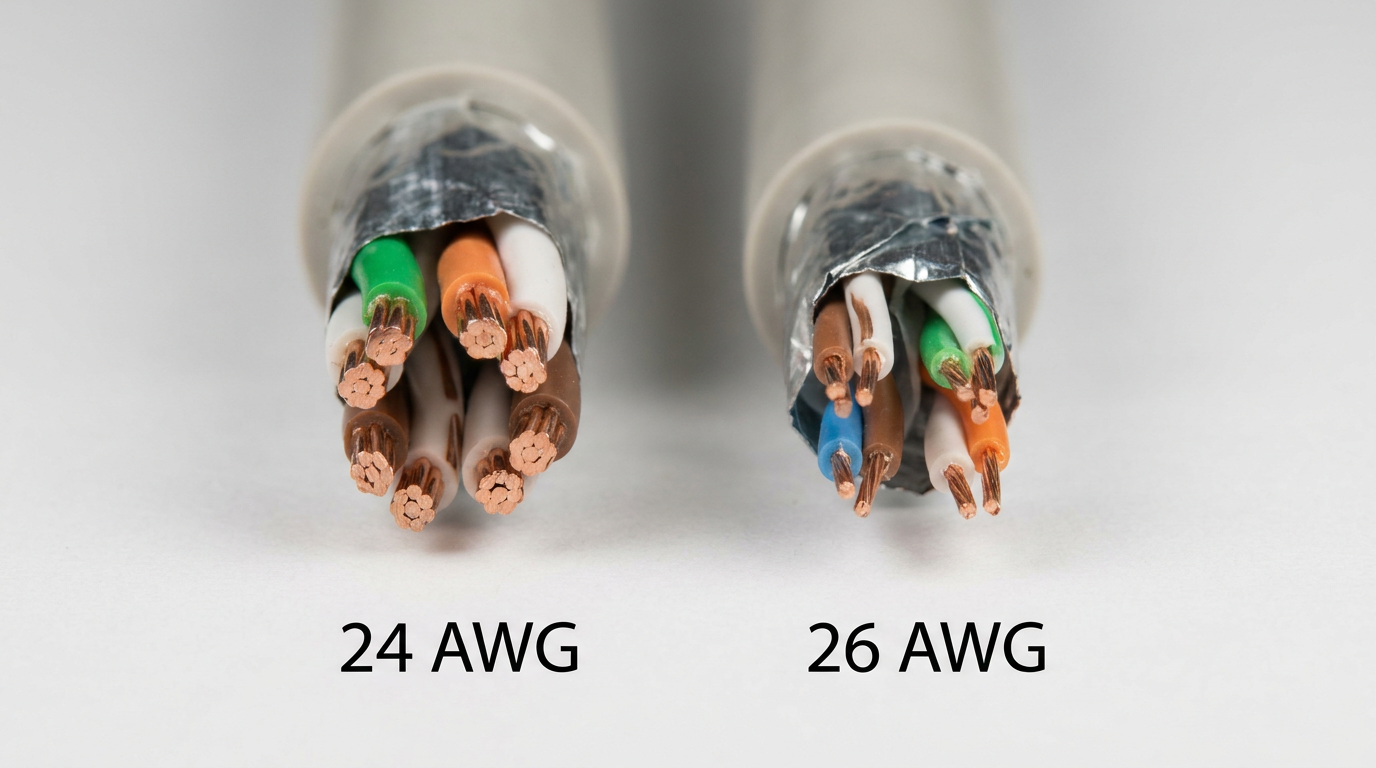
Practical Benefits by Application
The right cat5e wire gauge improves reliability, installation quality, and total ownership cost. A thicker cable is not automatically better in every situation, and a thinner cable is not automatically lower quality. The best choice depends on where and how the cable is used.
Según nuestros datos internos y análisis de mercado, aquí está el desglose:
| Área de beneficios | 24 AWG Advantage | 26 AWG Advantage |
|---|---|---|
| Long cable runs | Better signal margin | Less ideal for extended links |
| Rendimiento PoE | Lower voltage drop and heat | Acceptable for short, low-power runs |
| Patch panel density | Bulkier cable bundle | Easier routing in crowded racks |
| Flexibilidad | Menos flexible | Más flexible |
| Durabilidad | More robust conductor | Easier to bend, but more delicate |
| Costo de instalación | Often better long-term value | Often lower material weight and easier handling |
| Mejor ambiente | Structured cabling | Short patching and workstation links |
24 AWG is commonly selected for backbone-style horizontal cabling between network rooms and outlets. 26 AWG is commonly selected for patch cords that connect switches, routers, patch panels, computers, printers, or IP phones over short distances.
Consejo profesional de cwcables: I avoid choosing cable only by price. A slightly higher-cost 24 AWG cable can prevent troubleshooting later when you need stable PoE, longer distance, or better performance margin.
How to maintain a 24 awg vs 26 awg cat5e,cat5e conductor size,cat5e wire gauge?
Maintaining 24 AWG and 26 AWG Cat5e cable means protecting conductor integrity, avoiding sharp bends, preventing excessive pulling force, and keeping terminations clean. 26 AWG requires extra care because thinner conductors are more sensitive to stress, while 24 AWG is more durable but still must be installed correctly.
Handling and Maintenance Practices
Good maintenance preserves Ethernet performance and helps prevent intermittent faults. Many Cat5e problems are caused not by cable category, but by poor handling, overbending, damaged jackets, crushed cable, or low-quality terminations.
Pasos de mantenimiento recomendados:
- Respect bend radius. Avoid sharp bends, especially with 26 AWG patch cords.
- Do not crush cable bundles. Over-tight cable ties can deform twisted pairs and increase signal loss.
- Avoid excessive pulling force. Pull gently during installation to protect the conductor and insulation.
- Keep cable away from EMI sources. Maintain separation from power lines, motors, fluorescent ballasts, and high-voltage equipment.
- Inspect connectors. Replace patch cords with loose plugs, broken latches, or visibly damaged jackets.
- Etiquete ambos extremos. Good labeling reduces unnecessary unplugging and cable stress during troubleshooting.
- Test critical links. Use a cable tester for continuity, wire map, and performance verification when reliability matters.
- Use the right connector type. Match plugs and jacks to solid or stranded conductors as required.
24 AWG solid copper cable is typically used in permanent links, while 26 AWG stranded cable is common for flexible patch cords. Mixing connector types or using the wrong termination hardware can cause unreliable contact.
Consejo profesional de cwcables: I treat 26 AWG patch cords as precision components, not throwaway accessories. If a short patch cord gets kinked, crushed, or repeatedly pulled, replacement is usually faster than chasing random network drops.
What is the price of 24 awg vs 26 awg cat5e,cat5e conductor size,cat5e wire gauge?
The price of 24 AWG vs 26 AWG Cat5e depends on copper content, jacket rating, shielding, length, certification, and whether it is bulk cable or patch cable. 24 AWG often costs more because it uses more copper, while 26 AWG may be more economical for short patch cords.
Pricing Variables That Matter
Cable price should be evaluated by application, not only by unit cost. A lower-cost cable that causes PoE voltage drop, failed certification, or unstable links can become more expensive after labor and troubleshooting.
Según nuestros datos internos y análisis de mercado, aquí está el desglose:
| factor de compra | Impacto en el precio | Qué comprobar |
|---|---|---|
| Conductor gauge | 24 AWG usually costs more than 26 AWG | Confirm actual AWG, not only category rating |
| Copper type | Pure copper costs more than CCA | Choose solid bare copper for reliable networks |
| Longitud del cable | Longer rolls or cords increase total cost | Compare price per foot or meter |
| Calificación de la chaqueta | Plenum and riser ratings cost more | Match building code requirements |
| Blindaje | Shielded cable costs more | Use only when the environment requires it |
| Certificación | Tested/certified products may cost more | Look for standards compliance |
| Calidad del conector | Better plugs and boots add cost | Important for patch cord reliability |
For permanent installations, 24 AWG solid copper Cat5e often delivers the best long-term value. For rack patching and desk connections, 26 AWG patch cords can reduce clutter and simplify cable management without overspending.
Consejo profesional de cwcables: I compare total installed cost, not just the cable price. If labor is significant, I prefer the more reliable cable option because replacing a failed run later costs far more than choosing the right gauge upfront.
Características clave y comparación
The key difference between 24 AWG and 26 AWG Cat5e is conductor size. 24 AWG offers better electrical performance, lower resistance, and stronger PoE support. 26 AWG offers better flexibility and easier routing. For most permanent Ethernet runs, choose 24 AWG; for short patching, choose 26 AWG.
Side-by-Side Selection Matrix
Según nuestros datos internos y análisis de mercado, aquí está el desglose:
| Característica | 24 AWG Cat5e | 26 AWG Cat5e | Mejor elección |
|---|---|---|---|
| Conductor thickness | más grueso | Disolvente | 24 AWG |
| Resistencia | Más bajo | Más alto | 24 AWG |
| PoE efficiency | Mejor | Lower over distance | 24 AWG |
| Heat buildup under load | Más bajo | Más alto | 24 AWG |
| Flexibilidad | Bien | Excelente | 26 AWG |
| Cable bundle size | Más grande | Menor | 26 AWG |
| Fiabilidad a larga distancia | mas fuerte | Más limitado | 24 AWG |
| Short patch cable use | Bien | Excelente | 26 AWG |
| Permanent installation | Preferred | Menos común | 24 AWG |
| Dense rack management | Aceptable | Preferred | 26 AWG |
| Durabilidad | More robust | More delicate | 24 AWG |
| Typical value | Best for infrastructure | Best for patching | Depende del uso |
A simple rule works well: use 24 AWG for infrastructure and 26 AWG for convenience. If the cable is installed inside a wall, above a ceiling, or connected to a PoE device, the stronger electrical characteristics of 24 AWG are usually worth it. If the cable is only a short patch between devices, 26 AWG can be easier and cleaner.
Consejo profesional de cwcables: I never downgrade permanent links to 26 AWG just to make installation easier. Flexibility is useful, but the hidden cabling infrastructure should be built for margin, durability, and future device requirements.
Costo y factores de compra
When buying Cat5e cable, consider more than 24 AWG vs 26 AWG. The best purchase depends on cable length, copper purity, jacket rating, solid or stranded construction, PoE needs, and installation environment. A properly selected cable reduces failures, supports future upgrades, and improves network stability.
Buying Checklist for the Right Cat5e Gauge
Before ordering, define how the cable will be used. This prevents overbuying for simple patching or underbuying for critical infrastructure.
Utilice esta lista de verificación:
- Choose 24 AWG for permanent runs. It is the safer option for walls, ceilings, long links, and structured cabling.
- Choose 26 AWG for short patch cords. It is easier to bend, route, and organize in crowded areas.
- Use pure copper conductors. Evitar aluminio revestido de cobre for professional Ethernet and PoE installations.
- Match jacket rating to code. Use riser or plenum cable where required by the building environment.
- Check PoE requirements. Higher-power PoE devices benefit from lower-resistance conductors.
- Confirm cable construction. Solid conductors are common for bulk cable; stranded conductors are common for patch cords.
- Buy from a reliable supplier. Consistent manufacturing and testing matter as much as gauge.
- Plan for future devices. Cameras, access points, and phones may demand more power later.
If you are buying from cwcables, match the product type to the job: bulk 24 AWG Cat5e for structured cabling and flexible 26 AWG Cat5e patch cords for equipment connections.
Consejo profesional de cwcables: I advise customers to map the network first, then choose cable. Once you know run length, PoE load, rack density, and building code requirements, the correct Cat5e wire gauge becomes much easier to select.
Conclusión
For most installations, 24 AWG Cat5e is the better choice for permanent cabling, longer distances, and PoE devices, while 26 AWG Cat5e is ideal for short, flexible patch connections. Choosing the right cat5e conductor size improves performance, simplifies installation, and helps prevent future network problems.
Recomendación final
The best choice is not simply the thickest or cheapest cable. It is the cable that fits the application. 24 AWG Cat5e gives you stronger electrical performance and more installation margin. 26 AWG Cat5e gives you flexibility and cleaner patch management.
Quick decision guide:
- Choose 24 AWG Cat5e for in-wall cabling, long runs, PoE cameras, wireless access points, VoIP phones, and business infrastructure.
- Choose 26 AWG Cat5e for short patch cords, workstation connections, switch-to-patch-panel links, and high-density cable management.
- Avoid low-quality conductors when reliability matters, especially for PoE.
- Prioritize certified cable from a trusted supplier when installing networks that must last.
For dependable Cat5e solutions, cwcables can help you select the right conductor size, construction, and cable type for your network environment.
Consejo profesional de cwcables: My final rule is simple: if the cable is difficult to replace, choose 24 AWG. If the cable is short, visible, and easy to swap, 26 AWG is often the practical choice.