

Choosing between USB 3.0 and GigE cabling in thị giác máy depends on bandwidth, cable length, installation environment, latency expectations, and system architecture. USB 3.0 is often preferred for high-speed short-distance setups, while Tầm nhìn GigE cable solutions are stronger for longer runs, distributed cameras, and factory-floor flexibility. The right machine vision interface should match both camera performance and deployment constraints.
What is usb 3 vs gige camera cable,machine vision interface, GigE vision cable?
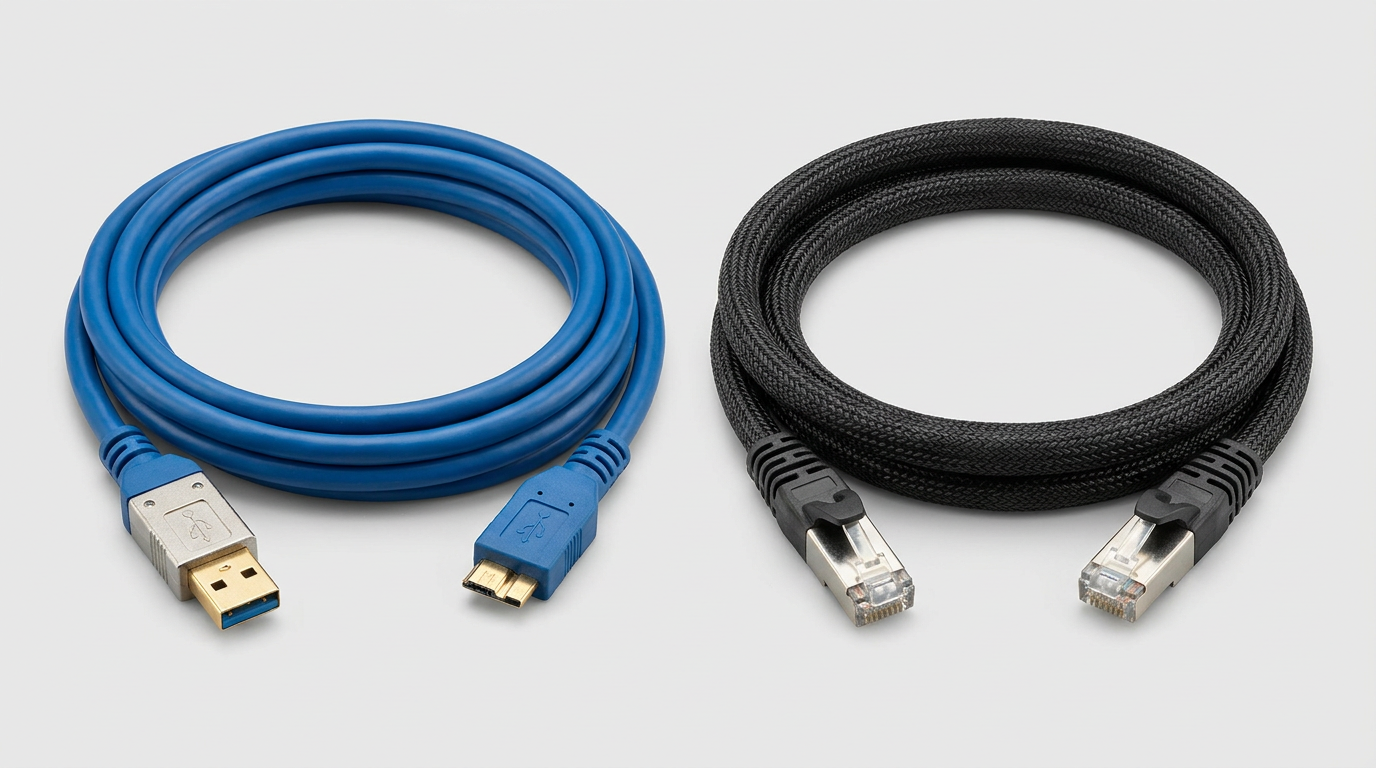
USB 3 vs GigE camera cable refers to the choice between USB 3.0 cabling and GigE Vision cabling for connecting industrial cameras to host systems. As a machine vision interface decision, it affects bandwidth, cable distance, stability, installation cost, and how reliably image data moves from camera to processor.
Interface Definition and Practical Role
USB 3.0 and GigE are two common physical and communication interfaces used in industrial vision systems. A USB 3.0 camera cable typically connects directly from the camera to a PC or embedded controller, offering high bandwidth over relatively short distances. A GigE vision cable uses Ethernet-based communication, enabling longer cable runs and easier networking.
Dựa trên dữ liệu nội bộ và phân tích thị trường của chúng tôi, đây là bảng phân tích:
| Interface Type | Trường hợp sử dụng điển hình | Common Cable Length | Key Strength | Hạn chế chính |
|---|---|---|---|---|
| USB 3.0 | High-speed local camera connection | 3–5 m passive, longer with active cable | High bandwidth, plug-and-play | Shorter reliable distance |
| Tầm nhìn GigE | Industrial networked camera systems | Up to 100 m with copper Ethernet | Long distance, flexible topology | Lower bandwidth than USB 3.0 |
| PoE GigE | Camera power and data over one cable | Lên đến 100 m | Simplified wiring | Requires PoE-compatible hardware |
| Multi-camera GigE | Distributed inspection systems | Facility-scale layouts | Scalable networking | Requires careful network design |
USB 3.0 is often selected for laboratory systems, high-frame-rate imaging, and compact machine vision stations. GigE Vision is commonly used in production lines, robotics, logistics, packaging, and inspection systems where cameras may be mounted far from the processing computer.
cwcables Mẹo chuyên nghiệp: I usually recommend USB 3.0 when the camera is close to the host and bandwidth is the priority, but I choose GigE vision cable when the installation needs distance, routing flexibility, or multiple cameras across a production line.
How Does usb 3 vs gige camera cable,machine vision interface, GigE vision cable Work?
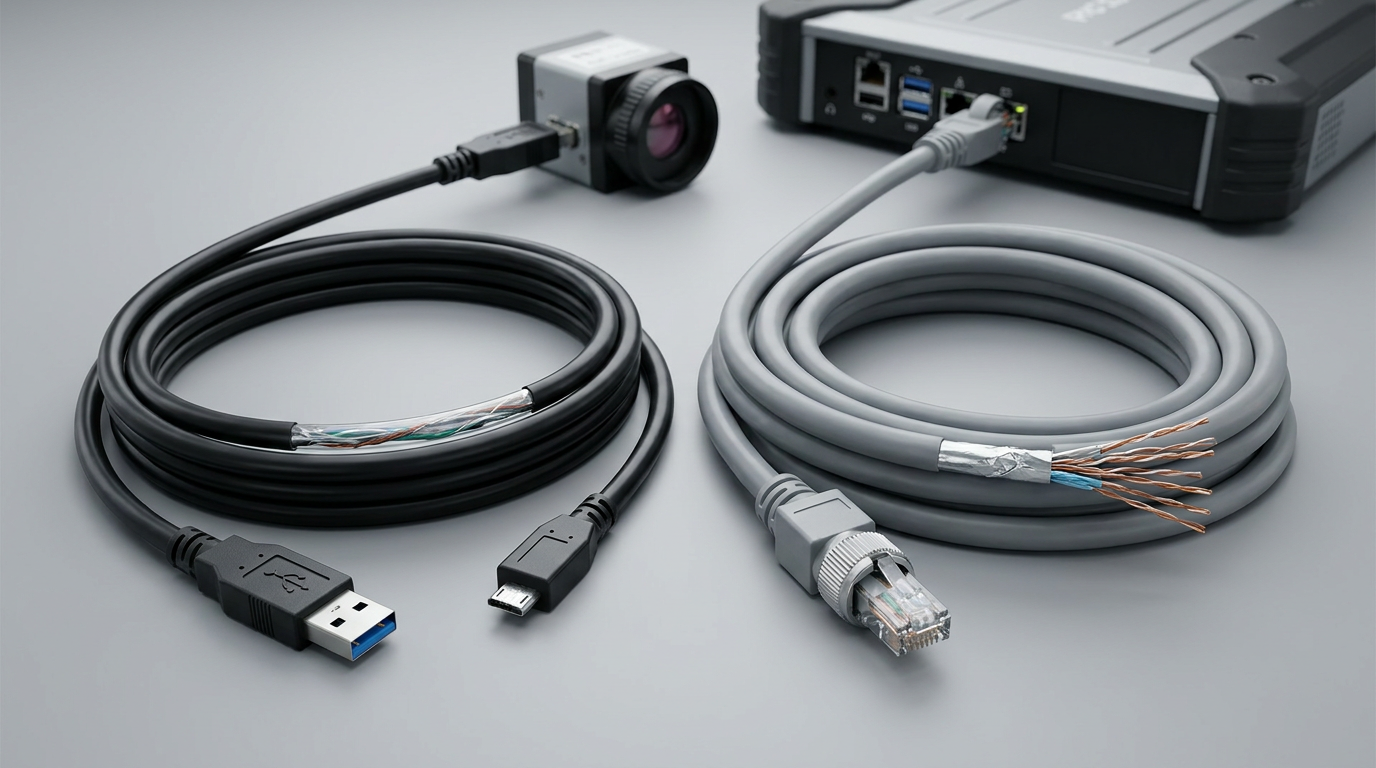
USB 3.0 camera cables transmit image data through a direct high-speed serial connection, while GigE vision cable uses Ethernet networking and GigE Vision protocol standards. Both carry digital image data from camera to host, but they differ in packet handling, cable distance, power options, and system architecture.
Data Transmission Workflow
In a machine vision system, the camera sensor captures an image, the camera electronics convert it into digital data, and the interface cable sends that data to a computer, frame grabber, switch, or embedded processor. USB 3.0 and GigE both move digital data, but the communication method is different.
- The camera sensor captures the image.
- The camera converts the signal into digital image data.
- The interface packages the data for transmission.
- The cable carries the data to the host system.
- The host software receives, processes, and analyzes the image.
- The system triggers an action, such as inspection pass/fail, robotic guidance, or barcode verification.
USB 3.0 generally works best as a direct point-to-point connection. GigE Vision works over standard Ethernet infrastructure, meaning cameras can connect through switches and operate across longer distances. For factory layouts, this networking ability is one of GigE’s biggest advantages.
cwcables Mẹo chuyên nghiệp: I always check whether the application is bandwidth-limited or distance-limited first. That single question often makes the USB 3 vs GigE camera cable decision much easier.
What are the benefits of usb 3 vs gige camera cable,machine vision interface, GigE vision cable?
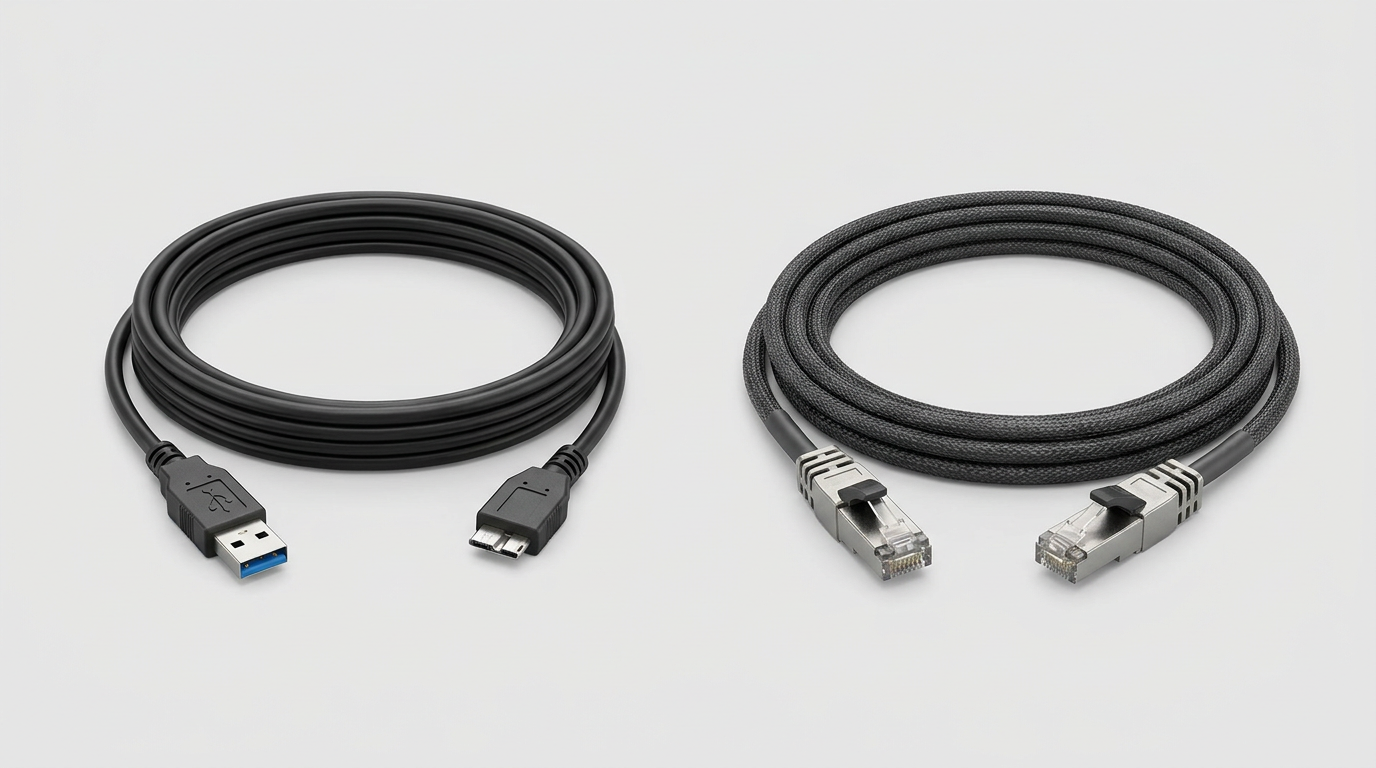
The main benefit of comparing USB 3.0 and GigE Vision is that it helps engineers choose the most stable and cost-effective machine vision interface. USB 3.0 offers speed and simplicity, while GigE vision cable provides longer reach, better network scalability, and easier integration into industrial environments.
Performance and Installation Advantages
Each interface has distinct advantages depending on camera resolution, frame rate, distance, and factory layout. USB 3.0 is a strong option for high-throughput imaging when the camera is close to the processing unit. GigE Vision is ideal when cameras are spread across a larger machine or production floor.
Dựa trên dữ liệu nội bộ và phân tích thị trường của chúng tôi, đây là bảng phân tích:
| Khu vực lợi ích | USB 3.0 Camera Cable | Cáp tầm nhìn GigE |
|---|---|---|
| Băng thông | Higher, suitable for fast image transfer | Moderate, suitable for many industrial inspections |
| Khoảng cách | Best for short runs | Excellent for long runs up to 100 m |
| Cài đặt | Simple direct connection | Flexible network-based deployment |
| Multi-camera Systems | Limited by host ports and cable length | Easier through Ethernet switches |
| Power Options | May need separate power depending on camera | PoE can carry power and data |
| Cost Efficiency | Good for compact systems | Good for large or distributed systems |
USB 3.0 reduces complexity in short-distance applications because it often requires fewer networking components. GigE Vision reduces installation restrictions because Ethernet cables can route through machines, cable trays, and control cabinets more easily.
cwcables Mẹo chuyên nghiệp: I recommend looking beyond camera price alone. Cable length, routing path, host ports, power delivery, and future camera expansion can change the total system cost quickly.
How to maintain a usb 3 vs gige camera cable,machine vision interface, GigE vision cable?
Maintaining USB 3.0 and GigE camera cables means protecting signal integrity, preventing mechanical stress, checking connectors, and selecting the right cable grade for motion, shielding, and environment. Good maintenance reduces image dropouts, communication errors, intermittent camera disconnects, and unexpected production downtime.
Cable Care and Reliability Checklist
Machine vision cables often operate near motors, robotics, conveyors, lighting systems, and control wiring. These environments can create nhiễu điện từ, vibration, bending stress, and connector wear. Maintenance should focus on both electrical performance and mechanical durability.
- Inspect connectors for looseness, bent pins, oxidation, or latch damage.
- Avoid sharp bends that exceed the cable’s minimum bend radius.
- Use drag-chain-rated or high-flex cables for moving camera installations.
- Keep vision cables separated from high-voltage power lines and motor drives.
- Use shielded cables in electrically noisy environments.
- Secure cables with strain relief near the camera and host connection.
- Replace cables showing jacket cracking, kinking, crushing, or intermittent signal loss.
- Label cables clearly to simplify troubleshooting and replacement.
For USB 3.0, connector stability is especially important because short disruptions may cause camera disconnects. For GigE Vision, cable quality, shielding, and connector termination are critical for reliable packet transmission over longer distances.
cwcables Mẹo chuyên nghiệp: I never wait for total cable failure. If an inspection station starts showing random frame loss or camera reconnects, I test the cable first because it is often the fastest and lowest-cost fix.
What is the price of usb 3 vs gige camera cable,machine vision interface, GigE vision cable?
Pricing depends on cable type, length, shielding, connector style, motion rating, locking mechanism, and certification level. USB 3.0 camera cables are often cost-effective for short runs, while GigE vision cable prices vary based on Cat rating, PoE support, industrial jacketing, and flex-life requirements.
Typical Price Drivers
The cable itself is only one part of the total cost. For USB 3.0, active extension may increase cost when longer distances are required. For GigE, switches, PoE injectors, or industrial Ethernet hardware may affect the budget, especially in multi-camera systems.
Dựa trên dữ liệu nội bộ và phân tích thị trường của chúng tôi, đây là bảng phân tích:
| Yếu tố chi phí | USB 3.0 Impact | GigE Vision Impact |
|---|---|---|
| Chiều dài cáp | Cost rises quickly for active or extended cables | Longer passive runs are usually practical |
| Che chắn | Important for stable high-speed transfer | Important for noise-resistant Ethernet links |
| Locking Connector | Adds cost but improves reliability | Adds cost for industrial RJ45 or M12 versions |
| Motion Rating | High-flex USB cables cost more | Drag-chain Ethernet cables cost more |
| Power Delivery | May require separate power cable | PoE may reduce separate wiring |
| System Hardware | Usually fewer components | May require switch, PoE device, or network card |
For a compact single-camera station, USB 3.0 may have a lower initial cost. For long-distance or multi-camera installations, GigE Vision can reduce wiring complexity and offer better expansion value.
cwcables Mẹo chuyên nghiệp: I suggest pricing the full connection path, not just the cable. Include connectors, adapters, active extensions, switches, PoE hardware, replacement access, and downtime risk.
Các tính năng chính và so sánh
USB 3.0 is best when short-distance high bandwidth matters, while GigE Vision is best when long-distance industrial deployment and network scalability matter. A proper comparison should include speed, distance, topology, connector security, power options, environmental durability, and future expansion needs.
Side-by-Side Interface Comparison
Dựa trên dữ liệu nội bộ và phân tích thị trường của chúng tôi, đây là bảng phân tích:
| Tính năng | USB 3.0 Camera Cable | Cáp tầm nhìn GigE |
|---|---|---|
| Primary Strength | High-speed local image transfer | Long-distance industrial networking |
| Typical Maximum Passive Distance | About 3–5 m | Up to 100 m on copper Ethernet |
| Bandwidth Potential | Higher than standard GigE | Lower than USB 3.0, unless using faster Ethernet variants |
| Ứng dụng tốt nhất | Compact inspection cells, lab systems, high-frame-rate cameras | Factory lines, robotics, distributed cameras |
| Cable Infrastructure | Direct camera-to-host connection | Ethernet switches and network architecture possible |
| Multi-camera Scalability | Limited by host resources and cable length | Strong scalability through switches |
| Power Options | Camera-dependent, sometimes separate power required | PoE available on compatible systems |
| Connector Choices | Standard or screw-lock USB 3.0 | RJ45, industrial RJ45, M12 |
| Noise Resistance | Requires quality shielding and short controlled routing | Strong with industrial shielded Ethernet cable |
| Installation Flexibility | Simple but distance-limited | Highly flexible across larger machines |
| Maintenance Complexity | Easy for short systems | Requires network and cable diagnostics |
| Best Buying Priority | Bandwidth, simplicity, close camera placement | Distance, scalability, robust industrial routing |
The best machine vision interface is not universal. USB 3.0 can deliver excellent performance in short, controlled setups. GigE Vision is often more robust for factory-scale installations where cable length, routing flexibility, and multiple camera nodes matter more than maximum single-camera bandwidth.
cwcables Mẹo chuyên nghiệp: I like to map camera locations before selecting the interface. If the cable path is already longer than a few meters or crosses noisy equipment zones, GigE Vision often becomes the safer design choice.
Yếu tố chi phí và mua hàng
The smartest buying decision balances performance requirements with installation reality. Consider resolution, frame rate, cable length, connector locking, shielding, flex rating, power method, host compatibility, and expansion plans before choosing USB 3.0 or GigE Vision cabling for a machine vision system.
Practical Selection Criteria
When evaluating USB 3 vs GigE camera cable options, the technical specifications should be matched to real operating conditions. A cable that works on a test bench may not survive vibration, drag-chain motion, washdown zones, or electrical interference on a factory floor.
- Confirm camera interface requirements and host compatibility.
- Calculate required bandwidth from resolution, bit depth, and frame rate.
- Measure the actual routing distance, not just straight-line distance.
- Check whether the cable will be static, flexing, or in continuous motion.
- Choose proper shielding for nearby motors, drives, and power cables.
- Decide whether locking connectors are required for vibration resistance.
- Evaluate PoE needs for GigE Vision installations.
- Plan for spare cables and maintenance access.
- Consider future camera expansion before finalizing the interface.
For cwcables customers, the right choice often depends on whether the system prioritizes compact high-speed transfer or long-distance industrial reliability. A well-selected cable prevents image loss, reduces troubleshooting time, and extends equipment service life.
cwcables Mẹo chuyên nghiệp: I always ask for camera model, cable length, motion type, connector requirement, and environment before recommending a cable. Those details matter more than choosing by interface name alone.
Phần kết luận
USB 3.0 and GigE Vision both work well for machine vision, but they solve different problems. USB 3.0 favors short-distance speed and simplicity, while GigE vision cable supports longer, scalable, industrial installations. The best choice depends on bandwidth, distance, environment, and system layout.
Khuyến nghị cuối cùng
For short cable runs, compact equipment, and high-speed local image capture, USB 3.0 is often the practical choice. For longer production lines, multi-camera systems, industrial routing, and PoE-based designs, GigE Vision is usually the better long-term solution.
- Choose USB 3.0 when the camera is close to the host and bandwidth is critical.
- Choose GigE Vision when distance, scalability, and factory integration are priorities.
- Use industrial-grade shielding when electromagnetic interference is possible.
- Select locking connectors for vibration-prone machinery.
- Specify high-flex or drag-chain-rated cable for moving applications.
- Work with cwcables when you need application-specific guidance on cable length, connector type, shielding, and durability.
A reliable machine vision interface starts with the right cable. Matching the cable to the camera, environment, and installation layout improves image stability and reduces downtime.
cwcables Mẹo chuyên nghiệp: If you are unsure, send the camera model, required length, motion condition, and installation environment. I can usually narrow the choice between USB 3.0 and GigE Vision very quickly from those four details.