

Moving applications place continuous mechanical stress on data cables, so controlling ethernet cable bend radius is essential for stable signal transmission and long service life. In robotics, drag chains, automated handling systems, and moving machine assemblies, the bend radius must match the cable’s construction, motion frequency, and installation path. Choosing the right dynamic bend radius Ethernet cable helps prevent conductor fatigue, jacket cracking, impedance shifts, and unexpected network downtime.
What is Ethernet cable bend radius?
Ethernet cable bend radius is the minimum curve a cable can safely make without damaging conductors, shielding, insulation, or signal geometry. In moving applications, the required radius is larger than in static installations because repeated flexing creates fatigue. Following the correct Ethernet cable bend radius protects performance, reliability, and cable lifespan.
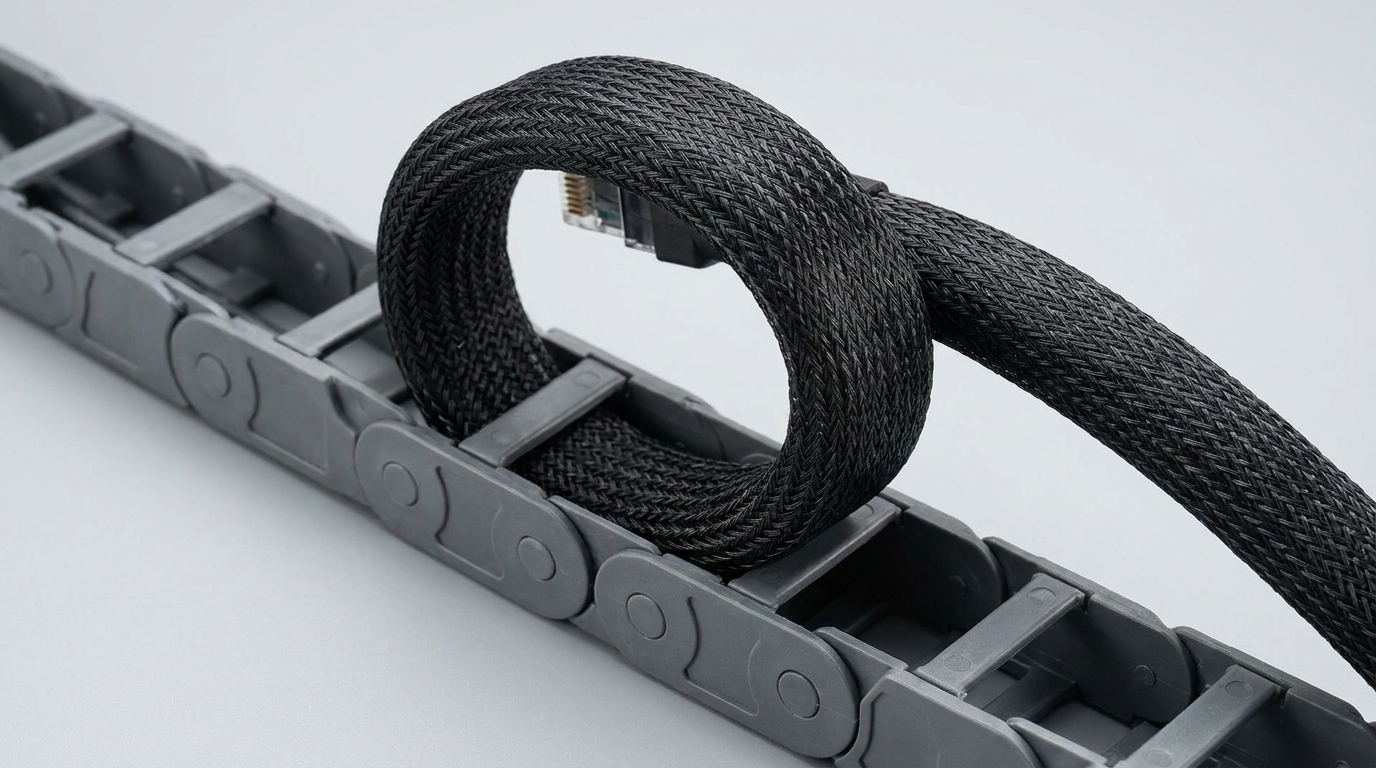
Minimum Safe Curvature
Ethernet cable bend radius is usually expressed as a multiple of the cable’s outside diameter, such as 4x, 8x, 10x, or 12x OD. A static cable may tolerate a tighter bend, while a moving cable needs a larger bend radius to reduce mechanical strain during repeated motion.
Dahili verilerimize ve pazar analizlerimize dayanarak, döküm şu şekildedir:
| Başvuru Türü | Typical Bend Radius Guidance | Motion Condition | Risk if Too Tight |
|---|---|---|---|
| Sabit kurulum | 4x to 8x cable OD | No repeated motion | Jacket stress, pair deformation |
| Ara sıra hareket | 8x to 10x cable OD | Low-cycle flexing | Shield fatigue, impedance change |
| Drag chain / continuous flex | 10x to 15x cable OD or more | High-cycle motion | Conductor breakage, packet loss |
| Robotic torsion | Manufacturer-specific | Flexing plus twisting | Pair separation, shield failure |
For example, if a high-flex Ethernet cable has an outside diameter of 7 mm and requires a 10x dynamic bend radius, the minimum bend radius is 70 mm. In continuous-motion environments, this value should be treated as a hard design limit, not a rough suggestion.
cwcables Profesyonel İpucu: I always verify bend radius from the cable’s actual datasheet, not just the Ethernet category. A Cat6A cable and a high-flex Cat6A cable can have very different bend radius requirements because their conductor, shield, and jacket designs are not the same.
How Does Ethernet cable bend radius Work?
Ethernet cable bend radius works by limiting mechanical strain on the cable’s internal structure. When a cable bends, the outer side stretches and the inner side compresses. If the bend is too tight, copper conductors, insulation, shielding, and twisted-pair geometry can deform, causing signal degradation or physical failure.
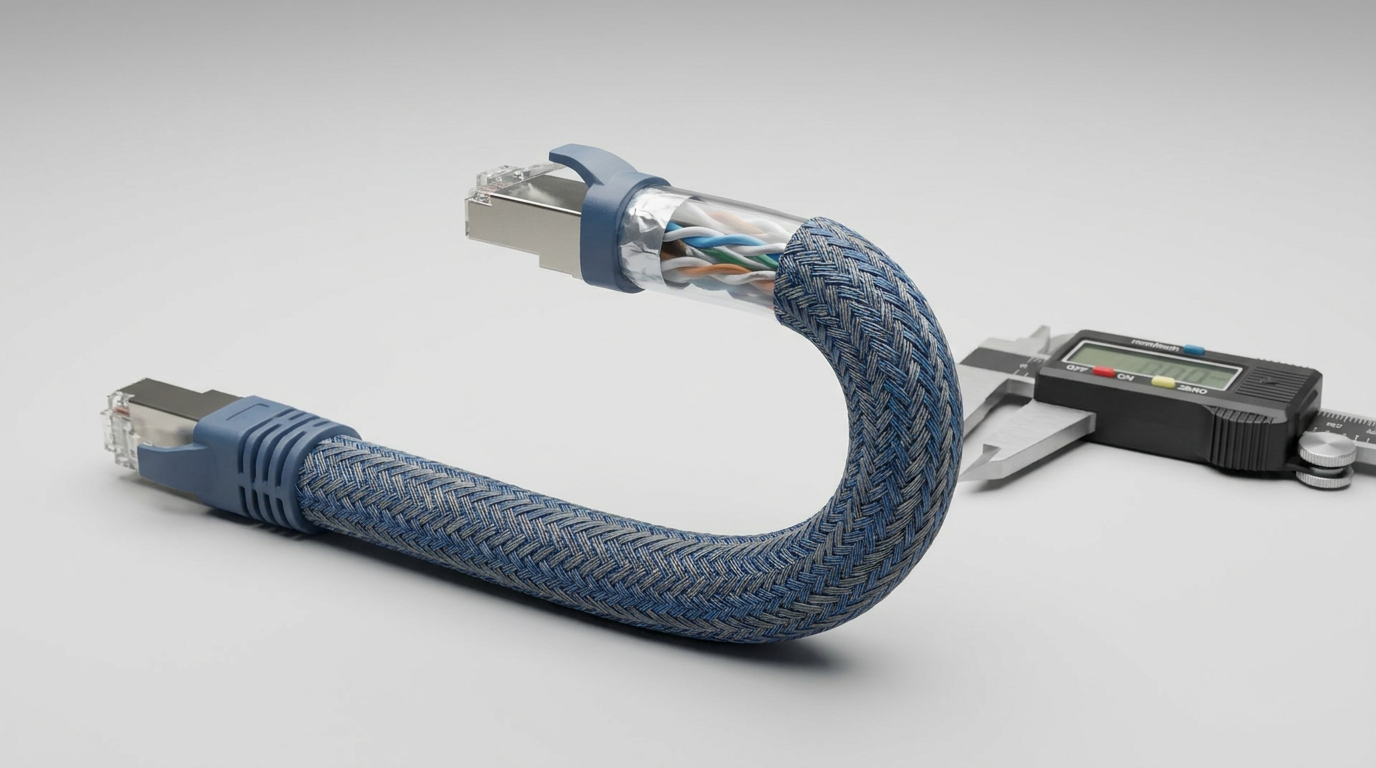
Mechanical Strain and Signal Integrity
Ethernet cables rely on precise bükümlü çift spacing to control empedans, karışma, geri dönüş kaybı, and data stability. Excessive bending changes that geometry. In moving applications, the damage may not appear immediately; it often develops over thousands or millions of flex cycles.
A correct moving Ethernet cable bend radius protects the cable by controlling:
- Conductor stress — prevents copper work-hardening and strand breakage.
- Çift geometri — maintains twist consistency for stable impedance.
- Kalkan sürekliliği — reduces foil cracking or braid fatigue.
- Ceket dayanıklılığı — prevents cracking, flattening, or abrasion.
- Ağ performansı — lowers the risk of intermittent paket kaybı and link drops.
For dynamic systems, the bend radius must also work with the cable carrier, acceleration, travel distance, fill ratio, and cable routing. Even a high-flex bend radius rating can fail early if the cable is twisted, forced against sharp edges, or packed too tightly inside a drag chain.
cwcables Profesyonel İpucu: I recommend checking the bend radius while the machine is moving, not only when it is stopped. The tightest curve often appears during acceleration, reversal, or at the end of travel inside the cable carrier.
What are the benefits of Ethernet cable bend radius?
Maintaining the correct Ethernet cable bend radius improves network uptime, extends cable life, and protects signal quality in moving systems. It reduces conductor fatigue, prevents shield damage, and helps avoid intermittent faults that are difficult to diagnose. For automation and robotics, correct bend control directly supports reliable machine operation.
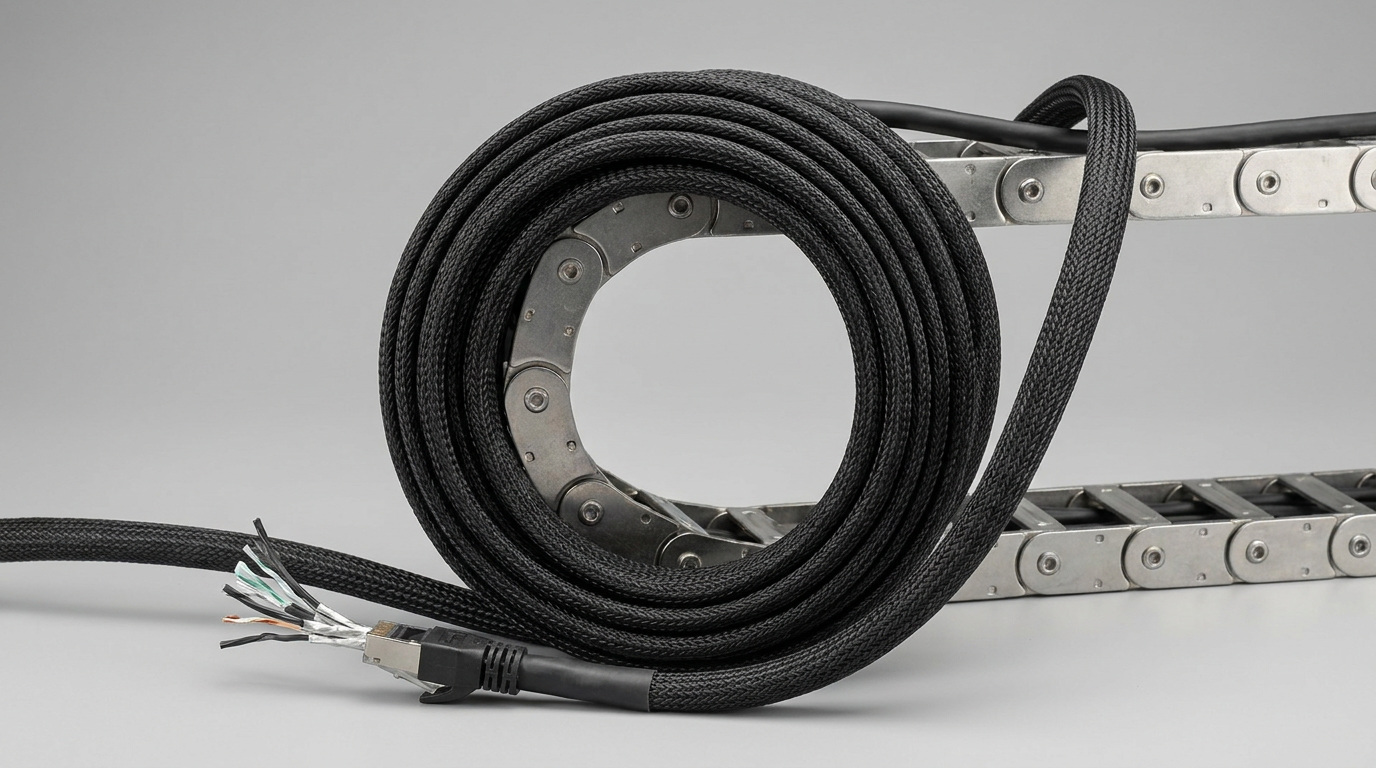
Reliability Gains in Moving Installations
Correct bend radius is one of the simplest ways to improve Ethernet cable performance in dynamic applications. It does not require complex electronics or software; it requires proper cable selection, routing, and installation discipline.
Dahili verilerimize ve pazar analizlerimize dayanarak, döküm şu şekildedir:
| Fayda | Pratik Etki | Neden Önemlidir? |
|---|---|---|
| Daha uzun servis ömrü | Fewer cable replacements | Reduces maintenance downtime |
| Stable data transmission | Lower packet loss and fewer dropouts | Protects machine communication |
| Better shield performance | korur EMC koruma | Important near motors and drives |
| Reduced conductor fatigue | Prevents internal breaks | Critical for drag chains and robots |
| Cleaner troubleshooting | Daha az aralıklı arıza | Saves diagnostic time |
In industrial Ethernet systems, a cable that is bent below its rated dynamic radius may pass a continuity test when stationary but fail during motion. That makes bend radius especially important for applications using EthernetNet/IP, PROFINET, Modbus TCP, machine vision, or real-time motion control.
cwcables Profesyonel İpucu: I treat bend radius as part of the network design, not just the mechanical layout. If a machine depends on real-time Ethernet communication, the cable path deserves the same attention as switches, connectors, and grounding.
How to maintain an Ethernet cable bend radius?
To maintain an Ethernet cable bend radius, select a cable rated for the motion type, calculate the minimum radius from the cable diameter, and route it through guides, carriers, or clamps that prevent sharp bends. Regular inspections should confirm that movement, vibration, and cable memory have not changed the bend path.
Installation and Inspection Practices
Maintaining bend radius requires both initial installation control and ongoing maintenance. A cable may be installed correctly but later shift due to vibration, cable carrier wear, improper repairs, or added cables in the same track.
Use this practical process:
- Confirm the cable OD from the manufacturer’s datasheet.
- Identify the required bend radius for static, dynamic, high-flex, or torsion movement.
- Measure the actual bend path inside the carrier or machine frame.
- Avoid cable twisting during installation and payout.
- Uygun gerilim azaltıcıyı kullanın so connectors do not carry motion loads.
- Maintain carrier fill limits to prevent cable stacking or compression.
- Inspect for wear marks, jacket flattening, cracks, or exposed shielding.
- Replace cables showing motion-related deformation before network faults appear.
In drag chain applications, cables should lie freely in the neutral axis when possible. They should not be tied tightly together inside the carrier because this can force uneven movement and create localized bend stress.
cwcables Profesyonel İpucu: I never pull a moving Ethernet cable from a side-wound coil like ordinary rope. I unroll it properly to avoid built-in twist, because twist plus bending is one of the fastest ways to shorten cable life.
What is the price of Ethernet cable bend radius?
Ethernet cable bend radius itself is not a separate product cost; it is a design requirement that affects cable selection. Cables rated for smaller dynamic bends, high-flex cycles, shielding, oil resistance, or robotic movement usually cost more than standard Ethernet cable, but they reduce downtime and replacement costs.
Pricing Drivers for High-Flex Ethernet Cable
The price of a cable suitable for moving applications depends on material, construction, category rating, shielding, approvals, and flex-life testing. A standard patch cable may be inexpensive, but it is usually unsuitable for continuous motion.
Dahili verilerimize ve pazar analizlerimize dayanarak, döküm şu şekildedir:
| Kablo Tipi | Typical Relative Cost | Bend/Flex Capability | En İyi Kullanım Durumu |
|---|---|---|---|
| Standart Ethernet yama kablosu | Düşük | Static or minimal movement | Office or fixed panels |
| Endüstriyel Ethernet kablosu | Orta | Better jacket and shielding | Factory networks |
| Yüksek esnek Ethernet kablosu | Orta ila yüksek | Tekrarlanan bükme | Sürükleme zincirleri ve hareketli eksenler |
| Robotic Ethernet cable | Yüksek | Flexing plus torsion | Robot arms and multi-axis motion |
| Custom assembly from cwcables | Project-dependent | Matched to application | OEM machines and specialized systems |
When evaluating price, the better question is not only “What does the cable cost?” but “What does an unexpected network failure cost?” In automated production, the downtime cost of a failed cable can exceed the cable price many times over.
cwcables Profesyonel İpucu: I recommend comparing cable cost against expected flex cycles, machine downtime risk, and replacement labor. A cheaper cable can become expensive quickly if it fails inside a moving cable carrier.
Temel Özellikler ve Karşılaştırma
The key features to compare are static bend radius, dynamic bend radius, flex-cycle rating, shielding, jacket material, conductor construction, and motion compatibility. For moving systems, the best cable is not simply the highest Ethernet category; it is the cable that matches the bend, speed, travel, and environment.
Feature Comparison for Moving Ethernet Applications
Dahili verilerimize ve pazar analizlerimize dayanarak, döküm şu şekildedir:
| Özellik | Standart Ethernet Kablosu | Endüstriyel Ethernet Kablosu | Yüksek Esnek Ethernet Kablosu | Robotic Ethernet Cable |
|---|---|---|---|---|
| Static bend radius | Ilıman | Ilıman | Kontrollü | Kontrollü |
| Dynamic bend radius Ethernet rating | Usually not rated | Sınırlı | Özel olarak derecelendirilmiş | Uygulamaya özel |
| Flex-cycle capability | Düşük | Düşük ila orta | Yüksek | High with torsion |
| Kalkan dayanıklılığı | Temelden iyiye | İyi | Reinforced | Reinforced for multi-axis stress |
| Ceket malzemesi | PVC or similar | PVC, PUR, TPE options | PUR/TPE often preferred | PUR/TPE often preferred |
| Oil/abrasion resistance | Sınırlı | Daha iyi | Güçlü | Güçlü |
| Çekme zinciri uygunluğu | Tavsiye edilmez | Bazen | Tavsiye edilen | Sometimes, depending on design |
| Robotic torsion suitability | Tavsiye edilmez | Sınırlı | Derecelendirilmediği sürece sınırlıdır | Tavsiye edilen |
| Tipik kullanım | Fixed networks | Factory installations | Hareketli makine eksenleri | Robot arms and rotating joints |
A high-flex bend radius specification is especially important when cable carriers reverse direction frequently. However, not every “industrial” cable is automatically a continuous-flex cable. Always confirm the datasheet language, including whether the listed bend radius is static, dynamic, or torsional.
cwcables Profesyonel İpucu: I look for three separate details before approving a cable for moving use: dynamic bend radius, flex-cycle rating, and jacket material. If one of those is missing, I ask for clarification before installing it on a machine.
Maliyet ve Satın Alma Faktörleri
When buying Ethernet cable for moving applications, consider total ownership cost rather than unit price alone. The right choice depends on dynamic bend radius, cable carrier size, flex cycles, shielding needs, environment, connector type, and downtime risk. A properly specified cable can prevent costly service interruptions.
Selection Criteria Before Purchasing
For moving applications, buying decisions should combine electrical performance with mechanical life. An Ethernet category rating such as Cat5e, Cat6, Cat6A, or Cat7 only tells part of the story; it does not guarantee dynamic flex performance.
Use these buying factors as a checklist:
- Hareket türü: linear drag chain, rolling movement, torsion, robotic arm, or occasional service loop.
- Minimum bükülme yarıçapı: confirm whether the value is static or dynamic.
- Cable outside diameter: affects carrier size and bend calculation.
- Transmission requirement: Cat5e, Cat6, Cat6A, or higher depending on bandwidth.
- Ekranlama: choose U/UTP, F/UTP, S/FTP, or other designs based on EMI exposure.
- Ceket malzemesi: PUR or TPE is often preferred for high-flex industrial environments.
- Bağlayıcı sistemi: RJ45, M12 D-coded, M12 X-coded, or custom assemblies.
- Çevresel maruziyet: oil, coolant, UV, abrasion, washdown, temperature, and chemicals.
- Uyumluluk ihtiyaçları: UL, RoHS, CE, industrial Ethernet standards, or customer-specific requirements.
- Tedarikçi desteği: engineering help, documentation, samples, and consistent production quality.
For OEMs and maintenance teams, cwcables can help align bend radius, cable construction, and connector options with the actual movement profile of the equipment.
cwcables Profesyonel İpucu: I ask customers for travel distance, bend radius target, cycle rate, and environment before quoting cable. Those details help prevent overspecifying an expensive cable or underspecifying one that will fail early.
Çözüm
Ethernet cable bend radius is a critical design factor for moving applications because it protects both mechanical durability and data integrity. By selecting a cable with the correct dynamic bend radius, routing it properly, and inspecting it regularly, teams can reduce failures and improve long-term machine reliability.
Practical Takeaway for Reliable Motion Networks
For static installations, bend radius is important. For moving applications, it is essential. Continuous flexing, acceleration, vibration, and torsion expose weaknesses that ordinary Ethernet cables are not designed to handle.
A reliable approach includes:
- Define the movement profile before choosing the cable.
- Use the manufacturer’s dynamic bend radius, not a generic estimate.
- Select high-flex or robotic cable when the application requires it.
- Install with proper carrier layout and strain relief.
- Inspect the cable path during live motion.
- Replace damaged cable before it causes intermittent network faults.
If your application involves robotics, drag chains, moving gantries, automated tools, or industrial Ethernet equipment, cwcables can help identify a suitable cable construction and bend radius strategy for your system.
cwcables Profesyonel İpucu: I always design for the worst movement condition, not the easiest one. If the cable survives the tightest bend, fastest reversal, and harshest environment, the network is far more likely to stay stable in production.