

Ethernet is a general-purpose networking technology used for computers, switches, cameras, CLPs, and many industrial devices, while EtherCAT is a real-time industrial communication protocol built on Ethernet hardware principles. In simple terms, Ethernet moves data reliably across networks; EtherCAT moves automation data extremely fast and predictably for motion control, sensors, drives, and machine control systems.
Video Guide: This overview helps frame the core ethercat vs ethernet differences from an engineering and industrial networking perspective.
What is ethercat vs ethernet?
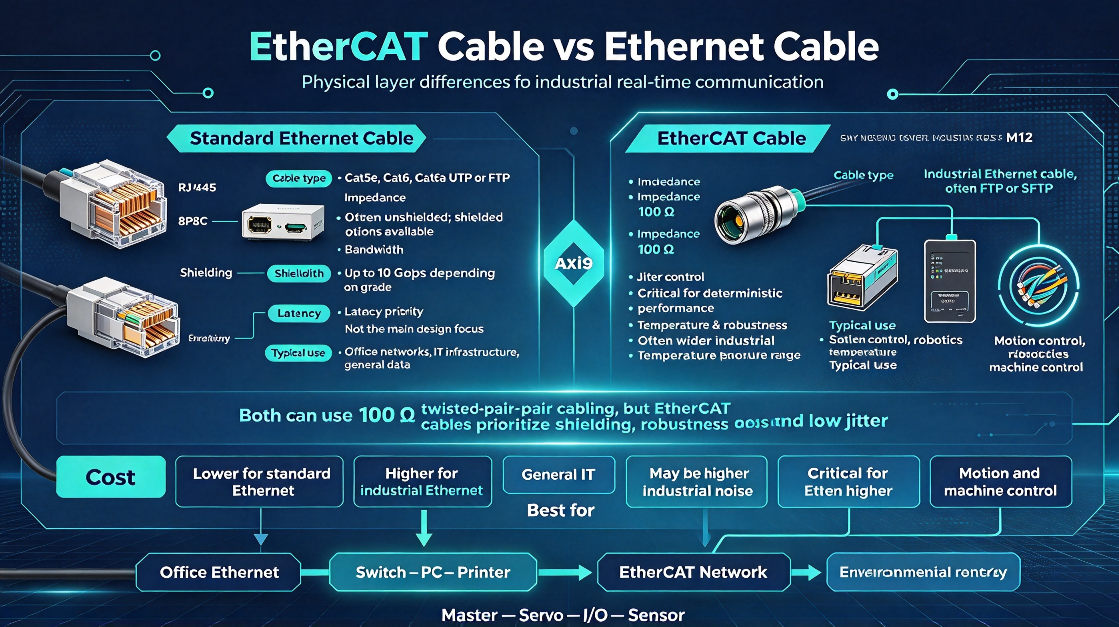
Ethernet is the broad networking standard used in offices, homes, and factories, while EtherCAT is a specialized real-time industrial protocol based on Ethernet frames. The main difference is purpose: Ethernet prioritizes flexible data communication, while EtherCAT prioritizes deterministic, low-latency machine control across automation devices.
Video Guide: This video explains how to choose between Ethernet and EtherCAT when designing an industrial network.
Definição e propósito central
Ethernet is a family of networking technologies defined mainly by IEEE 802.3. It supports many types of traffic, including internet access, file transfer, video streaming, SCADA communication, and general device networking. Standard Ethernet is powerful and flexible, but it is not inherently deterministic because switches, congestion, and packet timing can introduce variable delays.
EtherCAT, short for Ethernet for Control Automation Technology, was created specifically for industrial automation. Instead of sending separate packets to each device in the traditional way, EtherCAT sends a frame that passes through multiple devices, and each device reads or writes its data “on the fly.” This makes EtherCAT especially effective for high-speed motion control and synchronized automation.
Com base em nossos dados internos e análises de mercado, aqui está o detalhamento:
| Categoria | Ethernet | EtherCAT |
|---|---|---|
| Uso primário | Rede geral | Real-time industrial automation |
| Timing behavior | Non-deterministic unless enhanced | Deterministic by design |
| Common devices | PCs, routers, switches, cameras, PLCs | Servo drives, I/O modules, sensors, motion controllers |
| Network traffic | Broad data communication | Cyclic control data |
| Typical priority | Flexibility and compatibility | Speed, synchronization, and low latency |
Dica profissional do cwcables: If your application is ordinary device communication, standard Ethernet is usually enough. If you are controlling synchronized drives, robotics, or high-speed I/O, I recommend designing around EtherCAT from the start.
How Does ethercat vs ethernet Work?
Ethernet typically sends packets between devices through switches, with each device receiving traffic addressed to it. EtherCAT works differently: one frame travels through a chain of devices, and each node processes data as the frame passes, creating much faster cycle times and more predictable control behavior.
Video Guide: This motion-control webinar is useful for understanding how EtherCAT achieves fast, synchronized machine communication.
Communication Method and Data Flow
In a standard Ethernet network, devices communicate using frames that are routed or switched across the network. A computer, PLC, or controller sends data to another device, and switches forward frames based on MAC addresses. This model is excellent for mixed traffic, but timing can vary when traffic loads change.
EtherCAT uses a master-slave communication model. The EtherCAT master sends a single Ethernet frame through all connected slave devices. Each slave reads its assigned output data and inserts its input data while the frame is moving through the device. The frame then returns to the master, completing the communication cycle.
This “processing on the fly” approach is why EtherCAT is so fast.
Typical EtherCAT communication flow:
- The EtherCAT master sends one process-data frame.
- The frame enters the first slave device.
- Each slave reads relevant command data from the frame.
- Each slave writes feedback or input data into the same frame.
- The frame continues through the network with minimal delay.
- The master receives the updated frame and starts the next control cycle.
| Função | Ethernet padrão | EtherCAT |
|---|---|---|
| Data handling | Packet-by-packet communication | One frame processed by many devices |
| Device access | Usually addressed individually | Devices process data in sequence |
| Timing | Variable under load | Highly predictable |
| Synchronization | Requires extra protocols | Built into the EtherCAT system |
| Melhor ajuste | General network traffic | Real-time control loops |
Dica profissional do cwcables: When troubleshooting EtherCAT, I always check topology, cable quality, shielding, and grounding before replacing devices. Physical-layer problems often look like protocol problems in high-speed automation systems.
Posso usar um cabo Ethernet para EtherCAT?
Yes, you can often use Ethernet cable for EtherCAT if it meets the required category, shielding, length, and industrial durability needs. However, ethercat cable vs ethernet cable decisions should consider motion, EMI exposure, connector type, bend radius, and whether the cable is rated for factory environments.
Video Guide: This motion-control session provides practical context for cabling and network design choices in Ethernet-based automation.
Cable Compatibility and Industrial Requirements
EtherCAT uses standard Ethernet physical layers, so many EtherCAT networks can run on common twisted-pair Ethernet cables, especially Cat5e or better. For many control cabinet installations, a high-quality Cat5e Ethernet cable may work correctly if the environment is clean, the cable run is short, and there is limited electrical noise.
However, industrial EtherCAT installations often need more than basic Ethernet cable. Factory environments may include servo drives, Inversores de frequência, welding systems, robotics, high-flex cable tracks, oil exposure, vibration, and interferência eletromagnética. In these conditions, industrial Ethernet or EtherCAT-rated cable is the safer choice.
Com base em nossos dados internos e análises de mercado, aqui está o detalhamento:
| Cable Factor | Cabo Ethernet Padrão | EtherCAT/Industrial Ethernet Cable |
|---|---|---|
| Electrical compatibility | Often compatible | Designed for industrial Ethernet performance |
| Blindagem | May be unshielded or lightly shielded | Often shielded for EMI resistance |
| Vida flexível | Geralmente limitado | Available in high-flex and drag-chain versions |
| Material da jaqueta | Office/commercial grade | PUR, PVC, TPE, or oil-resistant options |
| Ambiente | Offices, panels, light-duty areas | Machines, robots, factories, harsh environments |
| Opções de conector | RJ45 common | RJ45, M8, M12, ruggedized connectors |
For stable EtherCAT performance, pay attention to these practical rules:
- Use Cat5e or higher cable for 100BASE-TX EtherCAT networks.
- Keep copper cable runs within the standard 100-meter segment limit.
- Use shielded cable in electrically noisy environments.
- Choose high-flex cable for moving axes or cable carriers.
- Match connector style to the device and enclosure rating.
- Avoid tight bends, crushed jackets, and poor shield termination.
Dica profissional do cwcables: If a machine has servo drives or VFDs nearby, I would not rely on basic office Ethernet patch cords. At cwcables, we recommend shielded industrial Ethernet cable for EtherCAT networks where uptime matters.
What are the three types of Ethernet?
The three common ways to classify Ethernet are by speed, transmission medium, and application environment. In practical terms, users often compare Fast Ethernet, Gigabit Ethernet, and higher-speed Ethernet, while industrial users also distinguish standard Ethernet, Industrial Ethernet, and real-time Ethernet protocols like EtherCAT.
Video Guide: This comparison of Ethernet/IP, PROFINET, and EtherCAT helps explain how industrial Ethernet types differ in automation networks.
Ethernet Categories Used in Practice
Ethernet can be grouped in several ways, so the “three types” depends on context. In general IT networking, people often classify Ethernet by speed. In industrial automation, people usually classify it by protocol behavior and real-time capability.
The most useful breakdown for automation buyers is:
- Ethernet padrão
Used for normal networking between computers, switches, HMIs, cameras, and general devices. It is flexible and widely supported but not inherently deterministic.
- Ethernet Industrial
Uses Ethernet technology in rugged factory environments. It may include industrial switches, shielded cables, rugged connectors, and protocols such as Ethernet/IP, PROFINET, Modbus TCP, and others.
- Real-Time Industrial Ethernet
Designed for time-critical automation. EtherCAT belongs here because it provides deterministic control, fast cycle times, and precise synchronization for motion and I/O.
Com base em nossos dados internos e análises de mercado, aqui está o detalhamento:
| Ethernet Type | Uso típico | Real-Time Capability | Example Applications |
|---|---|---|---|
| Ethernet padrão | Rede de dados geral | Low without enhancements | PCs, printers, routers, office networks |
| Ethernet Industrial | Factory communication | Medium to high depending on protocol | PLCs, HMIs, SCADA, machine networks |
| Real-time Ethernet | Motion and control | Alto | EtherCAT drives, robotics, synchronized I/O |
Another common speed-based classification includes:
- Fast Ethernet: 100 Mbps, widely used in many automation networks.
- Gigabit Ethernet: 1 Gbps, common for high-bandwidth data systems.
- 10 Gigabit Ethernet and above: Used for servers, vision systems, data centers, and advanced industrial applications.
Dica profissional do cwcables: Do not choose cable only by speed rating. I look at the full environment: protocol, EMI, flexing, oil exposure, connector style, and installation method.
What are the limitations of EtherCAT?
EtherCAT is extremely fast and reliable for real-time automation, but it is not always the best choice for every network. Its limitations include master dependency, engineering complexity, device compatibility requirements, topology planning, and the need for proper industrial cabling and installation practices.
Video Guide: This comparison helps show where EtherCAT is strong and where other industrial Ethernet options may be more suitable.
Practical Constraints in Real Installations
EtherCAT is one of the strongest choices for deterministic automation, but it is specialized. That specialization creates design requirements that are different from ordinary Ethernet networks.
For example, EtherCAT depends on a capable master controller. If the master configuration is incorrect, the network may not run as expected. Device files, synchronization settings, distributed clocks, cycle times, and topology order can all matter. This is very different from plugging a laptop into a normal Ethernet switch.
Key limitations include:
- Not intended for general IT traffic: EtherCAT is optimized for control data, not mixed office networking.
- Requires EtherCAT-compatible devices: Standard Ethernet devices cannot simply operate as EtherCAT slaves.
- Master configuration is critical: Performance depends on correct setup, device descriptions, and timing parameters.
- Topology must be planned carefully: Line, tree, star, and ring options exist, but the physical layout affects diagnostics and reliability.
- Cable quality matters: Poor shielding, damaged connectors, or excessive bend stress can cause intermittent faults.
- Learning curve is higher: Engineers need knowledge of EtherCAT configuration, synchronization, and diagnostics.
- Standard switches are not used the same way: EtherCAT normally passes frames through slave devices rather than relying on conventional switched Ethernet behavior.
| Limitação | Por que é importante | Practical Mitigation |
|---|---|---|
| Master dependency | Network timing comes from the controller | Use a proven EtherCAT master platform |
| Device compatibility | Slaves must support EtherCAT | Confirm device certification and ESI files |
| Installation sensitivity | Noise and cabling faults affect uptime | Use industrial shielded cable and proper grounding |
| Engineering complexity | Setup is more involved than standard Ethernet | Document topology and validate cycle times |
| Limited IT flexibility | Not designed for mixed office traffic | Separate control and enterprise networks |
Dica profissional do cwcables: I recommend treating EtherCAT as a control system, not just a network. Good documentation, labeled cables, correct shielding, and spare tested cables can save hours during commissioning.
Principais recursos e comparação
Ethernet is best for broad compatibility and general communication, while EtherCAT is best for deterministic automation, synchronized motion, and fast I/O updates. The right choice depends on whether your priority is flexible networking or precise real-time machine control.
Side-by-Side Technical Comparison
Com base em nossos dados internos e análises de mercado, aqui está o detalhamento:
| Recurso | Ethernet | EtherCAT |
|---|---|---|
| Technology type | General networking standard | Real-time industrial Ethernet protocol |
| Objetivo principal | Data communication | Machine and motion control |
| Determinismo | Not guaranteed by default | Highly deterministic |
| Latência | Variable depending on traffic and switches | Very low and predictable |
| Synchronization | Requires additional methods | Distributed clocks supported |
| Topologia | Star is common; also bus/ring with equipment | Line, tree, star, and ring supported |
| Switch dependency | Switches commonly used | Often passes through slave devices directly |
| Device compatibility | Muito amplo | Requires EtherCAT-capable slaves |
| Cabling | Cat5e/Cat6/Cat6A and fiber options | Often Cat5e or better industrial Ethernet cable |
| Melhores aplicativos | IT networks, cameras, PLC-to-HMI, SCADA | Servo drives, robots, packaging machines, CNC, synchronized I/O |
| Setup complexity | Baixo a moderado | Moderado a alto |
| Cost profile | Lower for simple networks | Higher engineering value for real-time systems |
| Failure diagnostics | Familiar IT tools | EtherCAT-specific diagnostics often needed |
Important selection factors:
- Escolher Ethernet for general connectivity, enterprise systems, web access, file transfer, and non-critical timing.
- Escolher EtherCAT for high-speed automation, coordinated motion, multi-axis control, and deterministic I/O.
- Escolher industrial-grade cable when the network is exposed to EMI, motion, vibration, oil, or harsh environments.
- Separate general Ethernet traffic from EtherCAT control traffic unless your architecture specifically supports safe integration.
Dica profissional do cwcables: For machine builders, I usually suggest designing the EtherCAT network separately from the plant Ethernet network. That separation improves reliability, simplifies troubleshooting, and protects real-time performance.
Fatores de custo e compra
Ethernet networks are usually cheaper to build for general communication, while EtherCAT systems may cost more upfront due to specialized controllers, devices, and engineering time. However, EtherCAT can reduce total machine cost when fast cycle times, fewer wires, and synchronized motion improve performance.
Guia de preços e critérios de seleção
Ethernet cost is often driven by cable category, switch count, connector quality, bandwidth, and installation labor. EtherCAT cost is more closely tied to the automation platform, compatible slave devices, commissioning time, and industrial cabling requirements.
For simple networks, standard Ethernet usually wins on cost. For high-performance machinery, EtherCAT may deliver better value because it can reduce control latency, simplify wiring, and improve machine throughput.
Com base em nossos dados internos e análises de mercado, aqui está o detalhamento:
| Fator de compra | Ethernet Cost Impact | EtherCAT Cost Impact |
|---|---|---|
| Cabo | Baixo a moderado | Moderate if shielded/high-flex industrial cable is needed |
| Conectores | RJ45 often inexpensive | Rugged RJ45, M8, or M12 may increase cost |
| Switches | Frequentemente necessário | May be reduced depending on topology |
| Controllers | Broad options | Requires EtherCAT master capability |
| Field devices | Many low-cost choices | Must be EtherCAT-compatible |
| Engineering time | Geralmente mais baixo | Higher during setup and tuning |
| Risco de tempo de inatividade | Depende do ambiente | Strong performance if installed correctly |
| Valor de longo prazo | Best for flexible data networks | Best for high-speed automation systems |
When buying cables or components, evaluate:
- Protocol requirement: Confirm whether the device uses standard Ethernet, EtherNet/IP, PROFINET, EtherCAT, or another protocol.
- Categoria de cabo: Cat5e is common for many EtherCAT applications, but Cat6 or Cat6A may be selected for broader Ethernet infrastructure.
- Blindagem: Use shielded cable near motors, drives, welding equipment, or high-noise machinery.
- Avaliação flexível: Use high-flex cable for moving machine sections, robots, and drag chains.
- Tipo de conector: Match RJ45, M8, M12, or ruggedized connectors to the device and enclosure.
- Material da jaqueta: Select PVC, PUR, TPE, or oil-resistant jackets based on the environment.
- Certificação e testes: Use properly tested cable assemblies for critical automation networks.
Dica profissional do cwcables: The cheapest patch cord is rarely the cheapest solution if it causes intermittent machine stops. I recommend choosing cables based on the real installation environment, not just the port type.
Conclusão
The difference between Ethernet and EtherCAT comes down to purpose and timing. Ethernet is the universal networking foundation for flexible communication, while EtherCAT is a high-performance industrial protocol for deterministic automation. For cable selection, focus on category, shielding, flex rating, connectors, and factory conditions.
Final Recommendation for Industrial Networks
If you need office networking, HMI communication, camera data, or general PLC connectivity, standard Ethernet is usually the practical choice. It is widely supported, cost-effective, and easy to maintain.
If you need synchronized motion, fast I/O response, multi-axis control, robotics, or precise machine timing, EtherCAT is often the better engineering choice. It uses Ethernet-based physical communication but operates with a control-focused method designed for deterministic performance.
Use este guia de decisão rápida:
- Escolher Ethernet when timing is not mission-critical.
- Escolher EtherCAT when deterministic real-time control is required.
- Escolher cabo industrial blindado when EMI is present.
- Escolher high-flex cable for moving applications.
- Escolher rugged connectors for washdown, vibration, or harsh environments.
- Escolher cabos cw when you need application-focused cable support for Ethernet, EtherCAT, and industrial automation installations.
Dica profissional do cwcables: If you are unsure whether you need standard Ethernet cable or an EtherCAT-ready industrial cable assembly, start with the machine environment. I would rather over-spec cable protection slightly than risk unstable communication in production.