

Escolhendo o certo Profibus Cable depends on whether your CLP is communicating with high-speed factory devices or low-speed process instruments. In most PLC cabinets, a cable profibus dp connection is used for Profibus DP networks, while Profibus PA is typically used in hazardous or process areas through a DP/PA coupler. The key is matching cable type, connector style, speed, distance, and installation environment.
What is cable profibus dp?
A cable profibus dp is a shielded, twisted-pair industrial communication cable designed for Profibus DP networks, usually operating over RS-485. It connects PLCs, remote I/O, drives, IHMs, and other automation devices. Compared with Profibus PA cable, DP cable is built for faster factory automation communication rather than powered field instrumentation.
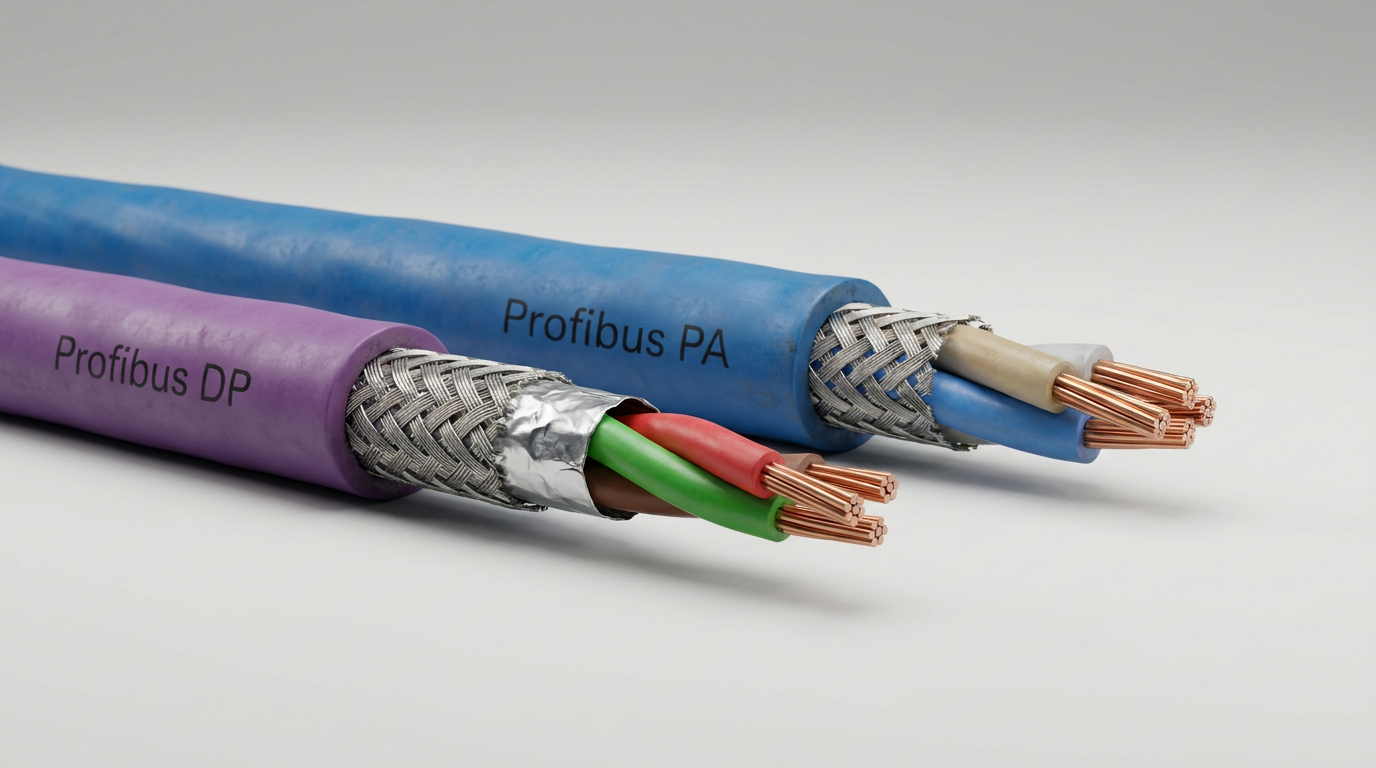
Basic Definition and Use Cases
A cable profibus dp is typically the standard purple Profibus Cable used inside control cabinets, along production lines, and between PLC-controlled devices. It is engineered for reliable data transmission in electrically noisy industrial environments, especially where motors, inverters, and switching equipment are present.
DP stands for Decentralized Peripherals, which means the PLC communicates with distributed field devices at high speed. PA stands for Process Automation, and it is usually used for instruments such as transmitters, valves, and sensors in process plants.
Com base em nossos dados internos e análises de mercado, aqui está o detalhamento:
| Item | Profibus DP Cable | Profibus PA Cable |
|---|---|---|
| Common application | PLCs, drives, remote I/O, HMIs | Process instruments, transmitters, valves |
| Typical physical layer | RS-485 | MBP / IEC 61158-2 |
| Cor comum do cabo | Roxo | Blue, especially in intrinsically safe areas |
| Data speed | Up to 12 Mbps | 31.25 kbps |
| Power over same cable | No, data only | Yes, data and power possible |
| PLC connection | Direct to DP port or module | Usually through DP/PA coupler or link |
Dica profissional do cwcables: I always check the PLC communication module first. If it says Profibus DP or RS-485, use cable profibus dp with proper Profibus connectors; if the field device is PA, plan for a DP/PA coupler instead of forcing the wrong cable type.
How Does cable profibus dp Work?
Cable profibus dp works by carrying differential RS-485 signals between a PLC master and multiple slave devices on a bus network. The shielded twisted pair reduces noise, while termination resistors at both ends stabilize communication. Correct cable impedance, connector wiring, grounding, and segment length are essential for dependable Profibus DP performance.
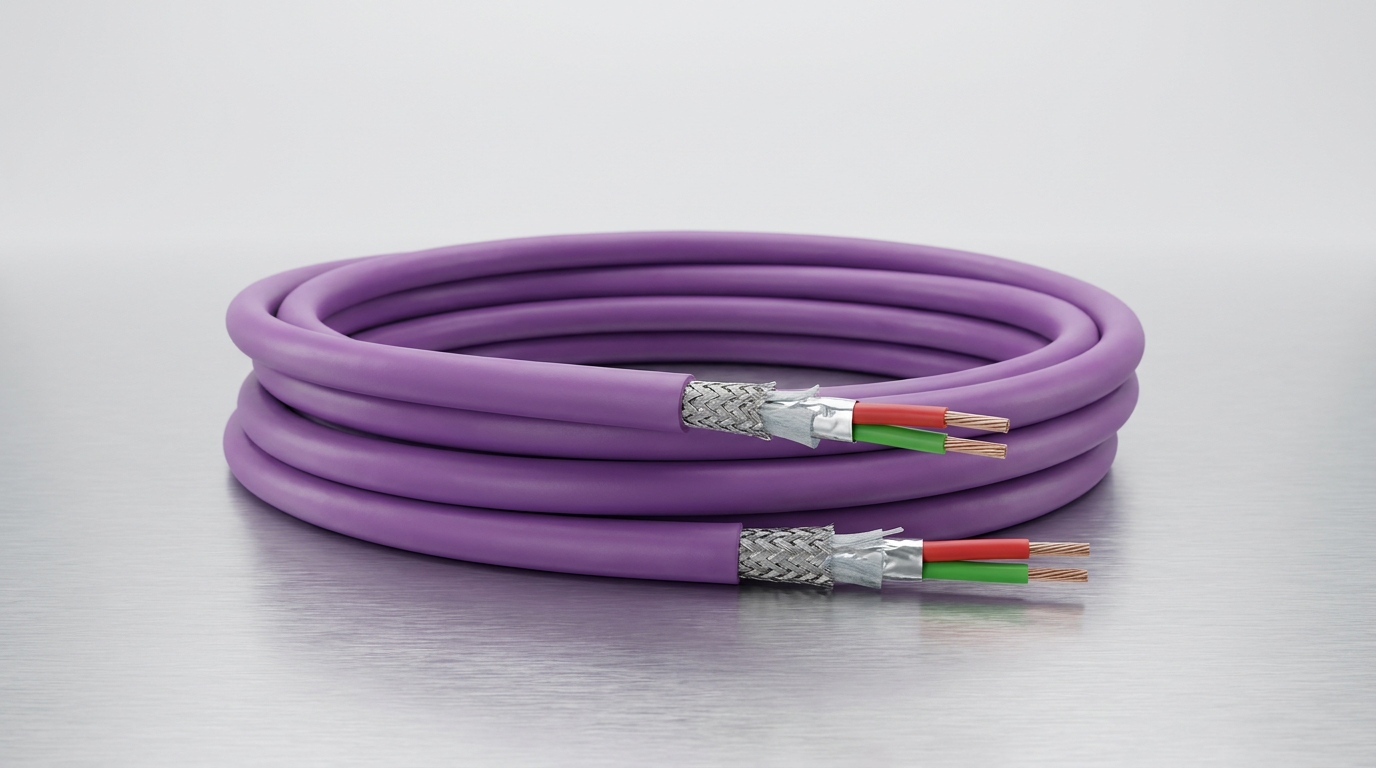
Signal Transmission and Network Layout
Profibus DP uses a bus topology, meaning devices are connected along one communication line rather than wired point-to-point back to the PLC. The PLC or master device polls each slave device in sequence, exchanging input and output data cyclically.
The cable itself is not just ordinary two-core wire. A proper Profibus Cable has controlled impedance, shielding, and conductor construction suitable for high-speed industrial communication. The Profibus connectors often include switchable termination resistors, making it easier to terminate the first and last devices correctly.
Key operating principles include:
- Differential signaling: Data is transmitted across two conductors, commonly referred to as A and B.
- Blindagem: The cable shield protects the signal from interferência eletromagnética.
- Bus termination: Both physical ends of the segment must be terminated to prevent signal reflection.
- Baud-rate-dependent distance: Higher speeds allow shorter cable lengths; lower speeds allow longer runs.
- Addressed devices: Each slave device must have a unique Profibus address.
- Continuidade do conector: Profibus connectors must maintain bus continuity even when devices are disconnected, depending on connector design.
Dica profissional do cwcables: When troubleshooting DP communication, I first inspect termination and connector wiring before replacing hardware. Many “PLC communication faults” are actually caused by one loose shield clamp, reversed A/B cores, or an unterminated bus end.
What are the benefits of cable profibus dp?
The main benefits of cable profibus dp are high-speed communication, strong noise resistance, wide PLC compatibility, and reliable multi-device networking. It is ideal for factory automation systems where PLCs must exchange data quickly with drives, I/O stations, sensors, and operator interfaces while maintaining stable communication in harsh electrical environments.
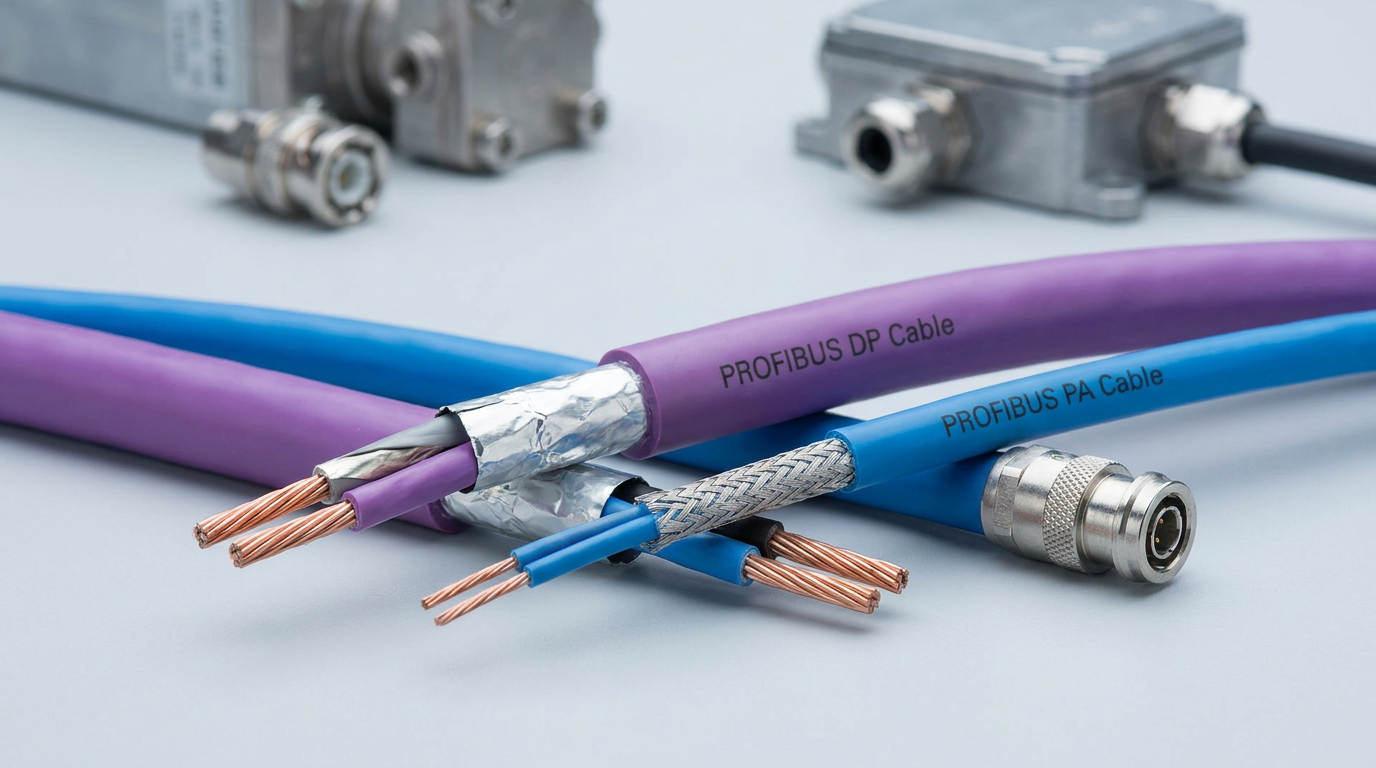
Performance Advantages in PLC Networks
Profibus DP remains widely used because it delivers deterministic communication. That means the PLC can exchange data with devices in a predictable cycle, which is important for machine control, conveyor systems, packaging lines, and process skids.
Unlike generic communication cable, cable profibus dp is built around the needs of industrial buses. Its shielding, impedance, and construction help prevent data errors that can stop production or create intermittent faults.
Os principais benefícios incluem:
- Fast communication: Supports high-speed PLC-to-device data exchange up to 12 Mbps.
- Reduced wiring complexity: Multiple devices can share one bus cable instead of individual home-run wiring.
- Strong device ecosystem: Compatible with many PLC brands, remote I/O stations, drives, encoders, and gateways.
- Industrial noise protection: Shielding helps protect communication from Inversores de frequência, motors, relays, and welding equipment.
- Easy expansion: Additional devices can be added when bus rules, addressing, and segment limits are respected.
- Proven reliability: Profibus DP is a mature standard used in many long-life industrial systems.
Dica profissional do cwcables: I recommend using certified Profibus Cable rather than standard shielded control cable. The cost difference is small compared with the downtime caused by random bus errors, especially near drives or high-current motor cables.
How to maintain a cable profibus dp?
To maintain a cable profibus dp, regularly inspect connectors, shielding, grounding, termination switches, bend radius, and cable routing. Most failures come from loose Profibus connectors, damaged jackets, poor shield bonding, incorrect termination, or cable runs installed too close to power wiring, inverters, or high-noise equipment.
Lista de verificação prática de manutenção
Maintenance should focus on preserving signal integrity. Profibus DP faults are often intermittent, which makes them harder to diagnose than a fully broken wire. A cable may look acceptable from the outside but still suffer from poor shielding, crushed conductors, or unreliable connector contact.
Use this routine inspection checklist:
- Check connector tightness: Ensure Profibus connectors are firmly seated and screws are secure.
- Verify termination: Confirm only the two physical ends of the bus are terminated.
- Inspect cable jacket: Look for cuts, crushing, oil damage, abrasion, or excessive bending.
- Check shield connection: Make sure the shield is properly clamped or bonded according to the system grounding design.
- Review cable routing: Keep Profibus Cable separated from high-voltage, motor, and VFD output cables.
- Confirm device addresses: Duplicate addresses can cause communication failures that resemble cable faults.
- Measure or diagnose the bus: Use a Profibus tester when available to check reflections, retries, and signal quality.
- Document changes: Record cable replacements, connector changes, and device additions.
Dica profissional do cwcables: I avoid opening every connector during routine checks unless there is a reason. Disturbing a stable Profibus connector can create new problems, so I start with visual checks, diagnostics, and termination verification first.
What is the price of cable profibus dp?
The price of cable profibus dp depends on conductor size, shielding quality, jacket material, certification, flexibility, flame rating, and order length. Standard fixed-installation cable is usually more economical, while drag-chain, outdoor, oil-resistant, or high-flex Profibus Cable costs more due to tougher construction and testing requirements.
Typical Pricing Variables
There is no single universal price because Profibus Cable is specified by installation conditions. A short control cabinet run may need standard cable, while moving machinery may require high-flex construction. Outdoor or chemical environments may require special jacket materials.
Com base em nossos dados internos e análises de mercado, aqui está o detalhamento:
| Fator de compra | Opção de custo mais baixo | Opção de custo mais alto | Por que é importante |
|---|---|---|---|
| Tipo de instalação | Instalação fixa | Drag-chain or robotic flex | Moving cable needs better fatigue resistance |
| Material da jaqueta | PVC padrão | PUR, PE, oil-resistant, UV-resistant | Harsh environments require stronger jackets |
| Blindagem | Standard braid/foil design | Blindagem aprimorada | Better EMC protection near drives |
| Certificação | Industrial geral | Certified Profibus specification | Reduces compatibility and signal issues |
| Comprimento | Carretel em massa | Short custom assemblies | Assemblies include labor and connectors |
| Tipo de conector | Basic straight connector | Angled, diagnostic, fast-connect | Connector features affect installation speed |
Dica profissional do cwcables: I suggest pricing the complete link, not just the cable. Include Profibus connectors, termination needs, panel routing, spare length, and installation labor because a cheaper cable can become expensive if it causes rework or unstable communication.
Principais recursos e comparação
Profibus DP and Profibus PA are not interchangeable, even though both belong to the Profibus family. DP is normally the PLC-side high-speed network for factory automation, while PA is designed for process instruments and may carry power with data. Your PLC usually needs DP cable unless it connects through PA infrastructure.
DP vs PA Feature Comparison
Com base em nossos dados internos e análises de mercado, aqui está o detalhamento:
| Recurso | Profibus DP | Profibus PA | What It Means for Your PLC |
|---|---|---|---|
| Função principal | High-speed device communication | Process field instrumentation | PLC cabinets usually use DP |
| Physical layer | RS-485 | MBP / IEC 61158-2 | Different signaling methods |
| Tipo de cabo | Shielded twisted pair, 150-ohm nominal | Instrumentation-style fieldbus cable | Cable selection must match network type |
| Velocidade | 9.6 kbps to 12 Mbps | 31.25 kbps | DP is much faster |
| Power and data | Data only | Power and data possible | PA can power field instruments |
| Typical connector | 9-pin D-sub Profibus connectors, M12 variants | Terminal blocks, fieldbus connectors | Connector style depends on device |
| Installation zone | Factory automation, cabinets, machines | Process areas, hazardous zones | PA is common in chemical and process plants |
| PLC integration | Direct DP master/module | Through DP/PA coupler or link | Most PLCs do not connect directly to PA cable |
| Rescisão | Active termination at segment ends | Fieldbus termination at segment ends | Both require correct termination |
| Erro comum | Using generic control cable | Connecting PA device directly to DP port | Both can cause communication failure |
The most important distinction is the physical layer. Profibus DP over RS-485 expects a specific cable impedance and termination arrangement. Profibus PA uses a different transmission method and is often selected where long field instrument runs, hazardous-area requirements, and power delivery over the same pair are important.
If your PLC has a Profibus DP master port, it needs cable profibus dp on the DP segment. If your instruments are Profibus PA, the PLC still normally communicates over DP to a DP/PA coupler or link, and the PA cable starts after that interface.
Dica profissional do cwcables: I never choose DP or PA based only on cable color. I confirm the device port, protocol marking, wiring diagram, and hazardous-area requirements before ordering cable or Profibus connectors.
Fatores de custo e compra
When buying cable profibus dp, evaluate the full installation instead of comparing only meter price. The right choice depends on baud rate, segment length, electrical noise, connector type, motion requirements, approvals, and environmental exposure. A properly specified cable reduces commissioning time and prevents costly intermittent network faults.
Guia de compra para seleção confiável
A good purchasing decision starts with the PLC network design. Cable that works in a clean control cabinet may not survive on a moving axis, near a welding cell, or outdoors. The same applies to Profibus connectors: a basic connector may be fine in a panel, while fast-connect or angled versions may save time in tight field installations.
Consider these buying factors before placing an order:
- Network type: Confirm whether the system is Profibus DP or Profibus PA.
- PLC interface: Check whether the PLC has a DP master, DP slave, or communication module.
- Construção do cabo: Choose fixed, flexible, high-flex, outdoor, or oil-resistant cable as needed.
- Estilo do conector: Select straight, angled, fast-connect, diagnostic, M12, or D-sub Profibus connectors.
- Baud rate and distance: Verify that the planned segment length supports the required speed.
- EMC environment: Use high-quality shielding and proper grounding near drives and motors.
- Método de instalação: Account for tray, conduit, cabinet routing, drag chain, or machine movement.
- Spare and maintenance needs: Keep spare connectors, termination plugs, and labeled cable sections available.
- Suporte ao fornecedor: Work with a cable supplier that understands industrial communication requirements.
Dica profissional do cwcables: I prefer ordering a little extra length and spare connectors with the first purchase. It costs less than stopping a commissioning job because the team is short one Profibus connector or needs to reroute a cable around unexpected interference.
Conclusão
For most PLC automation networks, the correct choice is cable profibus dp, especially when connecting remote I/O, drives, HMIs, and other high-speed devices. Profibus PA is better suited for process instrumentation and usually connects through a DP/PA coupler. Matching the cable to the network prevents communication faults and downtime.
Orientação de Seleção Final
The simplest way to decide is to start at the PLC port. If the PLC or communication module is labeled Profibus DP, use a compliant DP cable and suitable Profibus connectors. If the field instrument is Profibus PA, plan the architecture around a DP/PA coupler or link rather than connecting it directly to the DP segment.
Use este caminho de decisão rápida:
- Check the PLC communication port: Look for Profibus DP, RS-485, or module documentation.
- Identify the field device type: Drives and remote I/O are usually DP; transmitters and valves may be PA.
- Confirm the network interface: Use DP cable for DP segments and PA cable for PA segments.
- Select the right connectors: Match connector type to device port and installation space.
- Verify termination and shielding: Proper installation is as important as the cable itself.
- Choose a trusted supplier: Work with cwcables for Profibus Cable options matched to industrial applications.
Dica profissional do cwcables: My final check is always simple: protocol, port, cable, connector, termination. If those five items match, the Profibus network is far more likely to commission cleanly and run reliably.