

Choosing between a crane festoon cable system and a crane reel cable system affects travel distance, cable service life, installation cost, maintenance workload, and overall crane reliability. Festoon systems are widely used on bridge cranes y hoists with supported cable loops, while reeling systems are preferred where long travel, compact cable storage, or automated payout and retrieval are required.
What is festoon vs reeling cable,crane festoon cable,crane reel cable?
A crane festoon cable is carried in moving loops on trolleys along a track, while a crane reel cable winds and unwinds from a spring-driven or motorized reel. The best choice depends on crane travel length, speed, available space, cable weight, duty cycle, and whether power, control, or data transmission is required.
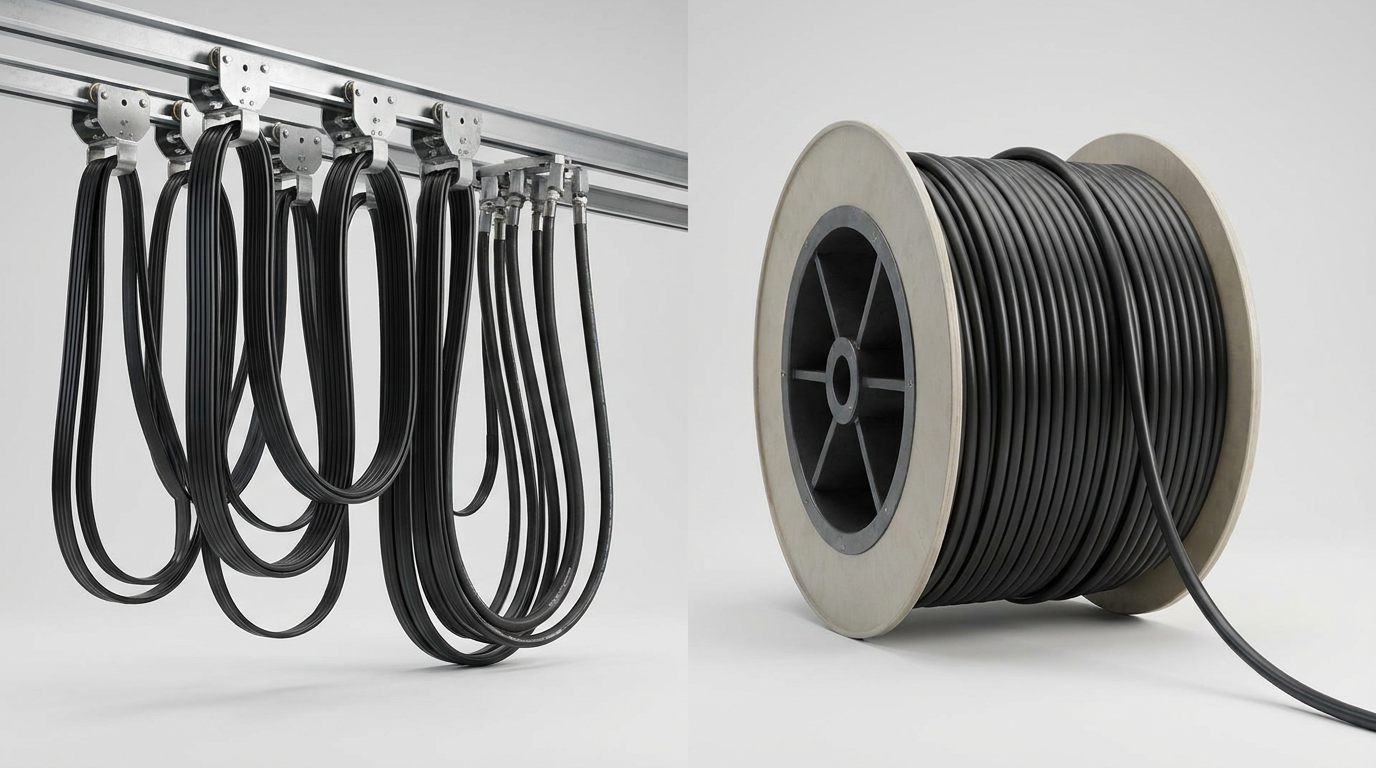
Basic Definition and Application Scope
A festoon system supports flat or round crane cable in hanging loops. The cable travels with the crane or hoist using carriers, trolleys, clamps, and a guide rail or C-track. It is widely used on overhead cranes, gantry cranes, monorails, hoists, and indoor material handling systems.
A reeling system stores cable on a drum and pays it out as the crane moves. The reel may use spring tension, motor drive, magnetic coupling, or frequency-controlled operation. Crane reel cable is typically used where travel distances are longer, where cable loops would interfere with equipment, or where controlled winding is necessary.
Según nuestros datos internos y análisis de mercado, aquí está el desglose:
| Artículo | Crane Festoon Cable | Crane Reel Cable |
|---|---|---|
| Movimiento de cables | Travels in supported loops | Winds and unwinds on a drum |
| Common cable shape | Flat or round | Usually round |
| Typical crane use | Bridge cranes, hoists, indoor gantries | Gantry cranes, port cranes, transfer carts, stackers |
| Lo mejor para | Viajes cortos a medianos | Medium to long travel |
| Ventaja principal | Simple, visible, easy to service | Compact cable storage and longer travel capability |
| Limitación principal | Requires loop space | Requires correct reel torque and winding control |
Consejo profesional de cwcables: When I help customers compare festoon vs reeling cable, I first check the available cable loop space. If the crane bay has limited headroom or obstructions, a reel system often becomes the more practical solution.
How Does festoon vs reeling cable,crane festoon cable,crane reel cable Work?
Festoon cable works by moving along a rail in suspended loops as the crane travels, keeping the cable supported and protected from excessive tension. Reeling cable works by winding onto a drum and unwinding under controlled tension, allowing power and signals to follow moving equipment over longer or more restricted travel paths.
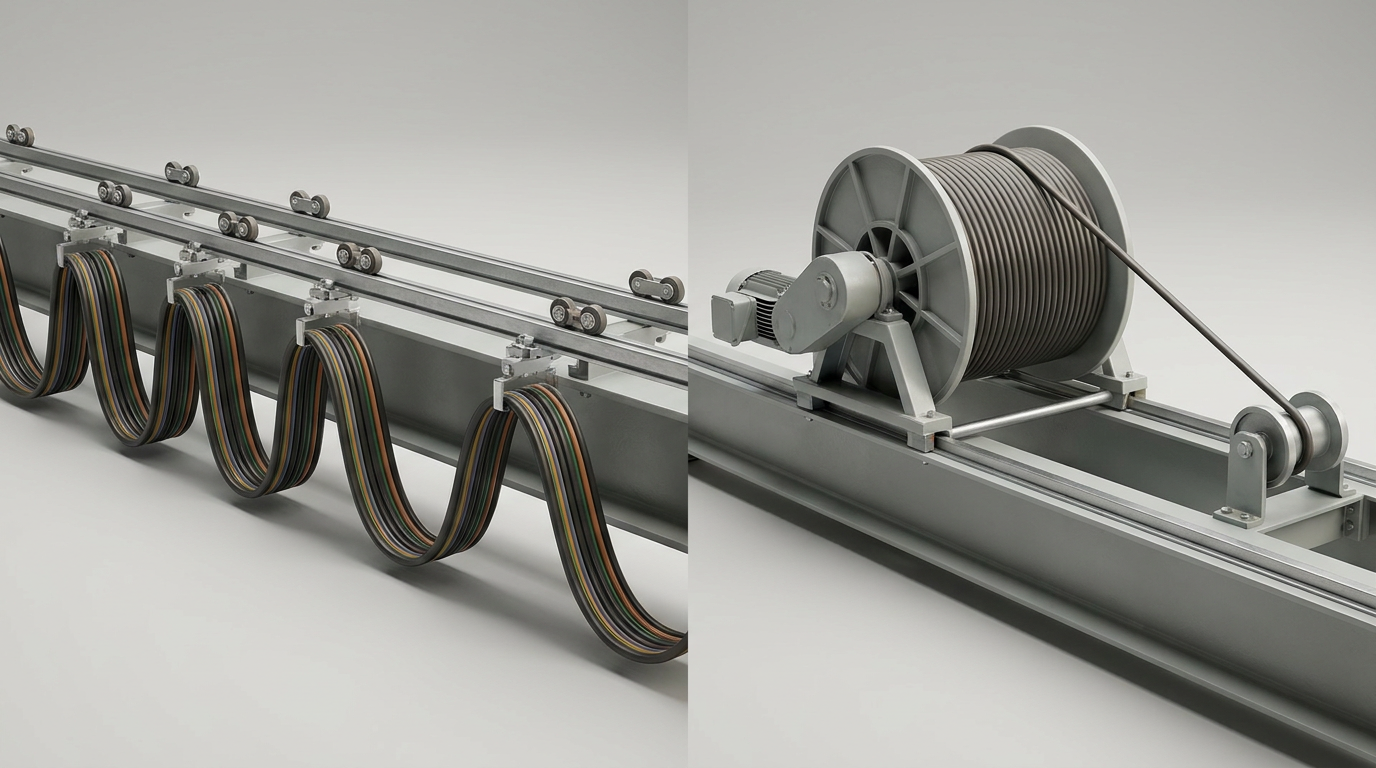
Operating Principle and Cable Movement
In a festoon system, the cable is clamped to a series of trolleys. As the crane or hoist moves, the trolleys spread apart or gather together, allowing the cable loops to expand and contract. This design minimizes pulling force on the cable, reduces mechanical stress, and makes inspection straightforward.
In a reeling system, the cable drum rotates to release or retrieve cable. Spring reels are common for shorter and lighter-duty movement, while motorized reels are used for longer travel, heavy cable, higher speed, or frequent operation. The cable must wind evenly to prevent crushing, twisting, or layering damage.
A typical operation sequence is:
- The crane starts moving along its travel path.
- The festoon trolleys roll along the rail, or the cable reel begins rotating.
- Cable is paid out or gathered while maintaining controlled radio de curvatura.
- Power, control, and data signals remain connected to the moving crane.
- At the end of travel, the system stops without overstretching or over-winding the cable.
Consejo profesional de cwcables: I always recommend checking minimum bend radius before selecting either system. Even a high-quality crane festoon cable or crane reel cable can fail early if the installation forces it into a tighter bend than designed.
What are the benefits of festoon vs reeling cable,crane festoon cable,crane reel cable?
The main benefit of a festoon system is simple, reliable cable support with easy inspection and maintenance. The main benefit of a reeling system is compact cable management for longer travel and limited-space applications. Both solutions improve crane safety, cable protection, and power delivery when correctly matched to the crane duty cycle.
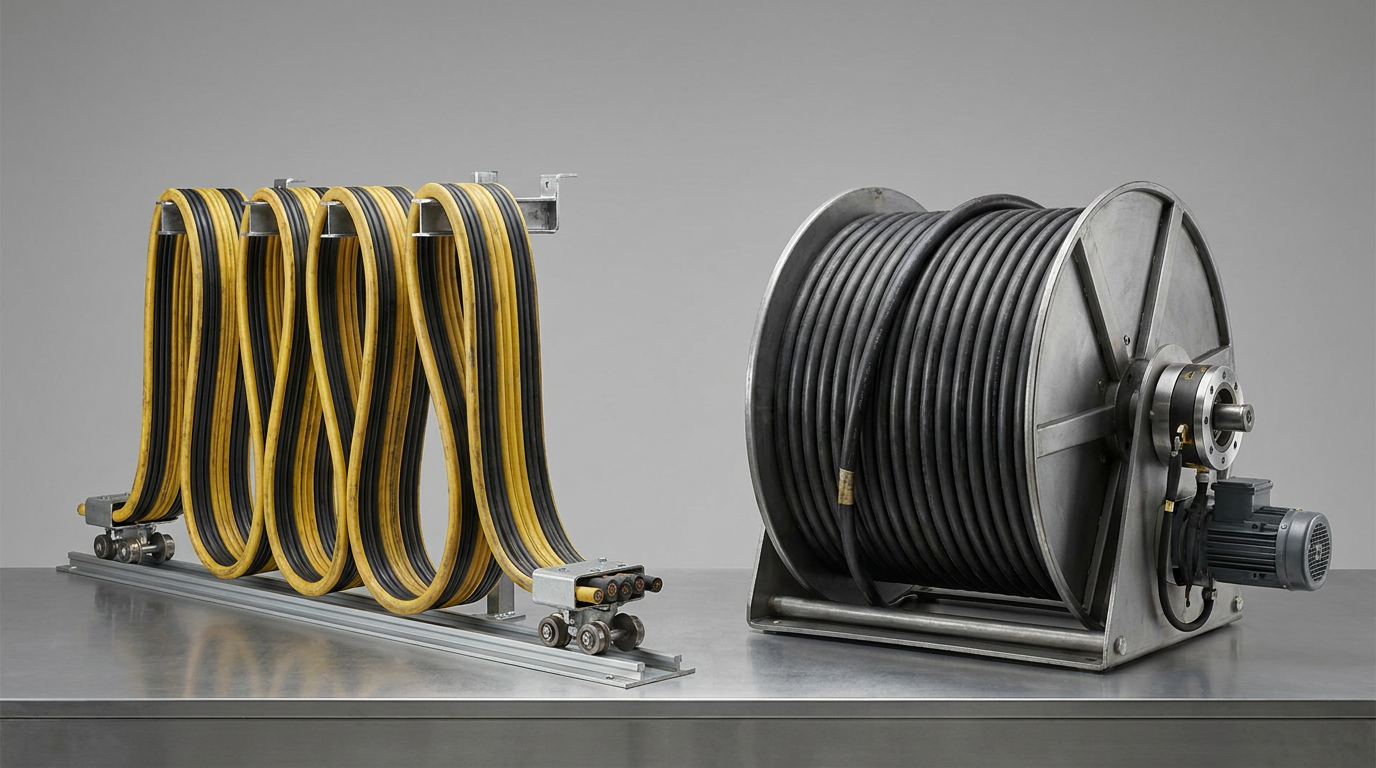
Performance Advantages by Crane Application
Festoon and reeling systems solve the same basic problem: delivering electrical power, control signals, and sometimes data to moving crane equipment. However, they do it in different ways, and each system has a clear performance advantage in the right environment.
Según nuestros datos internos y análisis de mercado, aquí está el desglose:
| Área de beneficios | Festoon Cable System | Reeling Cable System |
|---|---|---|
| Simplicidad de instalación | Alto | Medio |
| Maintenance visibility | Excelente | Moderado |
| Long travel capability | Limited to medium | Fuerte |
| Eficiencia espacial | Requires loop area | Compact cable storage |
| Cable tension control | Naturally low when designed well | Requires reel torque control |
| Suitability for automation | Bien | Muy bien |
| Outdoor heavy-duty use | Good with proper components | Excellent with correct reel and cable |
| Initial cost | Often lower | Often higher |
Festoon systems are especially valuable where operators want a visible, mechanical cable management setup that technicians can inspect quickly. Reeling systems are better where cable loops may interfere with loads, structures, vehicles, or crane movement.
Consejo profesional de cwcables: If your crane has frequent starts and stops, I usually look closely at acceleration, travel speed, and cable weight. These three factors decide whether a festoon trolley arrangement or a powered reel will protect the cable better.
How to maintain a festoon vs reeling cable,crane festoon cable,crane reel cable?
Maintenance should focus on cable jacket condition, trolley or reel movement, bend radius, mounting hardware, cable tension, and electrical continuity. Festoon systems need regular inspection of trolleys, clamps, and loop spacing, while reeling systems require checks on drum winding, slip rings, reel torque, guides, and cable layering.
Lista de verificación de inspección y mantenimiento preventivo
A crane cable system should be inspected before visible failure occurs. Most premature cable problems are caused by mechanical stress, abrasion, over-tension, incorrect bending, poor alignment, or contamination from oil, chemicals, water, or metal dust.
Utilice esta práctica lista de verificación de mantenimiento:
- Inspect the outer sheath for cracks, cuts, flattening, swelling, or abrasion.
- Check that festoon trolleys roll smoothly without jamming or skewing.
- Confirm cable clamps are secure but not crushing the cable.
- Verify loop depth and spacing remain consistent across the travel path.
- For reel systems, inspect cable winding layers for crossing, piling, or crushing.
- Check reel spring tension, motor drive, torque control, and limit switches.
- Inspect cable guides, rollers, and fairleads for wear or sharp edges.
- Test conductor continuity and insulation resistance during planned shutdowns.
- Clean dust, oil, and debris from moving components.
- Replace damaged cable immediately if conductors are exposed or insulation is compromised.
Consejo profesional de cwcables: I prefer scheduling cable inspections around crane duty, not just calendar dates. A high-cycle production crane may need weekly visual checks, while a low-use maintenance crane may only need monthly or quarterly inspection.
What is the price of festoon vs reeling cable,crane festoon cable,crane reel cable?
Pricing depends on cable type, conductor size, core count, shielding, jacket material, travel length, duty rating, and required accessories. Festoon cable systems are often more economical for shorter travel, while crane reel cable systems usually cost more because the reel mechanism, winding control, and heavy-duty cable construction add complexity.
Price Drivers and Budget Ranges
The cable itself is only one part of the total cost. A complete festoon solution may include C-track, trolleys, end clamps, towing arms, junction boxes, and installation labor. A complete reel solution may include the reel drum, slip ring assembly, motor or spring mechanism, cable guide, mounting bracket, and control components.
Según nuestros datos internos y análisis de mercado, aquí está el desglose:
| Factor de costo | Impacto en el precio | Notas |
|---|---|---|
| Longitud del cable | Alto | Longer travel increases both cable and hardware cost |
| Tamaño del conductor | Alto | Las secciones transversales de cobre más grandes aumentan el coste del material |
| recuento de núcleos | Medio a alto | More cores are needed for control, power, and signals |
| Material de la chaqueta | Medio | PUR, rubber, and specialty compounds vary in cost |
| Blindaje | Medio | Needed for VFD, signal, or data protection |
| ciclo de trabajo | Alto | Higher cycle ratings require stronger construction |
| System hardware | Alto | Reels are typically more expensive than festoon hardware |
| Ambiente | Medio | Outdoor, UV, oil, flame, and low-temperature resistance add cost |
For accurate pricing, buyers should provide voltage, current, number of cores, travel distance, speed, operating environment, installation method, and crane duty class.
Consejo profesional de cwcables: When customers ask for the lowest price, I remind them to compare total lifecycle cost. A slightly better cable jacket or higher-flex construction can save far more than the initial price difference by reducing downtime.
Características clave y comparación
Festoon cable systems are simple, accessible, and cost-effective for many overhead crane applications, while reeling cable systems provide better cable storage and longer travel capability. The right decision should consider travel distance, crane speed, space, cable weight, environment, maintenance access, and whether the crane requires power, control, data, or mixed transmission.
Side-by-Side Technical Comparison
Según nuestros datos internos y análisis de mercado, aquí está el desglose:
| Característica | Crane Festoon Cable | Crane Reel Cable | Guía de selección |
|---|---|---|---|
| Distancia de viaje | Corto a medio | Medium to long | Choose reel for longer travel paths |
| Space requirement | Needs loop storage space | Compact drum storage | Choose reel where loop clearance is limited |
| Complejidad de instalación | Más bajo | Más alto | Choose festoon for simpler installation |
| Acceso de mantenimiento | Very easy | Requires reel inspection | Choose festoon for quick visual checks |
| Cable stress | Low when loops are correct | Controlled by reel tension | Choose carefully for high-speed cranes |
| Tipo de cable | Flat or round flexible cable | Round reeling cable | Match cable construction to movement type |
| Idoneidad al aire libre | Good with protected hardware | Very good with heavy-duty reel | Choose reel for harsh outdoor long travel |
| System cost | Generalmente más bajo | Generalmente más alto | Compare total system cost, not cable only |
| Automation compatibility | Bien | Excelente | Choose reel for controlled automated movement |
| Common industries | Workshops, warehouses, factories | Ports, steel plants, mining, logistics yards | Match to duty class and environment |
The biggest technical difference is how the cable is managed mechanically. Festoon systems distribute movement across multiple loops, while reel systems concentrate cable storage on a rotating drum. This changes bend stress, pulling force, hardware requirements, and maintenance strategy.
Consejo profesional de cwcables: I do not recommend choosing based only on “festoon is cheaper” or “reel is stronger.” The correct choice is the one that keeps cable movement smooth, controlled, and within the cable’s mechanical limits.
Costo y factores de compra
Buying the right crane festoon cable or crane reel cable requires more than selecting a voltage and length. You should define the crane type, duty cycle, movement speed, bend radius, environment, electrical load, control requirements, and installation layout before requesting a quotation or approving a technical specification.
Specification Checklist Before Ordering
A strong purchasing specification prevents mismatched cable, premature failure, and unnecessary downtime. For crane applications, the cable must be designed for repeated movement, not just static power transmission.
Before buying, confirm the following details:
- Crane type: overhead crane, gantry crane, hoist, trolley, transfer cart, or port crane.
- Travel distance and usable cable path.
- Crane speed, acceleration, and frequency of operation.
- Required voltage, current, conductor size, and number of cores.
- Cable function: power, control, signal, data, or hybrid use.
- Cable movement type: festoon loop travel or drum reeling.
- Minimum bend radius available in the installation.
- Indoor or outdoor environment, including UV, oil, water, chemicals, and temperature.
- Required jacket material, such as rubber, PUR, PVC, or specialty elastomer.
- Compliance needs, flame resistance, shielding, and grounding requirements.
- Accessories required, including trolleys, reels, clamps, guides, or connectors.
- Expected maintenance interval and spare cable strategy.
Working with cwcables helps buyers align cable construction with crane motion, reducing risk from wrong cable geometry, unsuitable sheath material, poor flexibility, or underestimated mechanical load.
Consejo profesional de cwcables: I always ask for a drawing or travel sketch before final cable selection. A simple layout often reveals problems that a written specification misses, such as tight corners, interference points, or insufficient loop parking space.
Conclusión
Festoon and reeling cable systems are both proven crane power solutions, but they serve different operating conditions. Festoon is usually best for simple, visible, short-to-medium travel systems, while reeling is better for long travel, compact storage, and demanding outdoor or automated crane applications. Correct specification is the key to reliability.
Guía de selección final
The best choice between festoon vs reeling cable depends on how the crane moves and how the cable must be protected during that movement. Festoon systems are practical, economical, and easy to inspect. Reeling systems offer cleaner cable storage, longer travel capability, and stronger suitability for heavy-duty or space-limited installations.
Utilice esta guía de decisión rápida:
- Elegir crane festoon cable when the crane has enough loop space, moderate travel distance, and easy access for maintenance.
- Elegir crane reel cable when the crane has longer travel, limited loop clearance, outdoor exposure, or a need for controlled cable payout.
- Choose a custom-engineered solution when the system carries mixed power, control, data, or operates under high duty cycles.
- Consult cwcables when cable life, downtime, or safety is critical to production.
A properly selected cable system protects the crane, supports stable electrical performance, and reduces unplanned maintenance over the life of the equipment.
Consejo profesional de cwcables: If you are unsure which system fits your crane, I recommend comparing both options using travel length, cable weight, bend radius, and duty cycle. Those four factors usually make the correct choice clear.