

Correct twisted-pair assignment is one of the most important details in encoder cable design because it directly affects integridad de la señal, noise rejection, and position feedback accuracy. For differential encoder signals, each true/complement channel must share the same twisted pair. When pairing is wrong, even high-quality cable can suffer from jitter, missed counts, or unreliable motion control performance.
What is encoder cable twisted pairs,differential encoder signals,encoder pair assignment?
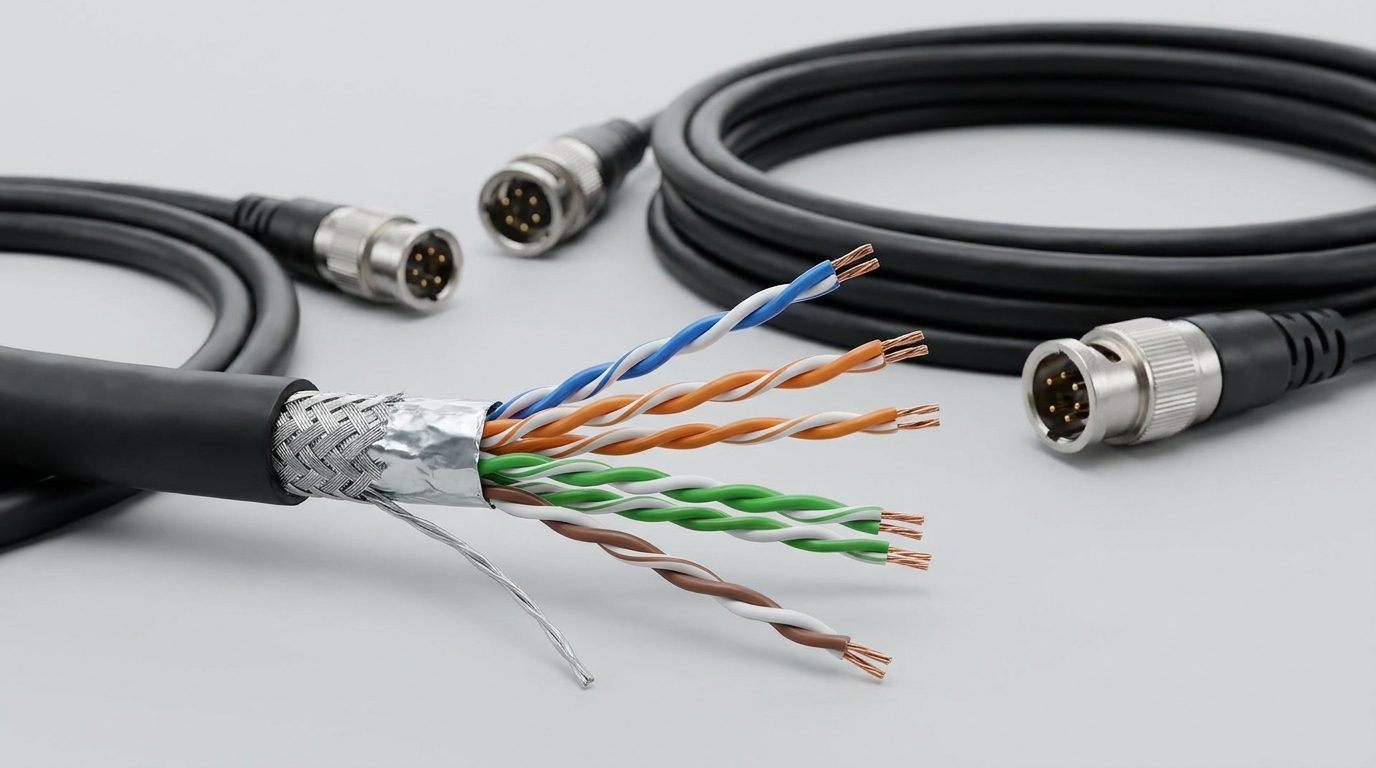
Encoder cable twisted pairs are insulated conductors twisted together to carry related encoder signals, especially differential encoder signals such as A+/A-, B+/B-, and Z+/Z-. Encoder pair assignment means matching each differential signal pair correctly inside the cable so the receiver can reject electrical noise and preserve accurate position feedback.
Signal Pairing Fundamentals
In an codificador incremental or servo encoder system, differential outputs use two opposite-polarity signals for each channel. The receiving drive or controller compares the voltage difference between the two wires instead of relying on one wire referenced to ground. This makes the system much more resistant to interferencia electromagnética.
For encoder cable twisted pairs, the key principle is simple: each differential pair must stay together from the encoder connector to the controller connector.
Según nuestros datos internos y análisis de mercado, aquí está el desglose:
| Encoder Signal | Correct Twisted Pair Assignment | Objetivo | Risk if Mispaired |
|---|---|---|---|
| A+ / A- | Same twisted pair | Primary position pulse channel | Count errors, jitter, false transitions |
| B+ / B- | Same twisted pair | Quadrature direction channel | Direction errors, unstable speed feedback |
| Z+ / Z- | Same twisted pair | Index or home reference pulse | Missed homing reference |
| +V / 0V | Separate power pair or heavier conductors | Encoder power supply | Voltage drop, noise coupling |
| Shield / Drain | Cable shield termination path | control de interferencias electromagnéticas | Poor noise protection |
Proper encoder pair assignment is especially important near motors, VFD, servo drives, relays, braking resistors, and other high-noise industrial equipment.
Consejo profesional de cwcables: I always verify the actual pair colors before crimping or soldering connectors. Never assume that wire color alone confirms pair structure—check the cable layup or continuity between twisted conductors first.
How Does encoder cable twisted pairs,differential encoder signals,encoder pair assignment Work?
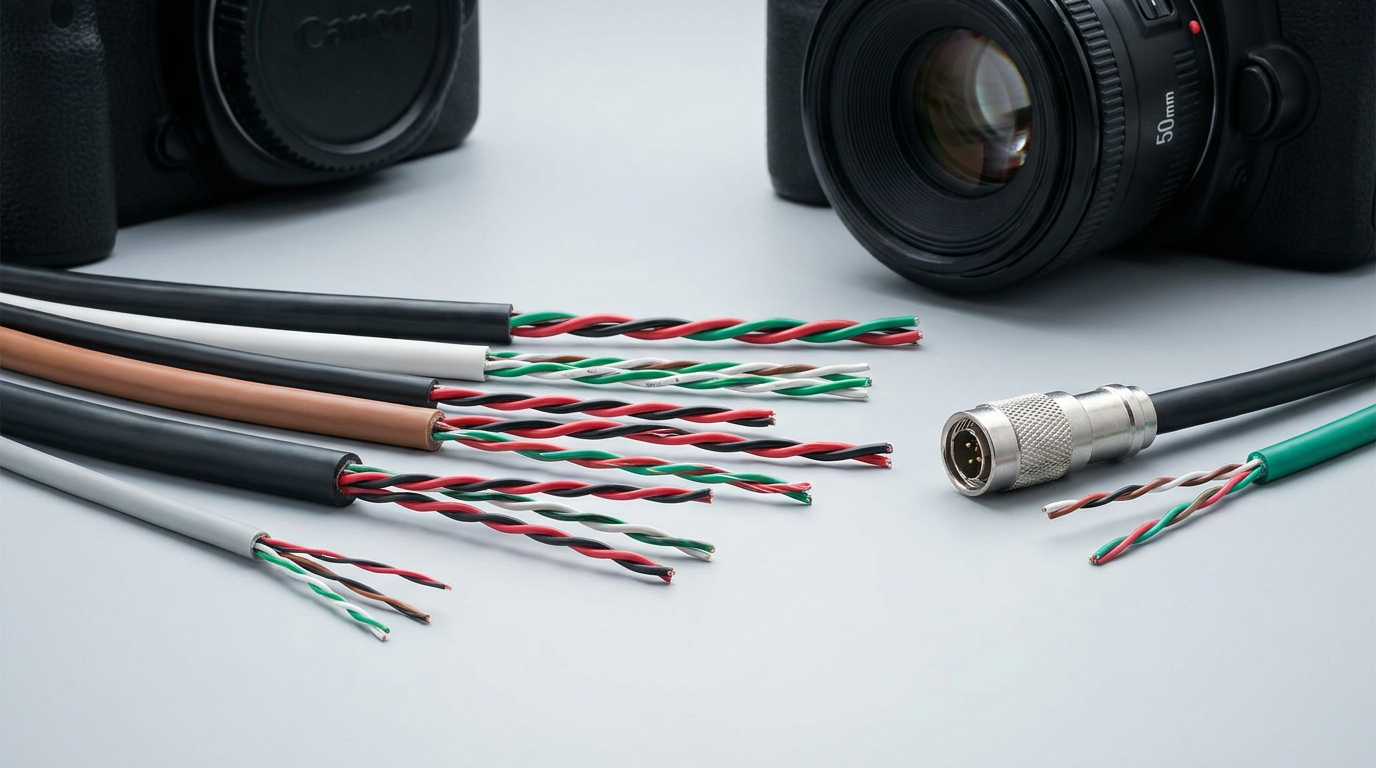
Encoder cable twisted pairs work by keeping equal and opposite differential encoder signals physically close together. External noise affects both conductors almost equally, allowing the receiver to subtract common noise and read only the true signal difference. Correct encoder pair assignment is what makes common-mode noise cancellation effective.
Differential Noise Rejection in Practice
Twisting two related conductors together ensures that both wires experience nearly the same electromagnetic environment along the cable route. When a noise source induces voltage into the cable, that interference appears similarly on both conductors.
The differential receiver then evaluates the difference between the two conductors:
- The encoder outputs A+ and A- as opposite-polarity signals.
- The twisted pair carries both signals side by side.
- External electrical noise couples into both conductors almost equally.
- The controller subtracts A- from A+.
- Common noise is rejected, while the true encoder pulse remains.
This only works properly when the positive and negative sides of each channel are paired together. If A+ is twisted with B+ instead of A-, both differential channels lose much of their noise immunity.
Según nuestros datos internos y análisis de mercado, aquí está el desglose:
| Condición | Receiver Result | Motion System Impact |
|---|---|---|
| Correct A+/A- pairing | Strong differential signal | Stable position feedback |
| A+ paired with B+ | Reduced noise rejection | Jitter or false counts |
| Long cable with correct pairs | Reliable performance if impedance and shielding are suitable | Good for industrial routing |
| Long cable with wrong pairs | High susceptibility to EMI | Intermittent encoder alarms |
| Cable de par trenzado blindado | Best overall protection | Recommended for servo systems |
Consejo profesional de cwcables: I treat encoder pair assignment as part of the signal design, not just wiring. If the pair map is wrong, adding a shield later usually will not fully solve the problem.
What are the benefits of encoder cable twisted pairs,differential encoder signals,encoder pair assignment?
The main benefits are stronger noise immunity, more accurate position feedback, longer reliable cable runs, fewer encoder faults, and improved servo stability. Correct encoder pair assignment allows differential encoder signals to perform as designed, reducing downtime and helping motion systems maintain precise speed, direction, and position control.
Performance Advantages in Motion Control
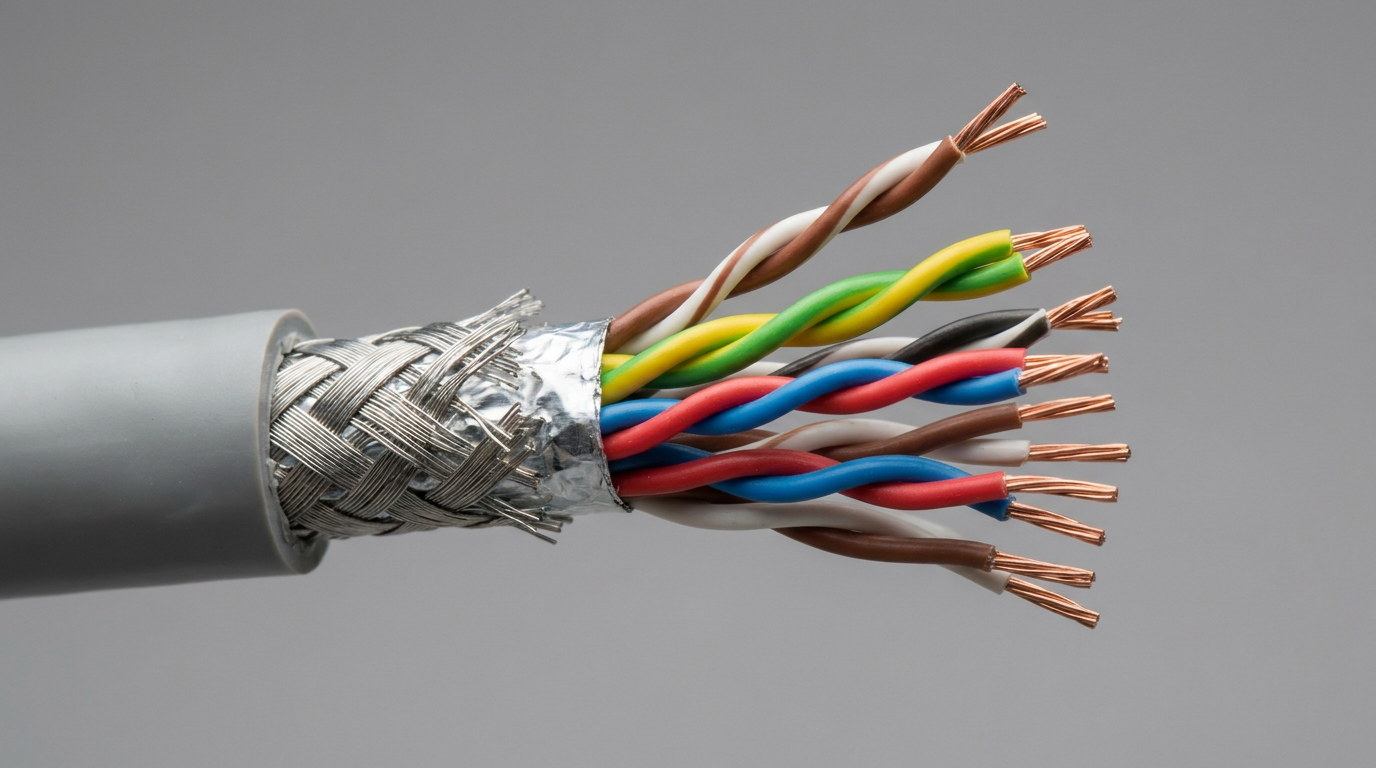
Correctly assigned encoder cable twisted pairs improve both electrical and mechanical system behavior. Since the controller depends on clean encoder pulses, signal quality affects everything from homing accuracy to high-speed servo response.
Los beneficios clave incluyen:
- Improved EMI resistance: Twisted differential pairs reduce the effect of external electrical noise.
- Cleaner pulse edges: Better signal integrity helps the controller detect transitions accurately.
- Reduced count loss: Correct pairing minimizes missed or false encoder counts.
- Longer cable distance: Differential signaling over twisted pairs supports longer runs than single-ended wiring.
- Better servo tuning: Stable feedback reduces hunting, vibration, and unexpected following errors.
- Higher machine uptime: Fewer intermittent feedback faults reduce troubleshooting time.
Según nuestros datos internos y análisis de mercado, aquí está el desglose:
| Beneficio | Por qué es importante | Typical Application Impact |
|---|---|---|
| Noise rejection | Prevents interference from motors and drives | Fewer encoder alarms |
| Accurate counting | Preserves pulse timing | Better positioning accuracy |
| Stable direction detection | Maintains A/B phase relationship | Reliable speed and direction control |
| Cleaner index pulse | Protects Z-channel reference | More repeatable homing |
| Lower maintenance burden | Reduces intermittent faults | Less downtime |
Consejo profesional de cwcables: I recommend documenting the encoder pair assignment in the control cabinet drawings. It makes future cable replacement much faster and prevents accidental cross-pair wiring during maintenance.
How to maintain a encoder cable twisted pairs,differential encoder signals,encoder pair assignment?
Maintain encoder cable twisted pairs by protecting the cable from mechanical damage, preserving shield continuity, avoiding tight bends, checking connector terminations, and verifying pair assignment during repairs. Differential encoder signals are sensitive to poor terminations, broken shields, corrosion, and accidental rewiring that separates true/complement signal pairs.
Pasos de inspección y mantenimiento preventivo
Encoder cable maintenance is not only about checking for broken wires. The goal is to preserve the original electrical structure of the cable, especially the twisted pair relationship and shielding system.
Recommended maintenance process:
- Inspeccionar la chaqueta exterior. for cuts, crushing, oil damage, abrasion, or heat exposure.
- Comprobar radio de curvatura to ensure the cable is not kinked or sharply folded.
- Verifique el alivio de tensión del conector so vibration does not pull on solder cups or crimp pins.
- Confirm shield termination according to the machine design, usually at the drive end or specified grounding point.
- Continuidad de la prueba for A+/A-, B+/B-, Z+/Z-, power, and ground.
- Confirm pair assignment after any repair or connector replacement.
- Check routing to keep encoder cables away from motor power cables, contactors, and high-current wiring.
- Look for intermittent faults by gently flexing suspect cable sections during controlled testing.
Según nuestros datos internos y análisis de mercado, aquí está el desglose:
| Artículo de mantenimiento | Qué comprobar | Señal de advertencia |
|---|---|---|
| Twisted pair integrity | A+/A-, B+/B-, Z+/Z- remain paired | Random count errors |
| Continuidad del escudo | Drain wire and shield connection | EMI-related faults |
| Connector pins | Loose, oxidized, or bent contacts | Pérdida de retroalimentación intermitente |
| Enrutamiento de cables | Distance from high-power conductors | Noise spikes |
| Mechanical condition | Jacket wear or crushed sections | Signal dropouts during motion |
Consejo profesional de cwcables: I avoid untwisting encoder pairs more than necessary at connector ends. Keeping the twist close to the termination helps preserve noise rejection right up to the connector.
What is the price of encoder cable twisted pairs,differential encoder signals,encoder pair assignment?
The price depends on cable length, conductor count, shielding, jacket material, flexibility rating, connector type, and whether custom encoder pair assignment is required. Standard encoder cables cost less, while high-flex, oil-resistant, shielded, custom-terminated cables for servo applications are more expensive but often reduce long-term downtime.
Variables de precios que afectan el costo
Encoder cable pricing is strongly influenced by application severity. A short static cable inside a control cabinet is very different from a high-flex cable in a cable carrier near servo motors.
Según nuestros datos internos y análisis de mercado, aquí está el desglose:
| Factor de costo | Opción de menor costo | Opción de mayor costo | Por qué es importante |
|---|---|---|---|
| Longitud del cable | Longitudes estándar cortas | Long custom lengths | Longer runs require better signal protection |
| Blindaje | Basic foil shield | Lámina más escudo trenzado | Mejor resistencia EMI |
| Calificación flexible | Static installation cable | Cable flexible continuo | Needed for moving axes |
| Material de la chaqueta | CLORURO DE POLIVINILO | PUR, TPE, compuestos resistentes al aceite | Mejora la durabilidad |
| Conectores | Unterminated ends | Molded or custom industrial connectors | Reduces installation time |
| Pair assignment | Standard wiring | Custom pinout and pair mapping | Prevents compatibility issues |
Typical buying logic should focus on total cost of ownership, not only the cable unit price. A cheaper cable with poor pair assignment or weak shielding can cause far more cost through machine downtime, troubleshooting, and production defects.
Consejo profesional de cwcables: I always ask for the encoder type, pinout, cable length, motion environment, and nearby noise sources before quoting. Those details determine whether a standard cable is enough or a custom cwcables assembly is the safer choice.
Características clave y comparación
Key features to compare include twisted-pair structure, differential signal compatibility, shielding, impedancia consistency, conductor size, jacket durability, flexibility, and connector quality. The best encoder cable is not simply the thickest or most expensive cable; it is the one with the correct electrical pairing and mechanical design for the machine.
Comparación de funciones para la selección de cables del codificador
Según nuestros datos internos y análisis de mercado, aquí está el desglose:
| Característica | Basic Encoder Cable | Shielded Twisted Pair Encoder Cable | High-Flex Industrial Encoder Cable |
|---|---|---|---|
| Pares trenzados | May be limited or inconsistent | Dedicated pairs for A/B/Z differential signals | Dedicated pairs optimized for motion |
| Differential encoder signals | Acceptable for short, low-noise runs | Strong support for A+/A-, B+/B-, Z+/Z- | Best for servo and robotic applications |
| Encoder pair assignment | May require manual verification | Usually easier to map correctly | Often custom-built to pinout |
| Protección EMI | Bajo a moderado | High with foil or braid shield | High, with rugged shielding design |
| vida flexible | Movimiento estático u ocasional | Moderate movement | Aplicaciones de movimiento continuo |
| Durabilidad de la chaqueta | PVC estándar | PVC, PUR, or industrial jacket | Oil-resistant, abrasion-resistant options |
| Uso típico | Cabinets, short connections | Factory automation, servo feedback | Cable tracks, robotics, moving axes |
| Nivel de costo | Bajo | Medio | Más alto |
For applications with differential encoder signals, the minimum recommended configuration is shielded twisted pairs with documented encoder pair assignment. For moving machinery, continuous-flex construction is usually worth the added cost.
Consejo profesional de cwcables: I compare encoder cables by signal path first and jacket material second. If the A+/A-, B+/B-, and Z+/Z- pairs are wrong, even a rugged jacket will not prevent feedback errors.
Costo y factores de compra
When buying encoder cable twisted pairs, consider signal type, pair assignment, cable length, electrical noise, motion requirements, connector pinout, environmental exposure, and replacement availability. A well-specified cable may cost more upfront, but it reduces commissioning problems and protects differential encoder signals from avoidable interference.
Lista de verificación práctica de compras
Before ordering or replacing an encoder cable, confirm both the electrical and mechanical requirements. This is especially important when replacing OEM cables or building custom assemblies.
Utilice esta lista de verificación:
- Encoder output type: Differential line driver, open collector, push-pull, or single-ended.
- Required channels: A/B only, A/B/Z, commutation tracks, alarm, or additional sensor lines.
- Pair assignment: Confirm A+/A-, B+/B-, and Z+/Z- are each in the same twisted pair.
- Connector pinout: Match encoder-side and controller-side wiring exactly.
- Longitud del cable: Longer cables need better shielding and careful routing.
- Ambiente ruidoso: Servo drives, VFDs, welders, and motors increase EMI risk.
- Tipo de movimiento: Static, occasional flex, torsion, or continuous cable carrier motion.
- Exposición ambiental: Oil, coolant, abrasion, temperature, UV, or washdown.
- Shield grounding plan: Follow controller and encoder manufacturer guidance.
Según nuestros datos internos y análisis de mercado, aquí está el desglose:
| factor de compra | Por qué es importante | Acción recomendada |
|---|---|---|
| Precisión de asignación de pines | Prevents miswiring | Use a verified wiring diagram |
| Pair mapping | Protects differential signal quality | Request documented pair assignment |
| Tipo de escudo | Controls EMI | Choose foil, braid, or combined shield |
| Calificación flexible | Previene la fatiga del conductor | Use high-flex cable for moving axes |
| Material de la chaqueta | Extends service life | Match jacket to oil, coolant, and abrasion |
| Soporte de proveedores | Reduces design mistakes | Work with a cable specialist like cwcables |
Consejo profesional de cwcables: I recommend sending both mating connector pinouts when requesting a custom cable. It allows us to confirm not just continuity, but correct encoder pair assignment from end to end.
Conclusión
Encoder cable twisted pairs matter because differential encoder signals rely on correct physical pairing to reject noise and preserve accurate feedback. Proper encoder pair assignment improves reliability, reduces motion errors, and prevents difficult intermittent faults. For demanding automation systems, cable structure should be specified as carefully as the encoder itself.
Guía de selección final
A reliable encoder feedback system depends on the full signal path: encoder output, cable construction, connector termination, shielding, grounding, and controller input. Twisted pairs are not just a cable feature; they are part of the differential signaling method.
For best results:
- Keep each differential channel in its own twisted pair.
- Use shielded cable in industrial environments.
- Avoid routing encoder cables beside motor power wiring.
- Minimize untwisted conductor length at terminations.
- Verify connector pinout and pair assignment before commissioning.
- Choose high-flex cable for moving axes.
- Work with a supplier that understands encoder signal integrity.
cwcables can support standard and custom encoder cable assemblies with correct pair assignment, shielding options, connector selection, and application-focused recommendations.
Consejo profesional de cwcables: I treat encoder cables as precision feedback components, not simple accessories. If you want stable motion control, start by getting the twisted pairs and differential signal assignment right.